
Read the introduction to ‘How to Raise a Gentle Man’ for free
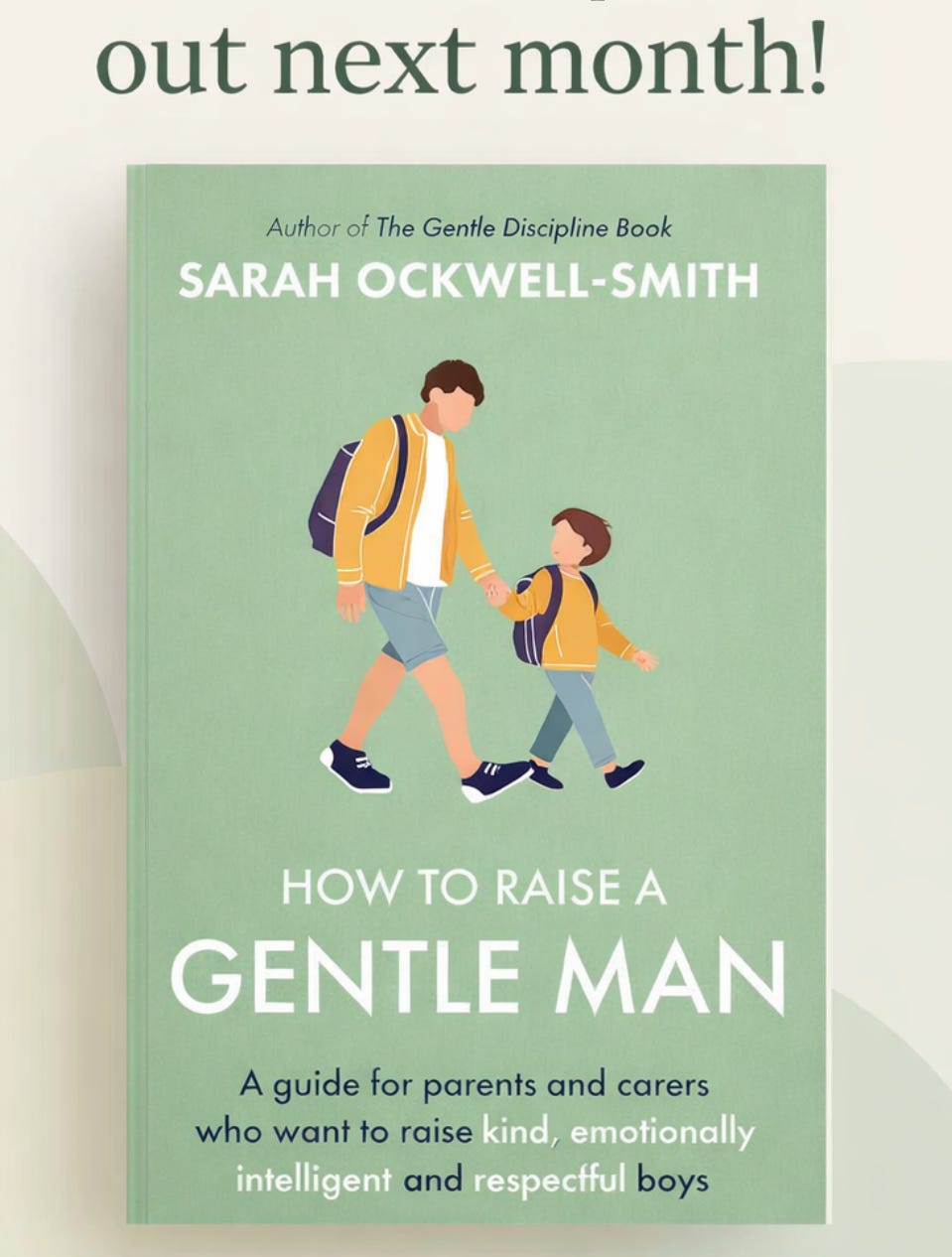
I can finally say that my new book ‘How to Raise a Gentle Man’ is OUT NEXT MONTH! To celebrate, I thought you’d like a little sneak peek. So, here’s the introduction of the book – in full. I hope you enjoy it!
“Nobody wants to play with me because I don’t like football.”
I had just picked my, then nine-year-old, son up from school. He looked sad and was withdrawn; I could see he had been crying. I asked him what was wrong and he confessed that he was struggling with friendships at school and was lonely at playtimes. The other boys in his class had told him that he couldn’t play with them because of his lack of interest in football. He loved music, nature, baking, unusual facts about the world, and Dr Seuss stories. He was the only boy in his class with long hair: beautiful golden waves falling onto his shoulders, like a Pre-Raphaelite painting. At school he was ‘the weird one’, the one that stuck out like a sore thumb in his class, not conforming to gender stereotypes. ‘Not a typical boy,’ his teachers often told me. I had raised him to embrace his uniqueness, his softness, and yet his lack of fitting in was now causing him heartache. He was too scared to tell the other boys that they were making him feel sad (because they would undoubtedly have told him to ‘stop being such a wimp’), or to challenge their assumptions that ‘real boys play football’. He tried to be strong, to shrug off their hurtful words and pretend they didn’t bother him; but they did, each one bruising his sensitive soul with the ability to leave long-lasting scars.
I knew the world could be a cruel place, but I thought we had a few more years before the gender stereotyping and related bullying would begin. I thought we would make it to secondary school before comments on hair length and ‘girly’ clothing colours and a lack of interest in football would become an issue and I thought I had a few more years to nurture his confidence before the world started denting it. Sadly, it seems I was wrong.
I spent many hours worrying if it was my fault. Was my desire to raise my children to be less constrained by societal norms and instead to be more authentic the wrong thing to do? Perhaps I should have raised them to fit in more, to go along with the status quo and not to challenge it. Whenever I write parenting books I think people expect me to know all of the answers. They seem to imagine that I did everything right with my own children and rarely, if ever, found myself stuck on a parenting conundrum. Honestly, this couldn’t be further from the truth. I’ve had to dig deep and do a lot of soul searching and there have been many times I’ve questioned my choices and abilities; that day in the car was just one of them. Thankfully, I managed to reconcile my personal feelings and my son’s experiences enough to help him to navigate this difficult period, to be proud of who he was and to recognise that masculinity does not revolve around a certain sport, or haircut. I learned that my own confidence in what I believed along with better connection and communication with my son were the most important things in the world.
My parenting focus from that day on was to nurture the softness in my sons that the world so sorely needs and which would protect them as they go out into the harshness of the world alone. My hope with this book is to help you to do the same and to fill with you with the confidence that perhaps, if you’re like I was, you’re lacking currently. So many boys grow up in a world that teaches them to be ashamed of their gentleness, learning to smile through the pressure and to swallow their feelings, believing that they have to ‘man up’. They live in a society that tells them that they are the problem, that everything is the fault of boys and men today, yet they are offered no support or understanding. If we are intent on telling boys that they need to be part of the solution, not the problem, then we have to help them. We have to accept that, actually, the problem may be us: the adults, whatever our sex, not the boys themselves.

Since the release of the 2025 Netflix series Adolescence and the rise of the Me Too movement, it’s understandable that many believe that boys and men are a danger to girls and women; but the pain and closeted emotions of their upbringing are far more of a risk to themselves than to others. Suicide is the single biggest killer of men under thirty-five in the UK and is the leading cause of death for boys aged between ten and nineteen.1 Suicide rates in women and girls are only one third of that for boys and men. Shocking, isn’t it? I’m not saying that we don’t need to teach boys how to respect girls, we do (and we’ll talk a lot about exactly that later in this book), but we have to start with teaching them how to respect and accept themselves, authentically, first.
The issue facing our boys today isn’t really about whether they like football or not, whether they have long hair or short, enjoy wearing pink or wouldn’t dare to be seen in anything that isn’t black, grey, navy or khaki. It’s about the expectations: the weight of the world boys carry that become deeply embedded beliefs about masculinity. It’s about whether a boy feels he is allowed to be who he really is, not what’s expected of boys, or men, as he grows. Far too many boys are still growing up being told that they should stop making a fuss, that it is somehow unbecoming of their masculinity to show sensitivity. They are taught that softness is weakness, that gentleness is ‘woke’. They are spun a lie that control (over themselves and others, especially girls and women) is strength. They are told that being popular and respected matters more than being kind. They are told that their body has to look a certain way: muscular, defined, ‘hench’ (the Gen Z terminology for the two former attributes). Again softness, this time related to their body, is not acceptable.
Somewhere between the playground chat of five-year-old boys, online rabbit holes that a ten-year-old unsuspectingly finds himself in in the middle of playing Fortnite, and a ‘lad chat’ between teen boys, often fuelled by alcohol (because you’re a wuss if you don’t drink), your son is trying to work out who he is now and what kind of man he’s supposed to become. The noise is deafening and damaging.
As much as we may believe we have control over the type of man our sons will become, the reality is they don’t learn it from their parents alone. They’ll pick it up from TV programmes, YouTube comments, discussions on podcasts by so-called ‘alpha men’, in throwaway jokes and insults with the subconscious messaging that lets boys know that they’ve only really got two choices in life: either toughen up or be a pathetic wimp, or simp (the Gen Z term for a boy or man who shows too much sympathy, emotions and attention towards others, usually who they have a romantic interest in but who doesn’t reciprocate their feelings), or worse – both.

Maybe you think that by restricting access to smart phones, or other screens, your boy will be safe from these messages? I hate to say it, but you’re wrong. They will pick it up from other boys and non-screen-related sources. By the time you notice the signs – maybe an unusual flash of anger at a simple request from you, a silence when he would normally have spoken up or a comment about girls that makes you feel uncomfortable – those messages may already be taking root.
This book is your chance to step in early, not to shield your son from the world, but to raise him to be both gentle and strong enough to stand up to it, and kind enough to help change it. It’s never too late to instil change, but the earlier we help our boys to break free of the stereotypes, stigma and unwritten social rules of what it means to be a boy, or a man, today the better.
As parents and carers, we have the power to intervene and change the trajectory of boys’ emotional development, for their own good as well as that of society. This book aims to explore how we can break the cycle and understand how we can help raise emotionally aware, compassionate and empathetic boys who understand that true strength lies not in dominance or suppression, but in love and vulnerability. We need to examine the ways in which boys are being raised today, how (and why) they are socialised to be ‘tough’, and how their emotional needs are often neglected in favour of traditional and stereotypical ideals of masculinity. By being aware of how we raise and communicate with our sons we can protect them from some of the toxic influences that lead to radicalisation (yes, the highly sexist views many boys have today count as radicalisation!) and instead, empower them to forge their own paths that are healthier, more compassionate and, importantly, more inclusive.
The sad truth is that we are failing our boys currently. While society is busy blaming social media creators and tech firms, influencers, YouTubers, podcasters, smart phones, gaming and the like for ‘the demise of boys today’, we are missing the things that really matter: the way boys are treated differently to girls from birth, the harsher way in which they are parented, the biased way in which they are spoken to and about, and the many stereotypes we believe about boyhood that we unconsciously force upon them. Simply, it isn’t their fault we are where we are. It’s ours. If we want to help our boys, we have to start with examining our own beliefs and understandings.
This book is a guide to understanding the situation we find ourselves in today and exploring how we got there. It’s about fostering change, offering practical tools and strategies for raising boys who not only reject toxic masculinity but actively contribute to a more just and empathetic world. This book is for parents and carers who want to raise boys who are kind, who are open to question what they see happening around them and brave enough to be better. This is a guide to raising boys with the knowledge that true strength, and indeed masculinity, is always rooted in gentleness, not just for boys but for you too as a parent or carer.
Who is this book for?
Everybody.
While I primarily wrote this book for parents of boys, it also applies to educators, mental health and childcare professionals. It is applicable for everybody who loves a boy, or a man. It is for anybody who sees what is happening in our world at the moment and wants to be part of making things better. It doesn’t matter how old the boy in your life is, whether he’s one month old, ten years old or a fully grown adult. It’s never too early or too late to understand and change. What qualifies me to right this book? Primarily, I’m a mother to three sons, now young adults. I was thrown into ‘boy world’ a quarter of a century ago and I’ve been trying to fight my way through the stereotypes ever since. I am passionate about helping my boys, and yours, to live in a world that embraces their softness. Maybe you know me as the founder of gentle parenting. I’ve been writing parenting books since 2010 (this is my seventeenth) and I’ve also worked with thousands of parents over the last two decades, helping them to understand their children, their needs, their behaviour and the impact of skewed societal expectations, myths and misconceptions. My interest, knowledge and personal experience are rooted deeply in the need to smash stereotypes and support a child to be authentic, with the help of their parents or carers.
Isn’t gentle parenting alone enough to protect our sons?
It should be. If the whole world followed gentle parenting (which is nothing more than parenting with empathy for children, understanding their level of development and capabilities, respecting them rather than always demanding respect from them, and mindfully setting and endorsing boundaries) then yes, it should be enough. Sadly, despite all the media interest and furore, gentle parenting is still a fringe movement.
It can feel as if it is becoming mainstream if you surround yourself in a gentle parenting bubble, but parenting today is still as authoritarian, harsh and controlling as it’s ever been. The default societal parenting style of today remains highly stereotyped. If you’re already following gentle parenting (maybe you’ve read some of my other books?), then that’s a great first step, but it’s sadly naïve to presume that it’s enough. It really isn’t, not any more.
One question I was asked when I announced I was writing this book was: ‘Is it a gentle parenting book for raising boys?’ And in a sense I suppose it is, though I’m reluctant to call it that. The book is rooted in the principles of understanding, empathy, respect and boundaries, and if you’re already following gentle parenting you will recognise the themes contained in it. It is so much more than that, though; it’s an exploration of our society today and how it affects boys and men (and girls and women) differently. Does it matter if you’re a gentle parent? Absolutely not; which is why I’m reluctant to label it as a gentle parenting book. First and foremost, this is a book for any parent or carer interested in helping boys, whatever parenting style they follow.
Do we really need different books for raising boys or raising girls?
About fifteen years ago, when I was writing my first book, I wrote that I didn’t want to write a book that was specifically about raising boys or girls; I wanted my work to be inclusive. I wanted parents to see the child that was in front of them and to see their unique needs, not what was ‘good for boys’ or ‘good for girls’. In fact, I was quite vocally anti girl- or boy-specific parenting books. I have, however, seen an alarming shift over the last few years and I don’t believe this approach is the correct one any more. Just as I don’t think gentle parenting alone is enough now. We need to talk about the unique challenges and environments surrounding both boys and girls today (there’s a little hint about the topic of my next book!). I don’t believe that there are any innate differences between boys and girls, or that they need different styles of parenting based upon their chromosomes; however, the way they are treated by society is hugely different and it is these differences that have led me to recently believe that it’s now necessary to write specific books for raising boys and raising girls.

What will you find in this book?
My aim with this book is to help you to understand the world boys, and indeed men, face today. Not to blame them, but to really grasp how difficult life is for them. Once we, as parents and carers, understand the current landscape, we are then equipped to navigate it and raise our boys in such a way that they can help our society to heal, rather than perpetuate the harm that seems so rife today. For this reason, we have to begin by exploring masculinity. Chapter One asks, ‘What is masculinity?’ Who decides whether something is masculine or not? Has it always been this way? What stereotypes do you need to be aware of with your son, and how can you raise him in such a way as to embrace his masculinity and all that is good, while avoiding common pitfalls? We’ll talk about the recent rise of ‘the manosphere’, ‘red pill’ and ‘incel’ culture (I won’t explain these now, as we’ll look at them in depth soon) and help you to be as informed as possible, so that you can really help your son and maybe even yourself if you’re male.
Chapter Two looks at the importance of nurturing boys, of understanding that real strength is rooted in love. We will explore the myriad ways that society treats boys more harshly than girls and question how this affects our boys as they grow. This chapter leads on naturally to our next: in Chapter Three we will study the ideas of emotional intelligence and emodiversity, or embracing all emotions, and consider why this idea is so valuable to boys, particularly in a world that seems to forever teach them to mask their feelings and ‘put on a brave face’. Chapter Four once again picks up on the theme of embracing authenticity and why it is so important for parents and carers to share open and honest communication with boys. Too often boys, particularly tweens, teens and young adults, keep their thoughts and feelings to themselves, struggling, without reaching out for help from their parents and carers. There is a reason for this: they are taught subconsciously from a young age to be independent, to ‘stand on their own two feet’, and are exposed to messages that tell them that masculinity is strength and that crying, asking for help, being emotional, is somehow ‘soft’. The first four chapters of this book could be summed up as encouraging parents, carers and their sons to embrace the softness of masculinity.
In Chapter Five we switch the focus from immediate caregivers to wider society. While parents and carers clearly have the strongest impact on boys as they grow, the older they get the more others influence them. Peers, friends, extended family, teachers, group leaders, employers and those who they find themselves in a parasocial relationship (a perceived personal relationship with a celebrity) with, for instance, online influencers, all play a role. We need to help our boys to carefully curate their ‘village’, to vet the messages that they surround themselves with and to fill their orbit with positive influences. For this reason, Chapter Five concentrates on the value of good male role models and where and how to find them. Positive role models alone aren’t enough, however; it is vital that we show boys the discrimination that women and girls face on a daily basis. To show them, we first need to see it ourselves, and even if you’re a woman nodding right now I suspect you don’t realise the full reality of the discrimination surrounding you. When we give boys a ‘why’, a cause, and an understanding, then we can raise genuine feminists who really care about women and girls, which is exactly what Chapter Seven is all about. Raising boys to be allies for girls isn’t enough, though. There is strong intersectionality (or a link) between sexism and misogyny and other forms of discrimination in society, such as homophobia, ageism, ableism and racism. Isms often co-occur and so we need our boys to be allies for all of those who find themselves in a marginalised position in society; this is the way to nurture true respect.
In Chapter Eight we move on to discussing the world a boy experiences online, with digital relationships, handling online toxicity in the manosphere and pornography. However you approach screen time as a family, this is an area that your son will stumble across at some point and so it is important to be prepared. Chapter Nine continues the theme of relationships, this time moving from virtual to ‘in real life’ ones. Whether we’re talking friendships or romantic relationships, it is crucial that boys know what a positive relationship looks like, to protect both themselves and others. Here we will discuss themes such as respect and consent, and look at both red flags and green flags.
Our final chapter, number ten, summarises three real masculine strengths that parents and carers should aim to foster in their boys: courage, compassion and character. We’ll talk a little about what these look like and, using information we will discuss in chapters two through nine, we’ll come up with a plan for you to follow in your own parenting or caregiving. This plan is comprised of eight points; I call it my eight-point plan to raise a gentle man. We’ll discuss this much more in Chapter Ten, but I thought I would leave you with a little teaser before you read on.
The eight points are:
1. Nurture boys, at all ages.
2. Raise boys to be emotionally intelligent.
3. Encourage open and honest communication.
4. Surround boys with good role models.
5. Make boys aware of discrimination.
6. Raise boys to be feminists.
7. Protect boys from online radicalisation.
8. Teach boys about positive relationships.
I hope this short summary of the contents of this book appeals to you. As a mother of three boys, now young men, this is a topic I feel passionate about. Much is made of raising boys to be obedient, to be respectful of societal rules, ‘to be a gentleman’; yet not enough is spoken about how to raise a gentle man. To me, gentleness is a vital strength to instil in our children, especially our boys, I hope you agree? If you do, read on . . .
How to Raise a Gentle Man is out next month. You can preoder HERE in the UK (HERE if you want to avoid Amazon) and HERE if you live elsewhere in the world.
 Sarah Ockwell-Smith