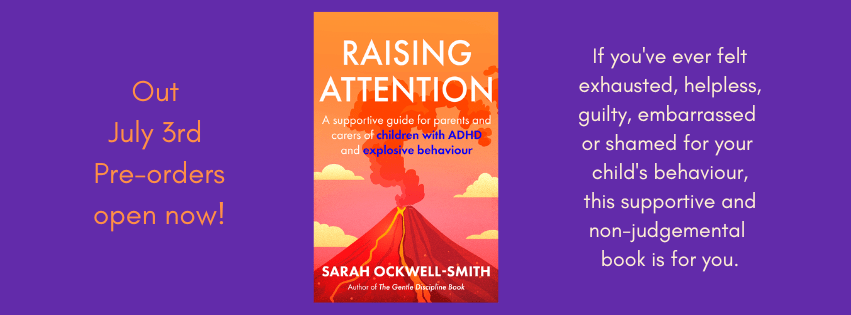
My new book RAISING ATTENTION, a supportive guide for parents and carers of children (of any age) with ADHD or undiagnosed explosive behaviour is published on July 3rd. Read on for a free excerpt from the introduction:
The path of a parent who has a child displaying explosive behaviour can be a lonely one. I want to start this book by telling you that you are not alone, especially on the days when you feel isolated and ostracised. If I could reach through this page and give you a hug, I would, because I know you probably need it.
You may know me as a ‘parenting expert’ – a gentle-parenting guru who is all about staying calm and being a great role model – and perhaps you believe I possess some sort of natural ability to know all the answers. I want to tell you that, like much of parenting witnessed online, this is an illusion. Underneath the surface and the calm persona, I’ve been hiding a secret: that is quite how much I have struggled over the last two decades. I have been to rock bottom as a parent, and I’ve dug a multilevel basement beneath that, too. There have been days (many of them, if I’m honest) when I’ve questioned why anybody would listen to my advice. There have been days when other professionals have insinuated that I am a bad parent and school leadership have told me that I am ‘the problem’ (much more later on the gaslighting many of us, including you, I suspect, experience as the parents of an explosive or neurodivergent child). There have also been days when I honestly didn’t feel like I could go on anymore. I kept this information private for several reasons. First, out of respect for my child (who is now an adult and happy to share our story in this book); second, because it was too painful and raw to talk about (I now feel in a place where I’m able to share); and third, well, you can’t be a ‘parenting expert’ if you admit quite how much you struggle as a parent yourself, can you?
Why am I writing this book now, you may ask? Because I’ve realised that embracing and accepting your own flaws and talking about your difficult days is so important as a parent. I feel far enough along my own family’s journey now for it not to be painful to talk about it anymore, my son, as I said, is old enough to give his full consent for me to talk about his struggles and I genuinely feel I have insights and wisdom to share that will help you. I also feel that this book is desperately needed. When I was searching for information about how to parent through the maze of attention deficit hyperactivity disorder (ADHD) and explosive behaviour, all I found was outdated, behaviourist, authoritarian advice that made my heart sore and my child feel (and behave) significantly worse. The parenting courses that several professionals tried to make me take were similar.
We need a revolution in the way society speaks about ADHD and difficult behaviour in childhood, and we need to drastically change the way we treat the individuals involved, both parents and children. For the last couple of years, I have felt a calling to contribute to that revolution. This book is my contribution to the cause. It is also the encouragement, the virtual hug and the non-judgemental listening ear I wish I had found when I was at my lowest point. I hope to be able to lift you out of yours a little.
Who is this book for?
In short, this book is for any adult who cares for a child with explosive behaviour, whether they have a diagnosis of ADHD or not. You will find lots of information here about ADHD, but it applies equally to those who may have a different diagnosis, are early in the diagnostic pathway or have no diagnosis at all. On that note, please forgive me if I occasionally just refer to ADHD and not explosive behaviour – the information I discuss will apply equally to any of the scenarios just mentioned.
This book is for adults who care for children who struggle to regulate their behaviour, who are prone to outbreaks of violence (including, but not limited to: hitting, kicking, slapping, biting, throwing, pushing, banging and smashing), who act impulsively, don’t listen to instructions, frequently break the rules, show deliberate defiance and destructive behaviour (including verbally). It doesn’t matter if the child is your own, one you look after or one you teach, although you will find specific help for those who are struggling with parenting. This is a book for adults who care about children, who want to understand them and behaviour that is so often described as ‘naughty’. It is a book for adults who want to help children and who are willing to make changes to their own behaviour and beliefs in order to do so. Ultimately, this book is a love letter to children with ADHD and those who struggle with their behaviour – and for the adults in their lives who care about them.
What is this book about?
Let me start with what it’s not about. You won’t find lengthy and detailed descriptions of how to get an ADHD diagnosis, how to get an Education, Health and Care (EHCP) support plan in place, or how to understand the legalities of disability discrimination. I have deliberately not included these for four reasons: First, I don’t want to reinvent the wheel. There are many amazing charities and organisations who offer support and advice on these issues. Instead of repeating this information, I have instead signposted to them in the Resources section. Second, I am acutely aware that while I am based in England, UK, not all of my readers are, and rather than give you very English-centric advice, my aim is to provide information that will help no matter where you live in the world. Third, I’m hoping for something of a reform in the way our society approaches neurodivergence and SEND (special educational needs and disabilities), and so I hope that any information I could include about diagnostic pathways or educational support will quickly become out of date (perhaps wishful thinking, but I’m keeping my fingers crossed!). And fourth, my intention with this book is to provide a sort of manual to support you in caring for and raising children with big, explosive behaviours. I don’t want to take away from the core idea with detours into medical pathways, educational policy and different legal systems; my focus is on increasing awareness and understanding of why some children act in the way they do and what adults can do to help them.
When I was in your position, what I really wanted was to feel heard and supported and for somebody who had been in my situation to give me advice on how to help my child, alongside some tips on how I could cope better, so that’s exactly what this book will focus on, without the noise of anything else.
Now, what will you find in this book?
Let me walk you through some of the main content you’ll find in each chapter. We start the book with an exploration of ADHD and explosive behaviour in Chapter One, posing the questions of how you know if your child has ADHD and when – if ever – you should seek a diagnosis. While this chapter is initially aimed at those who do not yet have a diagnosis for their child, we soon include those of you who are a little further along the path, with a child who is already diagnosed with ADHD. In this chapter we also consider other conditions that often co-exist with ADHD, such as autism, sensory processing disorder (SPD) and pathological demand avoidance (PDA), and yet are so often missed in the initial diagnosis. Although Chapter One talks about diagnoses, I am firmly of the opinion that all children should be treated as individuals, with unique needs, rather than medicalising, stereotyping and labelling them as a whole – a point we will explore more in this chapter and, indeed, throughout the whole book.
Chapter Two covers the many myths and misunderstandings surrounding children with ADHD and explosive behaviour; from screentime to vaccines, ultra-processed diets to a lack of play and the new kid on the block: childhood trauma. Almost
everybody seems to have an opinion about the cause of ADHD and how overdiagnosed it is today. This chapter aims to sort the wheat from the chaff, the evidence and the realities of ADHD. I’ll also give you some tips on how to handle people who constantly offer you unsolicited advice and ridiculous opinions. Chapter Three is titled ‘It’s not their fault’. I believe that removing the blame that is so often heaped on children is key when attempting to help them to regulate their behaviour. Too many children are labelled ‘naughty’ and punished, chastised, lectured and cajoled into trying to change their behaviour to please adults. When they inevitably fall short ofthe desired behaviour, they find themselves in a vicious circle of failure, punishment, disappointment and dented self-esteem. The most important concept for parents and carers of children with explosive behaviour to understand is that as much as they wish their children could behave ‘better’, I’m pretty sure the children wish it more. In this chapter, we will explore some of the underlying reasons for some of the difficult behaviour you are probably so used to seeing, and why blaming children is not only ineffective, but potentially makes things a whole lot worse.
Chapter Four is all about getting to the root of your child’s explosive behaviour, identifying their triggers and working with them to try to prevent meltdowns and eruptions. Of course, this isn’t always possible, and so Chapter Five is all about how to cope when your child’s behaviour is out of control and what to do in the moments when you yourself feel out of control, too. It also looks at concerns for other children you may have (especially if they are neurotypical)These two chapters contain the practical tips and nitty gritty of how to work with your child’s behaviour; however, please don’t be tempted to skip the earlier chapters and focus solely on these – they will make much more sense having read chapters One through Three first.
In Chapter Six we turn our attention to education, or, specifically, how to help your child survive (and preferably thrive) at school when they have lots of big, difficult behaviour. We discuss navigating school-behaviour systems, relationships with school staff and how they can help your child. We also talk about school avoidance and alternatives to mainstream education that may be better suited to your child. It isn’t only daytime behaviour that parents and carers of children with ADHD and undiagnosed explosive behaviour struggle with – behaviour at night is often tricky, too. Sleep struggles are common among neurodivergent children, and so the whole of Chapter Seven is devoted to these, covering everything from bedtime refusal, difficulties falling asleep to problems staying asleep, and many ways in which you
can help to improve your child’s sleep (and maybe your own, too).
The last three chapters of the book turn the focus from children to ourselves: the adults. In Chapter Eight we consider the possibility that it isn’t just our children who may have a diagnosable condition. Indeed, there are strong hereditary links when it comes to neurodivergence (something we discuss in Chapters One and Three), and it is highly likely that you yourself, or other members of your child’s close family, have a condition that perhaps you’re not aware of, despite having always felt a little different. I’ve called this chapter ‘Unmasking Ourselves’ because often it is only when a child is diagnosed that a parent realises there is a reason for so many of the things they themselves have experienced in life and finally discover their authentic self. Chapter Nine picks up on the idea that, contrary to societal opinion, a child’s difficult behaviour is rarely the fault of parents. Parents of children with ADHD and undiagnosed explosive behaviour almost always find themselves in a sinkhole of blame and guilt. Was it something you did? Something you didn’t do? Something you didn’t do well enough? Is it your fault? Are you a bad parent? I can tell you right now that you’re not, and it’s not your fault. In Chapter Nine we’ll explore this in much more detail and hopefully reach a point where you finally stop blaming yourself. Finally, Chapter Ten is again all about you. In this final chapter, we discuss the common feelings experienced by parents of children with ADHD and explosive behaviour, from despair and exhaustion, to guilt, shame and embarrassment. One of the key messages in this book that you will read time and time again is the idea that we need to accept our children as they are, rather than trying to change them. We can’t change our children, but we can try to change our own thoughts and behaviours. This chapter, I hope, will help you to do just that. There is no added guilt or pressure from me (I’m sure you pile enough of both on yourself already), just empathy and support.
What age children does this book apply to?
Any. It doesn’t matter if you have a four-year-old, a fourteen-yearold or even a twenty-year-old. This book is about understanding your child, at their current level of development, and working with them to improve their behaviour alongside improving your knowledge and confidence as their parent. Age is irrelevant.
What qualifies me to write this book?
I was asked this question by somebody on social media when I announced I was writing this book and it has really stayed with me. I have pretty terrible imposter syndrome (more on this in Chapter Eight) and I have resisted writing this book for many years, not just in order to protect my son and because I was still processing everything we have been through, but also because I kept asking myself if I could do it justice. After ruminating on this for far longer than necessary, I’ve come to the conclusion that I think I can. I have lived this journey for over two decades now. There is not much research I haven’t read or hurdles we haven’t had to jump as a family. You’ll hear a lot about our experiences and thoughts throughout the chapters of this book. If you’ve read any of my other books, prepare for far more personal information than I’ve ever shared before. I have always said I would only write about a topic that I have personal experience of, and I have experience of raising a child with ADHD in spades. That said, I am also very aware of the feelings of the neurodivergent community and particularly the idea of writing ‘nothing about us without us’. To this end, I am indebted to the many children and adults with ADHD who have contributed their stories to this book. To really understand, and to be the best parents and carers we can possibly be to a child with ADHD or undiagnosed explosive behaviour, we have to listen to them and their lived experience.
Would you like to read more? RAISING ATTENTION is out on July 3rd. You can preorder now anywhere books are sold.
 Sarah Ockwell-Smith
You must be logged in to post a comment.