Parenting is a constant balance between ‘holding on’ and giving in to our child’s intense needs for attachment and security from us and ‘letting go’, mindful that our ultimate goal is for them to become a confident individual, with good self-esteem, ready to fly in the world alone.
As our children get older and start to reach for independence it can be tempting to over-protect them and become a ‘snowplough parent’ (a parent who clears the way of any obstacles), or a ‘helicopter parent’ (one who hovers and micromanages everything). Parents who fall into these styles are often nurturing and well-meaning, often following a gentle parenting style, but they can inhibit their child’s need for independence.
So, what’s the solution? Enter ‘scaffolding parenting’, or as I often refer to it ‘Jenga parenting’ – where parents build a secure structure of support, and gently remove it little by little when their children are ready. You build the secure groundworks in infancy and then, little by little, day by day, you construct a tower of supportive scaffolding as you meet your child’s needs. Once that tower is complete, it’s time to remove the scaffolding boards, or Jenga blocks, one by one, little by little, at the pace of your own unique child. If you try to remove a block and things get a little wobbly, you reinstate it and continue to provide that support, but still with an eye on ‘letting go’ (no matter how much your instincts may be screaming at you to ‘hold on’.
This toing and froing between ‘holding on’ and ‘letting go’ is tricky for parents, particularly of tweens and teens, but ultimately any struggles are simply signs of what a brilliant job we have done of focussing on security, attachment and support. As with any transition, it takes time for everybody to adjust – and perhaps the biggest transition here is the emotional one we, as parents, take, as we support our ‘big children’ to fly.
“Two of the greatest gifts we can give our children are roots and wings,” wrote journalist Hodding Carter. For me, the greatest gifts we can give our children are security, stability balanced space to build autonomy.
Demetrescence – the second transition of a mother on Woman’s Hour
Last week I was lucky enough to be a guest on Woman’s Hour, discussing the transition that mothers of teens go through, a little like Matrescence (the new motherhood transition), Demetrescence is the metamorphosis that mothers of tweens and teens transition through, which changes them in body and in mind.
Click on the image below to listen to the piece (scroll to 31 minutes in)
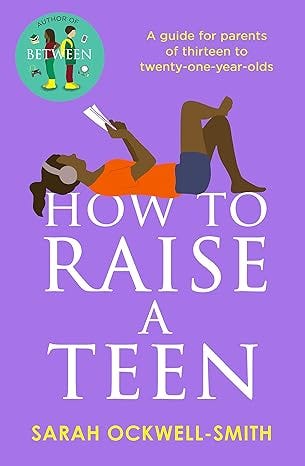
If you’d like to learn more about demetrescence and how to handle the transition alongside raising teens and young adults, you’re exactly who I wrote my new book ‘How to Raise a Teen’ for – it’s out now.
Finally, if you’d like to hear more about raising tweens and teens, you can sign up for my free newsletter HERE.
Matrescence — the term used to describe the transition and metamorphosis that women go through during early motherhood is a hot word on the lips of those who work in the childbirth and maternity industry, women’s health experts, journalists and authors. Although the idea was first discussed by American anthropologist Dana Raphael in the 1970s (Raphael also introduced the word ‘doula’ to modern vocabulary), it wasn’t until a decade ago that the word made its way into everyday use after being reintroduced by American Psychiatrist Dr Alexandra Sacks. Today, if you following childbirth or parenting content on social media you cannot go for more than a couple of days without seeing a matrescence related post.
Talk of matrescence is important. The physical and psychological changes that women go through in the early months and years of motherhood are astounding; a new hormonal landscape changes her in body, brain and mind. Societally new mothers are treated differently, we behave diferently towards them, politically they have had to fight — and are still fighting — for equality in the workplace. Everything is different and yet we bombard new mothers with advice to “get back to normal”, whether that be regaining their ‘pre-baby body’, hobbies, or career. There is no going back however, because everything has changed and these messages serve only to make a mother feel more anxious and confused and dent her self-esteem and confidence during a highly vulnerable period of time. Yes, we must all talk about matrescence, every professional who works with new mothers must understand it and most importantly, the mothers themselves should have more information about the metamorphosis they are undergoing. They should be given more grace and far more support.
When we speak about matrescence however we are only considering half of the picture. You see, mothers do not only undergo one transition. Arguably they have to adapt and grow constantly, but there is one other stage that also affects them physically and emotionally for them to traverse. This is the stage of ‘later parenting’, guiding their children through adolescence and preparing them to fly the nest, while they themselves are transitioning through the peri-menopause and menopause and often juggling changes in career and caring for their ageing parents too. While matrescence is the era of learning to ‘hold on’ to their children and tackling the often stifling need for connection that infants bring, this era is one of learning to ‘let go’, not only of our teens and young adults, but of our dreams for them and the expectations of where we thought our life would be at this stage.
Fifty long years after matrescence was recognised by Raphael I believe it is time we talk about the other transition. Finally society is talking about the menopause and ‘mid-life’ women more, we are emerging from invisibility. We exist and we are struggling with motherhood just as much as our beginner counterparts, only all parenting support is aimed at the first three or five years of life. Where is the help, the classes and groups for those of us raising teens? Where is the ‘teenternity leave’? This stage of ‘late parenting’ transition is so little talked about however that it doesn’t even have a name.
While holidaying in Greece and learning about the lore of their gods and godesses I came across the story of Demeter. Demeter was the goddess of the harvest. Daughter of Rhea and Chronus, and sister and consort to Zeus, Demeter gave birth to a beautiful daughter; Persephone. One day, Persephone was captured by Hades, god of the underworld and forced into marriage. During her search for her beloved daughter, Demeter’s grief caused the harvest to fail and the earth to become barren. Upon seeing the impact of Demeter’s angst, Zeus agreed to help. Hades agreed that Persephone could return to earth if she had not eaten from the delicious fruit of the underworld; the pomegranate. Sadly Persephone had been tricked into eating from a pomegranate and had already consumed six seeds. Hades relented however and allowed her to return to earth, but insisted that she had to return to the underworld for one month for each seed she had consumed. For the six months her daughter lived with her on earth, Demeter was happy, crops flourished, plants grew and flowers bloomed, but for the six months she returned to the underworld this growth ceased, until the time came for her to return again. I instantly felt an affinity with Demeter, with her life’s focus on nurturing and loving her daughter and then having to make peace with letting her go, not forever, but just for a season. The parallells with raising a teen and young adult and the constant push and pull, holding on and letting go required of this stage and the need to be at peace when alone, learning who you are now, after forging an identity of caring for a child for so long made me finally feel seen.
When writing my new book ‘How to Raise a Teen’, I took inspiration from Demeter’s story and named the transition of ‘later parenting’ Demetrescence. The ‘de’ prefix indicating a sort of reversal of matrescence, but with an emphais on Demeter, understanding that this is not the end, but rather a new beginning of a different relationship with your (almost) adult child.
Demetrescence sees mothers having to focus on their own health and physical reminders that they are no longer young, full of energy, and fertile. We must focus on the health of our own parents, considering our own mortality alongside their own. We must consider who we want to be in this next stage of life, when arms that once clung to us so desperately shrug us off without any malice or understanding of how tough that rejection can feel to us at times. Each day we live through ‘the lasts’ of parenting, wondering when we last kissed our child goodnight in bed, read them a bedtime story, bought them a toy as a gift, or carried them in from the car all warm, soft and yet inexplainably heavy after they fell asleep on a long journey. We look yearningly at mothers pushing babies in prams, our ovaries sending out one last “maybe another?” signal before the ticks of mother nature’s clock slow to a stop. We reminisce on the days when our children’s biggest concern was the colour of their sippy cup, instead of the friendship or relationship heartbreak they are currently facing. We feel foolish for ever thinking that parenting would be easier when our children were older, that they would need us less, that we would have more free time. We may have more time free of the physical demands of early parenting, but ‘late parenting’ brings with it a heavy mental load. Not an hour goes past when we are not thinking of our young people, mentally organising and worrying about them.
learn more about demetrescence in my video here
Demetrescence sees us faced with the dreams of our own adolescence, as we help to steer our young people towards their futures, learning that our dreams are not theirs and that they do not want what we wanted, or indeed what we wanted for them. We are faced with filling time, time that we so desperately wanted a decade or two ago, but that now feels empty. We must reconsider our careers, our life goals, our adult relationships, how we present ourselves to the world and most importantly the relationship with have with ourselves and we must do all of this through hot flushes, sleepless nights and hormone shifts that produce irritation, intolerance and attitude far worse than any our teens exhibit. And nobody is talking about it. I think that should change, don’t you?
Read a free excerpt from my new book all about parenting teenagers.
The following is an extract from the introduction of ‘How to Raise a Teen‘. I hope you enjoy it!
It was the spring of 1992. John Major’s Conservative Party had just won a second term in the UK’s general election, Disneyland Paris had just opened, George Michael wowed millions when he performed on stage with Queen at the Freddie Mercury tribute concert at Wembley Stadium, Kate Moss had just posed topless with Mark Wahlberg for a Calvin Klein advert and Beverly Hills, 90210 was the most talked about show on TV.
I was sixteen, just about to take my GCSE exams, struggling with anxiety and low self-esteem and trying to work out who I was and what I wanted to be in a family who had already decided for me. I was a talented artist and wanted to study fine art at a college in London. My parents, however, were concerned that this wasn’t an appropriate career choice, and it was decided, with little input from me, that art should instead remain a hobby and I would move from my state high school to take my A-levels at a local private school. My artistic skills had won me an art scholarship, making it affordable for my parents who had grown up in large families with little money in the East End of London and left school with only a handful of O-levels between them. It was a dream for them to have a child at such a prestigious school. It wasn’t my dream, though my dream didn’t matter, because I was young and naïve about ‘the real world’.
My nickname during this period was ‘Stroppy Sarah’. Still, I was a ‘good girl’. I rarely rebelled, broke curfews or answered back. I did my homework and begrudgingly completed my chores. I also spent hours alone in my bedroom, decorated with black and white Athena posters, sulking after disagreements with my parents. I can vividly remember desperately wanting them to come to my room and say, ‘It’s hard being a teen. How can I help?’ But they never did. Instead, I spent hours sulking and brooding, trying to find a sense of belonging in a world full of people who I felt didn’t understand me. ‘Stroppy Sarah’ thought she was the problem, or at least her hormones (something else her emotionally erratic behaviour was frequently blamed on) and her age were. Nobody told her anything different. It took years for her to develop self-confidence and to pursue her own path in life, one that led to writing rather than art – but still, a creative career that teen Sarah would likely have been steered away from.
Why am I telling you all this? Because it’s so important that we remember how we felt as teenagers ourselves if we want to truly understand the teenagers in our lives today.
I’d like you to take a pause from reading this book for a moment to revisit your own adolescence. Try to think of a time between the ages of thirteen and twenty-one, when you felt similarly misunderstood or unsupported by your parents or carers. Take a piece of paper or use your electronic device and write a few sentences about what was happening at that time in your world.
How were you feeling?
How were you behaving?
What did you hope your parents or carers would say to you?
What did they actually say or do?
Keep these words safe, because I’d like you to refer back to them later in this book. For now, however, just acknowledge that there were always underlying feelings beneath your so-called problematic behaviour as a teen, and often they revolved around not being understood or supported by those closest to you. Sadly, we forget all too quickly, but revisiting your own past feelings is key to deciphering those of your teen today.
We often paint teenagers in a negative light. We call them rude, disrespectful, manipulative, stubborn and deliberately defiant. We are wrong. We have all been teenagers; we know how misunderstood we felt. We know that any time we said, or did, something that could be construed as disrespectful there was an unmet need, or problem driving our behaviour. We all felt, at times, disrespected by adults. We all vowed, at some point, that we wouldn’t be like them if we ever had children in the future . . .and yet here we are.
Teenagers today get as much short shrift as we did in our own teen years. Nothing has changed, except we are now the adults, and we have, indeed, become the grown-ups we swore we never would.
Society has a funny way of perpetuating distrust and disdain towards teenagers. This is nothing new, with frequent protestations about the state of ‘the youth of today’ and how teen behaviour is apparently worse than ever (a myth we will bust later in this book). Teenagers have always been the butt of jokes and the cause of many complaints from adults, and I suspect they always will be. My hope with this book, however, is to try to change things a little. I want to help readers, including you, not only to see how magical their teens are (or the teens that they teach or care for) but to understand them a little more, to make things easier and happier for all.
Am I suggesting that teenagers are always right and adults are always wrong? Absolutely not. Teens often do, and say, stupid things – indeed, I expect this is part of the reason why you’re reading this book – and raising them is often infuriating and exhausting.
They make mistakes, they get angry, they get into trouble, they can be lazy, rude, obstinate and argumentative. I’m not making excuses for any of these behaviours or saying that they are OK. What I am saying, is that the best way through these years is to work with your teens, to support them, guide them and to understand them, rather than working against them, as so much parenting advice suggests. The easiest and most rewarding path through these years is one you walk together with your teen, with as much emphasis on your own behaviour as on theirs. After all, every descriptor I used near the start of this paragraph can also explain common adult behaviours – and if we’re not perfect, why should we expect our teens to be?
‘How to Raise a Teen’ is out now! You can order a copy HERE.
If you liked this post, you may also like THIS ONE about Demetrescence – the motherhood transition of raising older children.
Sarah
p.s: sign up to my newsletter all about raising tweens and teens for free HERE.
“Gentle parenting is so hard, I’m not sure I’m cut out for it!”
If I had a pound/dollar/euro for everytime I’ve seen this written online I would be a VERY rich woman by now. However it is totally and uttlerly WRONG.
This sentence makes me incredibly sad and frustrated because it highlights how much people don’t understand what Gentle parenting is. In all of my work, I talk about long term goals versus short term goals. Quick fixes that change behaviour today, versus focusing on who your child will be as a teen/adult. Gentle Parenting is very much focused on the latter. It is not about creating calm compliant, obedient robot children, it’s about raising individuals who will be happy and emotionally healthy adults.
The other thing that these articles alway miss is that gentle parenting is bloody hard because ALL parenting is blood hard. The inconvenient truth is that it doesn’t matter what style you follow, beliefs you hold, or techniques you try, it is BLOODY HARD being a parent. This applies whether you label your style strict, gentle, old-school, attachment or any other label. It’s ALL hard. There are no quick fixes and no magic solutions and most importantly there are no perfect parents.
A lot of how our children turn out is due to luck, & things out of our control, including: * genetics * our own upbringing * our economic status * the situations we find ourselves in * the support & information available to us
It really doesn’t matter how you choose to parent, your:
* baby will not sleep through the night * toddler will not avoid tantrums * preschooler will not be a non-fussy eater * six year old will not avoid defiance * tween will not avoid backchat * teen will not be drawn to homework over screens
…and whatever style you follow, you will feel thoroughly exhausted, guilty, confused, desperate for change and an easier life at times.
There is no magic (sorry).
Children behave like children, however much we want them to behave like adults. This doesn’t mean that a style is “not working” if you haven’t created compliant, obedient, easy children who sleep and eat on demand. It means our society’s expectations of children are completely screwed and THAT is what makes everything so damned hard for parents.
When our expectations of children’s behaviour are realistic everything is easier for us – and for them. If we all had realistic expectations we would also demand better from our governments. The fact is, their provision for families is pretty shitty. We aren’t meant to be doing all of this; working full time, trying to keep things afloat (often with no partner) & juggling a million mental load balls.
It feels hard because it is hard, not because gentle parenting (or any other style) doesn’t work and especially not because you are somehow not ‘good enough’ – because you are!
When do you see the big behaviour change and rewards for your hard work? You’ll see glimmers as they approach puberty and in their teens, but you won’t be able to see the full effect of your actions until the 20s and beyond. You must think long term.
We also have to stop talking about ‘failing’ to be a gentle parent. I’ve read so many op eds recently where the author says that they are not cut out for gentle parenting, that it doesn’t work for them or their children because they have too much of a temper, or their children are too feral. They say that the idea of gentle parenting is great for those who are naturally calm, with easy children, but that’s not them. They say they find the concept of gentle parenting toxic to parents, because it makes them feel as if they’re not good enough.
Can we please, once and for all, bust this myth?
YOU DO NOT HAVE TO BE A PERFECT, CALM, PARENT TO PRACTICE GENTLE PARENTING!!!!!
You absolutely can lose your shit, have a hot temper, make mistakes, get things wrong and have spirited children (so much more on this in my book ‘How to be a Calm Parent’).
So, before you give up on gentle parenting, ask yourself if you truly understand the goals? Or if you need to put your long term glasses on and take those ‘quick fix’ ones off for a bit? You should also give yourself grace. Gentle parenting is not about being perfect (children or parents), it’s about being real. It’s about screwing up, making things right, constantly learning and forgiving ourselves in order that we can be ‘good enough’.
Yes, gentle parenting is hard, but ultimately we make it a million times harder because of the unecessary pressure we place on ourselves and the unrealistic expectations of ‘results’ that we carry.
Want to learn more about the TRUTH of Gentle Parenting (and not what TikTok or media articles would have you believe?), check out ‘The Gentle Parenting Book‘.
If you raise a concern about your young person in a group of other parents, I can guarantee that within a minute talk will turn to hormones. If your young person is male, any difficulties you have will be blamed on the fact that their body is “swimming in testosterone”; if they are female, then their behaviour will be put down to “oodles of oestrogen”. Apparently, testosterone makes boys aggressive, rude and ‘boisterous’, whereas oestrogen makes girls sulky, erratic and rude, especially when it’s ‘the time of the month’.
What if I told you that this isn’t true?
In fact, hormones have little to do with your young person’s behaviour and constantly blaming it on this does them a great disservice. Why? Because dismissing behaviour as being caused by hormones prevents parents and carers from finding – and, most importantly, working with – any underlying problems. Constant talk of hormones also tries to neatly distinguish between ‘boy’ and ‘girl’ behaviour, with countless sources offering highly gender-stereotyped advice.
The truth is, regardless of what sex your young person is, what they need from you is exactly the same: support, attachment, understanding and great role modelling.
Does this mean hormones have no impact at all?
No. They do – just nowhere near as much as most people think. Similarly, the idea of a ‘surge of hormones’ during adolescence is misguided. Hormone levels start to change significantly at the beginning of puberty, usually between the ages of nine and eleven. So if they were really the issue, we would see an impact on behaviour far before the teen years.
There are some links between certain hormones and behaviour in adolescence, however – predominantly risk-taking behaviour. Higher levels of testosterone have been linked to an increase in this, not just in boys, but in girls, too. Interestingly, higher levels of oestradiol (a form of oestrogen) are linked with decreased risk-taking behaviours. While hormones do clearly have an impact on behaviour during the teen years, when we add brain development into the picture, too, we start to understand a lot more. You see, your young person’s brain, with a small influence from hormones, is responsible for almost all the behaviours you find challenging. And understanding the hormone–brain interplay is like flicking on a lightbulb for parents and young people alike, identifying the root causes of almost everything that both parties struggle to cope with.
Let’s take a look at some of the ways in which the young person’s brain influences their behaviour.
Common complaints of parents and carers of young people
When I run workshops for parents and carers of young people, I always start by asking them to list some of their common frustrations and concerns about their young people’s difficult behaviour. The following always appear – perhaps you can relate to some of them?
Disorganisation
Impulsivity
Erratic emotions
Lack of consideration for others
Rudeness and backchat
Not thinking about the consequences of their actions
Being prone to procrastination
Poor time management
Inability to prioritise
Irrational behaviour
Short-term thinking (too focused on the moment, not the future)
Overuse of their phones, gaming consoles and other screens
If you think back to your own teen years, I’d wager that you could probably tick quite a few of these behaviours. I know I certainly could and remember many of them appearing in school reports and discussions at my school parents’ evenings.
The behaviours in this list are almost universal during adolescence, and while your young person may not exhibit all of them all the time, it’s highly likely that you’ll have come across all of them to some extent by the time your young person turns twenty-one.
Executive functions
Executive functions, or EFs, is an umbrella term used to describe a range of cognitive – or mental – processes that control skills relating to decision making, completing tasks and emotion regulation. EFs enable us to study, work and engage with others; they are like the internal drivers of our behaviour that control our reactions to situations. EFs start to develop in early childhood. However, they do not fully mature until adulthood, with proficiency obtained in the mid- to late twenties. EFs mostly sit in the frontal lobe, the last area of the brain to complete myelination. (Myelin is a fatty sheath which surrounds a long, cable-like section of neurons – nerve cells – known as axons, enabling electrical signals to be transmitted as quickly as possible around the brain; myelination is the process of covering these axons with myelin.) While myelination mostly takes place during the end of pregnancy and the early years of life, the process is not complete until a young person enters their twenties. Incomplete myelination during adolescence therefore means we can expect the functions of the frontal lobe to be immature.
The main executive functions are:
Flexible thinking – the ability to be able to adapt to different situations, revising planned actions and rethinking approaches; for instance, coming up with a new solution to a problem when the previous one didn’t work out as expected.
Emotional control – the ability to recognise and regulate your own feelings so that you can complete activities; for instance, recovering from disappointment at not being able to do something and remaining calm afterwards.
Impulse control – the ability to think about how to behave, considering potential consequences of behaviour and preventing yourself from behaving in a socially inappropriate way; for instance, not shouting out in a classroom or workplace.
Self-monitoring – the ability to evaluate your own behaviour and actions, including your own strengths and weaknesses, considering how you impact others and using this knowledge to improve yourself; for instance, calmly receiving feedback in a work meeting or from a teacher and acting on constructive criticism.
Planning and prioritisation of time – the ability to organise your time, understanding the urgency of a task and the time available to you; for instance, pencilling in one hour in the evening to complete your homework or work report, before playing on your phone.
Organising – the ability to keep track of important information, utilising a helpful structure; for instance, keeping a list of groceries that have run out to take shopping with you.
Working memory – the ability to utilise stored information in your mind to help you to complete an activity; for instance, using a mind map or mnemonic to help you revise for a test or an exam.
Task initiation – the ability to get started on a task without procrastinating or becoming overwhelmed, combined with the ability to work hard until the task is completed; for instance, getting started on housework, without delay, and continuing until the room is tidy and clean.
The sad reality, is that if you were to eavesdrop on any conversation about young people, I can almost guarantee that you would hear an adult complaining about their EF abilities, whether that’s procrastination, emotional outbursts, inflexibility, stubborn behaviour, a lack of introspection or total disorganisation.
Undoubtedly, it is exhausting raising young people who have immature EF skills, but can you imagine how difficult it is to be the young person? Of course, you don’t have to imagine too hard because you’ve already been there. Maybe you were frequently shouted at for never tidying your room? Maybe you got into trouble for always forgetting to do your chores or hand in your homework on time? Perhaps you remember getting angry and saying things you didn’t mean in the heat of the moment? Perhaps you remember the adults in your life telling you that you needed to change and ‘grow up’? Maybe you internalised these attacks on your character and grew to believe that you were ‘lazy’ or ‘useless’ or maybe, like me, that you were ‘stroppy’. The thing is, you never were. You were simply being a young person, with a young person’s brain, just like the young person in your life today. It wasn’t your fault. And it isn’t theirs. It’s neuroscience.
In a world that tries so hard to change how young people behave, one of the most powerful things a parent or carer can do is to accept them as they are. Young people cannot change how their brains work today; they cannot magically develop mature, adult-level thinking skills, no matter how much we attempt to reward or punish them or subject them to lectures and consequences. If, instead of focusing our efforts on trying to change them, we worked with them and helped them to understand their marvellous brains, I believe everything would be very different, especially for those young people who are neurodiverse.
So much of what we describe as ‘attitude’, ‘rudeness’, ‘disrespect’ and ‘laziness’ is normal for young people. Many of their most frustrating behaviours don’t need to be disciplined out of them, instead, they need our support,guidance and patience. Yes, this is hard for us, but in the end, understanding and nurturance are key to caring for our young people, both now and in the future.
The best way we can help our young people’s brains to finish developing traits relating to confidence, calmness, empathy and consideration for others, is to embody these traits ourselves in our day-to-day dealings with them.
This is a short excerpt from my new book ‘How to Raise a Teen: A guide for parents and carers of 13- 21 year olds’. If you’d like to learn more about your teenager’s magical brain and how to support them, while keeping a calm and happy home, you can order a copy HERE.
f you liked this post, you may also like THIS ONE about Demetrescence – the motherhood transition of raising older children.
Sarah
p.s: sign up to my newsletter all about raising tweens and teens for free HERE.
Have you ever thought about the last time you did something with your young person (YP)? When they are little, we commemorate their firsts; first steps, first words, first solid food, their first pair of shoes and the first time they slept through the night. We take photos to stick in photo albums and share their pictures proudly on our social media. We call family and friends and let them know how exciting their new achievements are. Their lasts however either pass us by unconsciously, or we mark them with sorrow and regretful retrospect; the last school assembly or play, the last time you took them to a school disco, the last time you tucked them into bed at night, the last time you bought a toy for their Christmas (or other religious festivals) or birthday.
The last Christmas toy purchase always gets me the most.
You may be wondering why? Especially since it is surely the most materialistic of memories. Because it marks such a strong line between childhood and approaching adulthood.
Gone are the Christmases of the past where you would be handed a crumpled Christmas list with excitement, after they walked past the latest toy in a shop window, with wide-eyed wonder. There are no more Christmas Eve nights spent trying to quietly assemble large toys, before draping them in wrapping paper, ready for eyes twinkling as brightly as fairy lights, and eager hands to run and rip into on Christmas morning. There are no more sounds of electric trains, toy police car sirens, or meowing electronic pet cats competing for attention over Christmas cartoons on Christmas day afternoon. Now Christmas is silent.
Christmas eve is increasingly spent alone, waiting up for your YP to safely return from an evening out with their friends, the morning is also quiet, as you wonder what time your YP will wake up and finally get out of bed to begin the festivities. The afternoons are so often spent with their faces in a book, or a screen, with headphones on. The silence of adolescence and early adulthood can be deafening. Never did you image you would miss the cacophony of early childhood, and yet here you are.
What can you do if you recognise these feelings? Honestly, I have no expert answers. You gradually become acclimatised to the new stage in your life. It makes you appreciate the little things more and cherish glimpses of how things used to be. If your YP asks you to play a board game with them or join them for a game on their new console, you accept without hesitation.
You create new traditions too, in my family, our crazy Christmas eve nights have been replaced by a family Indian takeaway. It may sound a little dull, but it has become a beloved tradition that my YP never want to miss. Each year there is another seat at the table added, as their new partners join us and our family expands. I hope someday in the future even more chairs will be added as grandchildren are born, and so we start the cycle of noise, flashing lights, ridiculously early morning wake ups and discarded wrapping paper again. This time however, I know I will appreciate it far more than I ever did before and can hopefully give my adult children a much-needed break as I take some of the night wakes, early mornings, and constant requests to play off their hands.
If you’re a parent to a (nearly) 13-21 year old, and you want a little helping hand to get through the tougher days, you’re exactly who I wrote ‘How to Raise a Teen’ for. Find a stockist HERE.
f you liked this post, you may also like THIS ONE about Demetrescence – the motherhood transition of raising older children.
Sarah
p.s: sign up to my newsletter all about raising tweens and teens for free HERE.
Ten important takeaways from ‘Because I Said So! why society is Childist and how breaking the cycle of discrimination towards children can change the world’:
1. Childism is discrimination based on age. The correct term should actually be ‘ageism’, which is a well accepted ‘ism already – but universally used to talk about the discrimination of the elderly.
2. We have all been affected by childism when we were children, we often don’t realise it though and just grew to accept that adults hold a position of power over children. Often our loved ones have been even more deeply affected than us and when we struggle with their beliefs about parenting and discipline, we have to start with empathy and understanding how they have reached this position before we can ever try to change it.
3. When we become parents ourselves we tend to subsconsciously continue cycles of childism with our own children. This can make it incredibly hard when we try to be anti-childist as it means admitting some of the things we’ve done to and with our children may not have been in their best interests.
4. Childism is a feminist issue. If we don’t value children we don’t value those who are their primary caregivers – women. Mothers, and childcare workers who are mostly female are under supported, undervalued and underpaid by society.
5. Childism is political. We can be the best gentle parent in the world, but it won’t undo the inherent discrimination of children by our governments – especially the underfunding of schools, child mental health services, SEND support, funded childcare plans, handling of Covid lockdowns, climate change policies and the impact of children growing up in poverty. To stop childism, we have no choice but to be political.
6. Common parenting advice, especially focused on sleep and behaviour is highly childist, prioritising the needs and wants of adults over the needs and feelings of children. These techniques date from childist advice (always from men) from the late 19th and early 20th centuries.
7. The internet, social media and sharing images and videos of our children without their consent is an issue unique to our generation and one that has lasting and important consequences. There have already been legal precedents set when children have sued their parents – and won – for breach of privacy. The same legal rights to be forgotten and have personal data protected apply to children as well as adults.
8. While human rights laws protect all of us and specialist articles protect children even more tha no adults, they are frequently breached. On a daily basis schools breach a child’s rights to rest and play for instance when they keep children inside during breaks as a form of discipline.
9. Once you become aware of the existence of childism you will notice it everywhere – from tiktok challenges and social media shaming of children, to banning children from shops and airplanes. It is everywhere – and arguably is getting worse.
10. If we want to create a fairer, more equitable, world we have to start with how we treat our children. Ending childism is down to all of us, we all have an important role to play and we CAN make a difference, especially when we work together.
’Because I Said So!’ Is out now – it’s for anybody who has children, works with children, or simply cares about the future of our world.
When I had my first child, in 2002, I struggled to follow the mainstream parenting advice of the time, particularly when it came to sleep. My son was easily the worst sleeper of all the babies I came across in the baby groups we attended. The other parents were able to put their babies down awake in their cots in their blacked-out nurseries, give them a quick kiss on the cheek, then walk out and close the door. Their babies were capable of the miraculous skill of ‘self-soothing’, while mine would cling to me desperately. He wailed when I put him down, his arms reaching up for me, big brown, teary eyes pleading with me to pick him up again. My baby’s sleep and feeding schedules were erratic and unpredictable, while theirs would sleep and feed to the clock, with military predictability.
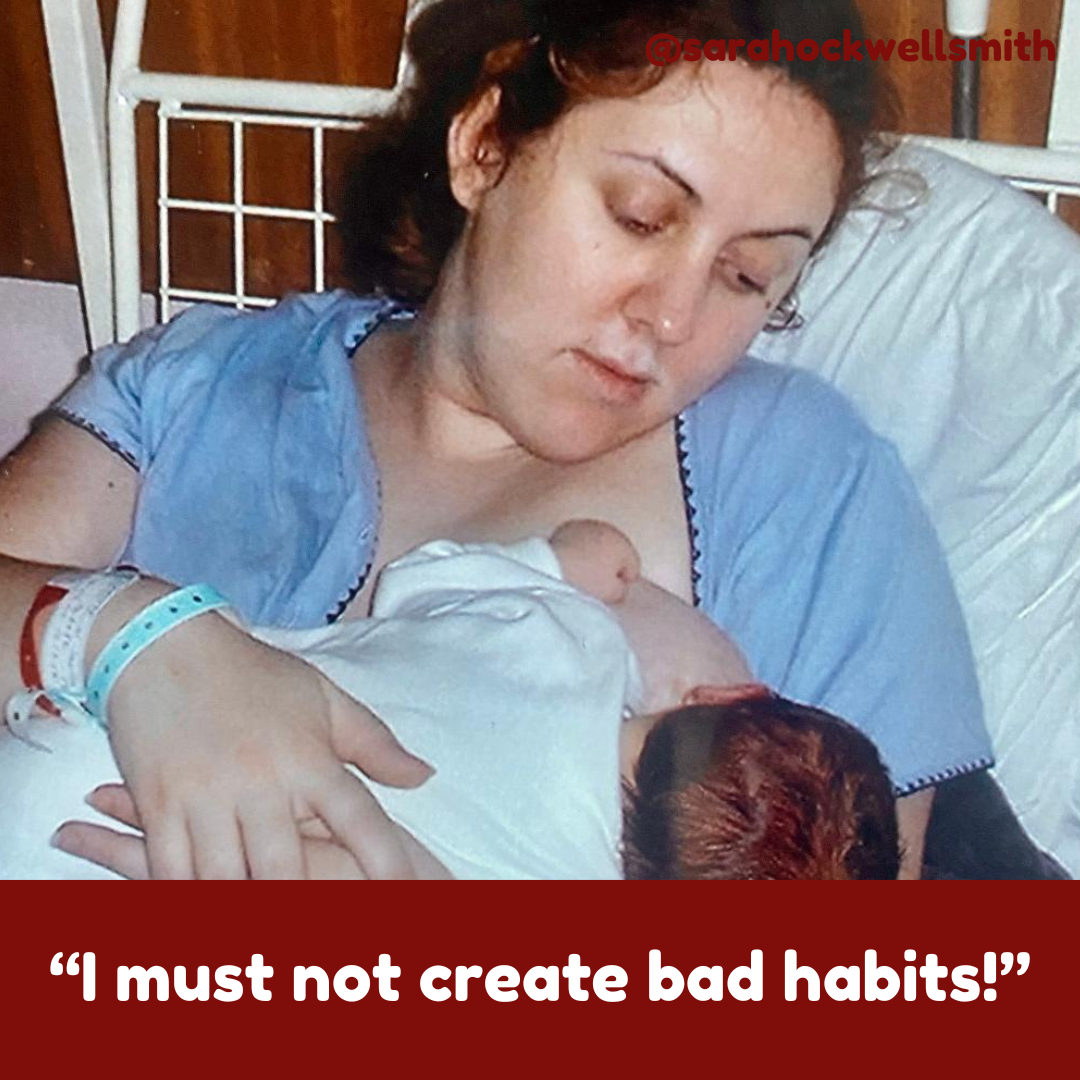
Desperate to ‘fix’ my baby, I turned to books and online advice that urged me to leave him to cry for a few minutes, while I waited, physically unresponsive, nearby. Apparently, in my quest to soothe my son, I had created bad habits that we now had to break. We lasted for one horrible, heartbreaking night. I couldn’t bear to put him through any more trauma. Reluctantly, I continued to meet his needs for physical contact throughout the day and night, all the while feeling that I was somehow a worse parent than those with the perfect sleeping babies because I had failed to do what was best for him.
My son quickly grew into a toddler and my worries moved on from sleep to be replaced by concerns about his tantrums. Here, the books, television experts and online chat groups told me to reward him when he was well behaved with stickers on a chart displayed on our fridge door, and to punish him by sending him for time out when he was ‘naughty’.
I struggled to make him stay in one place when we attempted time out, so one day, in desperation, I learned that if I shut him in our small entrance porch, he could not open the door handle and escape. For a week, I faithfully took him to the porch and closed the door every time he misbehaved. I would stand the other side of the door, while he howled and pleaded with me to let him out, timing two minutes – a minute for each year of his age, as advised. This seemed even worse than the sleep training we’d attempted. It physically hurt my heart to hear him begging me to open the door, and when his time was up, he once again clung to me, heaving big sobs for what felt like hours.
Once again, I abandoned the technique advocated by so many and decided that I just wasn’t strong enough to follow the advice. I had failed to sleep train my son and now I was failing to discipline him. I felt like a social pariah at baby and toddler groups, with the placid, good-sleeper babies and compliant toddlers. Eventually, I stopped going to them. Instead, I stayed at home, where I didn’t feel pressure to follow the popular childcare methods that produced such ‘easy’, ‘well-behaved’ children.
As the months and years went by, I learned that the best way to help my son (and his three siblings who followed) to sleep and to regulate his emotions, was through connection, meeting his needs and helping him to feel safe and secure. I began to learn his triggers and how to avoid them, and how to de-escalate him when his big feelings threatened to boil over. We were both so much happier. Slowly, I learned to trust my instincts to nurture my son and to place his needs above the opinions of others. And the more I did so, the more I resented the advice I had received – not just from books, strangers on the internet and the television parenting experts of the time, but from healthcare professionals, too.
Talk of ‘ignore, punish, praise and reward’ and teaching self-soothing was everywhere. Finally, I began to question the commonly held wisdom more than I questioned my own instincts and my son’s behaviour. I realised that the advice felt wrong because it was wrong. It was all about ignoring a child’s needs, not meeting them. It was all about disconnecting, rather than connecting. It was about compliance over compassion and forcing independence before meeting the primal need for dependence. The advice didn’t work for me. But perhaps most importantly, it didn’t work for my son.
I grew angry at the messages so prevalent in society which led me to try to raise my son in a way that felt instinctively wrong to both me and him. However, these experiences also planted a seed – one that would take a further five years to begin to sprout and another two decades to come to fruition. They became the fuel behind my desire to raise awareness of the way society discriminates against children and their needs in an attempt to prioritise the wants and wishes of adults. While I would dearly love to relive those early years free of self-doubt, to enjoy every precious snuggle with my son and to treat him with the full respect he truly deserved from the moment he was born, I wouldn’t be doing what I do today without them. The realisation of the terrible childism that exists in our society today, from the very moment a baby is born, is the inspiration for everything I have done in my professional life since.
In 2007, I started to run classes in my home, supporting parents to use what I called ‘gentle-parenting’ methods. We spoke about the importance of nurturance, empathy and meeting the needs of our children. We spoke of respecting babies and children as we would respect adults. Through word of mouth, these small classes quickly grew and I developed gentle-parenting workshops that I delivered, and still do to this day, to thousands of parents. I spoke of tackling sleep and tricky behaviour with a mindset of placing the child at the heart of the conversation, removing the discrimination towards children that features so heavily in most parenting advice.
In 2011, I began to write my first parenting book, with the aim of producing the book that I wished I had read myself as a new parent – one that honoured my baby’s needs and my instincts. That first book focused on gentle parenting from the very beginning of life, because that is where childism begins, and this is the reason why you will find two whole chapters devoted to the discriminatory treatment of children under three here. One book quickly led to another, and another, and now fourteen books on, I have become known as ‘the inventor of gentle parenting’. While the label is flattering, it isn’t true. I simply put into words what parents did for centuries naturally before the so-called experts came along and told them that they were doing everything wrong.
As I reflect on my personal and professional past, I realise that everything I have done and experienced to date has led me to writing this book. My passion for battling injustice and empowering parents to trust their instincts and treat children with the same respect we would show an adult is, ultimately, a calling to make as many people as possible aware of childism and how we can change it. This anti-childism message is the ‘why’ behind the ‘how to’ of the gentle-parenting messages I am so well known for, and which we will discuss later in this book.
This is an excerpt from my new book ‘Because I Said So! Why Society is Childist and How Breaking the Cycle of Discrimination Towards Children Can Change the World’.
“That’s the problem with the youth of today – no discipline, parents who mollycoddle them, wrap them up in cotton wool and let the little darlings get away with everything.”
“The youth of today have no respect, they run riot, out of control. Their parents are to blame of course.”
Go to any social media discussion about today’s generation of children and you will find a comment similar to the above. These statements are wrong for so many reasons. They are spoken through rose-tinted spectacles forgetting the past and misinterpreting the present. Incorrect beliefs and assumptions are woven to create a tapestry of falsehoods and myths.
The truth is – the youth of today are some of the best behaved in history – despite their parenting still very much focusing on harsh, outdated, authoritarian approaches, the adults of today just have trouble remembering and viewing the world without the discrimination with which they themselves were raised as a child.
The Truth of The Youth of Today
The inconvenient truth, that it appears those uttering these statements don’t realise, is that actually – children and teens today are much better behaved than those from previous generations. They smoke less, drink less, have sex later, have less teen pregnancies, achieve better at school and exhibit more prosocial behaviour than previous generations. They also care more about the environment, animals and social justice issues.
The kids are alright actually – they put a lot of adults to shame, especially the older generations who claim they are unruly tyrants. The sad truth is, that older adults have always complained about the youth of today and they’ve almost always been wrong.
Why do the same old complaints resurface every generation? Most likely it’s a memory issue. Psychologist John Protzko, who studied the phenomenon of ‘the kids of today’ with colleagues at the University of California explains it as “A memory tic that just keeps happening, generation after generation”, suggesting that these statements also reflect the bias held by those who believe them.
Most adults today were raised with a great degree of childism, or discrimination towards children. They were brought up to believe that children (and their views and needs) were somehow worth less than those of full-grown adults, this childism clouds views when the discriminated child becomes the adult with all the power. The childism is subconsciously passed down from generation to generation unless somebody is brave enough to challenge it.
No, Most Parents Don’t Follow Gentle Parenting
I get it, turn on the radio, flick open the newspaper, or tune in to a daytime TV programme and you would be forgiven for thinking that all parents today are following gentle parenting. You’d also likely believe that gentle parenting is basically akin to letting children do whatever they want, with zero boundaries or discipline. Both of these are incorrect. Most children today are still raised with traditional parenting practices that involve discipline via carrots and sticks (bribery and fear). Gentle parenting, despite its name actually places a strong focus on having boundaries, discipline and saying “no” a lot – these things are just done with compassion, calmness, empathy and understanding of the child and their abilities based on their age.
When the naysayers complain about the “unruly, disrespectful children of today” what they’re actually doing is criticising more traditional parenting practices – those that involve a lot of punishment, shaming, blaming, excluding, yelling and sadly – hitting (over 60% of parents in the UK admit to smacking their children according to a recent YouGov poll).
It is true that children raised in this way are more likely to display anti-social behaviour (if you yell at a child and hurt them physically or emotionally to try to manipilulate their behaviour, what you’re ultimately teaching them is to resolve problems with others with insults, disrespect and their fists). Ironically, in criticising “the youth of today” it is the very parenting practices that are being put on a pedestal as “the best way to teach children respect!” that are causing the problematic behaviour.
Alas, gentle parenting is still very much a fringe movement. It may seem as if the whole world is doing it, based on the media reports and TikTok videos, but the very reasons these are shared so widely, is because they are so unusual and unlike the parenting most of us were raised with. The novelty factor is high, but the true followers are significantly lower.
Imagine the Future if Parents Followed More Respectful Approaches
If “the kids of today” are more sociable, respectful and better behaved than ever, in spite of the majority being raised with traditional parenting, can you imagine how amazing they would be if gentle parenting WAS mainstream? If it was the default way to raise children? What would our world look like if everybody in it was raised with genuine respect? If their needs for attachment and emotional support were fully met? If they felt supported, listened to and their rights were upheld? Would we see a shift in society? Would we see less mental health issues? Less broken relationships? Better physical health? Less war? More caring about the environment?
We’re not there yet, but the journey has finally begun…
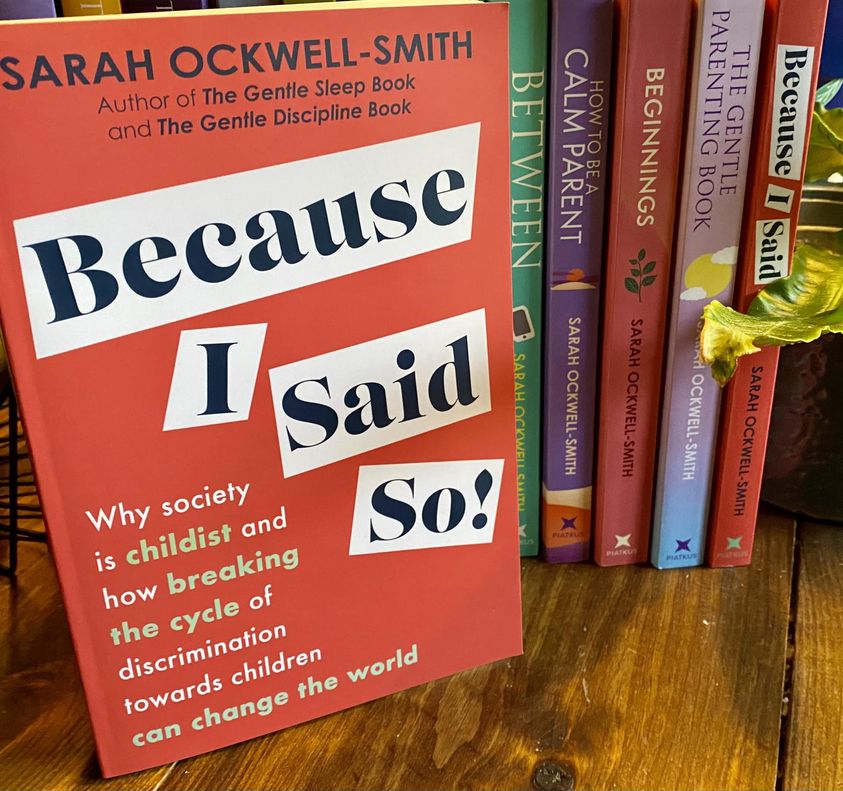
Essential for parents, carers, teachers and anybody who works with children, Because I Said So! is both a thought-provoking guide and an urgent call to action. It will help you to understand your own upbringing and how this has shaped your beliefs and behaviour; prompt you to consider the prevalence of childism in society today, so that you can change the way you look after the children in your care or reinforce the approach you are already taking; and consider how we can transform the way our society treats children to create positive, lasting change for generations to come.












 ’
’


 Sarah Ockwell-Smith
You must be logged in to post a comment.