Big Babies – The Curse of (mis) Diagnosing a Macrosomic Infant Part.1

Thousands of women are diagnosed with suspected big babies (or ‘macrosomia’ to use the medical terminology) every year, but this one simple label can have a profound effect on their birth.
Obstetric consultants often take the results of growth scans as gospel, scheduling elective C-Sections or inductions as a result of them, but how accurate are these estimates? and does early induction or elective C-Section really prevent problems if a baby is extra large? – you might be surprised at the answer!
…and even IF the baby is big, what’s to say that the mother will have problems giving birth? Some women have a great deal of trouble giving birth to a small six pounds baby, whilst others, like myself, can birth an eleven pound baby with ease. Then there is the issue of the nocebo effect – the creation of a medical problem when there was none initially, in short if you go looking for problems with ‘a big baby’, you dent the mother’s confidence, you induce her before her body and baby are ready and keep her immobile by monitoring constantly throughout her labour – the chances are her birth will be problematic, not because of the size of her baby – but because of the management of her labour. Yes the nocebo effect is particularly strong in modern day obstetrics.
So, even if the growth scan estimate is accurate how can anyone possibly know how YOU will birth? The only sure thing is that nobody knows how much your baby will weigh until it is placed in the scales after birth, or how your birth will go until after the event. I heard a great analogy from an obstetrician once, that likened trying to predict the size of a baby before birth, by ultrasound, to trying to guess the weight of a man, sitting in a bath full of water, in the room next door by measuring his waist and thigh bone. When you look at it like that it really does become apparent how ludicrous these gross measures we use are!
So How Accurate are Ultrasound Estimates of Foetal Weight?

Ultrasound is widely believed to be the most accurate method of estimation of foetal weight. Yet in 1988, Miller, Brown, Khawli, Pastorek & Gabert in “Ultrasonographic identification of the macrosomic fetus” found that the typical mean error ranges from 300 to 550g (11.6 to 19.4 oz). That’s around a WHOLE POUND! In 1992 Chauhan, Lutton, Bailey, Guerrieri & Morrison In “Intrapartum clinical, sonographic, and parous patientsestimates of newborn birth weight” found that ultrasound was the least accurate of the three methods, i.e: it was less accurate than the educated guess of the obstetrician or mother!  In their study “Pregnancy outcome following ultrasound diagnosis of macrosomia” Delpapa & Mueller-Heubach found that “In 66 of 86 women (77%) delivering within 3 days of ultrasound examination, estimated fetal weight exceeded birth weight. In only 41 of these 86 women (48%) were the estimated fetal weights within the corresponding 500-g category of birth weight” – That’s quite some difference!

Limitations in the sensitivity and specificity of ultrasound have been observed in many other studies but sadly despite these well documented limitations, health professionals continue to incorrectly believe that ultrasound is an accurate way of predicting macrosomia, this also despite the UK Government’s CESDI (Confidental Enquiry Into Stillbirths & Deaths in Infancy) report stating that “the inaccuracy of ultrasound estimates have been well documented. Indeed, it is possible that estimating fetal weight by late ultrasound may do more harm than good by increasing intervention rates”.
I’m sure many people can recount a story of a friend or relative who has been told their baby would weigh 10lbs only to birth a perfectly average sized 8lber, or those, as myself with my first baby (who subsequently weighed 10lbs) who were told “it’s completely average, a 7lber” only to find they were expecting a whopper. As a general rule of thumb growth scans are quite good at plotting the growth rate of a single baby over a time period following several scans, but as a one off, arbitrary measure, research suggests that “mother’s intuition” is more accurate!
So What to Do if You are Offered a Growth Scan?
If you are offered a growth scan (note you do not “have to have” one) you could ask what the results will be used for? For instance, will the results be used to benefit you and your baby? You could ask how accurate they are at predicting birth weight? Or you could ask if they have any negative effects or risks attached to them? (such as leading to unnecessary inductions or C-Sections). Some people also believe that Ultrasound scans themselves carry risks. Above all else, how will YOU feel about the result, how will you feel if you are told your baby is big? will it dent your confidence and potentially inhibit your labour? remember – the scans are being offered to you, as such you can politely decline them after carefully assessing the risks and benefits of them.
Why Are Some Babies Much Bigger Than Others?

If you believe the media you will probably think it is because we all eat too many chips. In reality there’s an awful lot more to it than that. It is true that women who develop Gestational Diabetes are more likely (a twofold risk in fact) to give birth to a larger infant, however this site is interested in those women who have not been labelled with any medical disorder and who seem to “just make big babies”. There are several known risk factors, aside from Gestational Diabetes, which can highlight certain women who are more predisposed to birthing a macrosomic baby, these are:
  • Multiparity (not your first baby)
  • Birthing a previous macrosomic baby
  • A prolonged period of gestation
  • Carrying a male baby
  • Parental Stature
  • Excessive weight gain during pregnancy
Genetics does seem to play a role though and often women will give birth to a very large baby with none of the above risk factors – in fact according to Boyd, Usher & McLean and their report “Fetal macrosomia: prediction, risks, proposed management” – 34% of macrosomic babies are indicated to be born to mothers with NO risk factors! similarly very obese women are just as likely to deliver smaller infants. Finally even with TWO of the above risk factors present, women are only 32% likely to have a macrosomic infant.
 
Why are We So Terrified of Birthing a Big Baby?
The female pelvis is PERFECTLY designed for birth…..no matter the size of the baby…..it is designed to open up to make more space for the baby…….and a baby’s head is PERFECTLY designed to gently mould, to make it smaller, so that it passes through the female pelvis with ease. Babies know how to get into a good position for birth, tucking their head tightly so that the smallest part presents first.
But when a women reduces her pelvic capacity, by being immobile on a bed, perhaps due to an induction – for a “big baby” or an epidural, because of the pain caused by the induction, or the fear caused by the constant “big baby” conversations everything gets a lot harder, words like”cephalopelvic disproportion” (CPD) – where the baby’s head is too big to pass through the pelvis and “shoulder dystocia” – where the baby’s shoulders get stuck – get used – needlessly.

If a woman enters labour free from fear and anxiety oxytocin (the hormone of labour) will be free to flow, her uterus will contract efficiently, endorphins (natural morphone like pain relievers released during labour) will flood her body, adrenaline will be kept to a minimum ensuring that her uterus is well oxygenated and making her as comfortable as possible. She will move instinctively into positions which freely open her pelvis, such as a squatting position (where the pelvis is said to have up to 30% more capacity) or perhaps on all fours – both superb positions for birthing a big baby.

The size of a baby then in a normal, physiological birth – where anxiety and “big baby” talk is not present – is largely irrelevant, it doesn’t make it more painful and it doesn’t make it harder! The following article, by midwife Gloria Lemay, is a MUST read for anybody worrying about birthing a large baby and wondering whether their pelvis is “big enough” Pelvises I have known and loved.

So, Is an Induction of Elective C-Section Not Necessary for a Suspected Big Baby Then? 

You may have been advised that it would be best for you and your baby if you are induced early? or perhaps an elective C-Section has been advised. You might have been told that you baby is much more likely to get stuck (also known as “shoulder dystocia”), but does the research agree?

Actually the vast majority of research into Macrosomic babies indicates that elective C-Section and induction for just a suspected large baby is a bad idea, deeming it unneccessary, needlessly expensive and not effective at preventing birth trauma to the mother or baby. When looking at induction the research is in fact even more scathing, with many suggesting that early inductions only serve to raise caesarean section rates without altering outcomes for the mums or babies.

Finally, just suspecting a macrosomic baby can lead to problems, with one study indicating that the risk of cesarean section was substantially higher (52 versus 30 percent) in pregnancies in which macrosomia was suspected, even after controlling for birth weight and other confounding variables. More importantly, the difference in the cesarean section rate was attributable to a greater proportion of failed inductions for the macrosomia in the group in which it was suspected.

Lets take a quick whistle stop tour of clinical research into suspected foetal macrosomia and birth outcome. Lets start with my favourite, a Cochrane Review looking at “Induction of labour for suspected macrosomia”, April 1998 suggested that elective C-Sections and inductions for a suspected big baby was a bad idea. The summary of the review is as follows. Important points have been highlighted:

“Babies who are very large (macrosomic – over 4500 g) can sometimes have difficult and, occasionally, traumatic births. One suggestion to try to reduce this trauma and to reduce operative births has been to induce labour before the baby grows too big. However, the estimation of the baby’s weight in utero is difficult and not very accurate. Clinical estimations are based on feeling the uterus and measuring the height of the fundus of the uterus, and both are subject to considerable variation. Ultrasound scanning is also not accurate. Induction, if undertaken too early, can lead to babies being born prematurely and with immature organs. The review of trials, assessing induction of women when it was suspected that their baby was above 4 kg, found three trials involving 372 women, none of them with diabetes. There was no evidence of any benefit in terms of caesarean section or instrumental births, or in outcomes for the baby. However, these studies were too small to be sure of the outcomes. Further research is in progress.”

The results section of the Cochrane Review also states: “Perinatal morbidity was not statistically different between groups (shoulder dystocia).”

In the Archives of Gynecology & Obstetrics, September 2008. Sadeh-Mestechkin, Walfisch, Shachar, Shoham-Vardi, Vardi & Hallak, in their study entitled “Suspected macrosomia? Better not tell” noted that:  “Our ability to predict macrosomia is poor. Our management policy of suspected macrosomic pregnancies raises induction of labor and cesarean delivery rates without improving maternal or fetal outcome.”

In 1994, in The Chinese Medical Journal, Yan, Chang & Yin, in their article “Elective cesarean section for macrosomia?” studying the births of 207 macrosomic babies concluded that: “Elective Cesarean section on macrosomic infants to prevent dystocia is not recommended because most of them can be delivered vaginally.”

In 2000, in the European Journal of Obstetrics, Gynecology & Reproductive Biology, Mocanu, Greene, Byrne & Turner studied the births of 828 macrosomic babies born over a 5yr period in their report entitled “Obstetric and neonatal outcome of babies weighing more than 4.5 kg: an analysis by parity” they concluded that:  “The poor antenatal predictability of macrosomia, the high rate of vaginal delivery and the low incidence of shoulder dystocia would not support the use of elective caesarean section for delivery of the macrosomic infant either in primigravidae * or multigravidae.”

* Editor’s Note: Primigravidae = First Time Mother, Multigravidae = Second or More time mother.

In april 1995 in Obstetric Gynecology in their research “The outcome of macrosomic infants weighing at least 4500 grams: Los Angeles County + University of Southern California experience” looking at 227 births of macrosomic babies, Lipscomb, Gregory & Shaw noted that:  “Vaginal delivery is a reasonable alternative to elective cesarean for infants with estimated birth weights of at least 4500 g, and a trial of labor can be offered.”.

In 2006 in the American Journal of Obstetrics & Gynecology, Chauhan, Grobman, Gherman, Chauhan, Chang, Magann and Hendrix reviewed the evidence for performing an elective ceasarean or an induction for suspected macrosomia, in their article”Suspicion and treatment of the macrosomic fetus: a review.” they noted that:  “Due to the inaccuracies, among uncomplicated pregnancies suspicion of macrosomia is not an indication for induction or for primary cesarean delivery.”

In 1996, Rouse, Owen, Goldenberg, Cliver, in “The effectiveness and costs of elective cesarean delivery for fetal macrosomia diagnosed by ultrasound” published in JAMA 1996.  estimated that “to prevent one case of permanent brachial plexus injury, 3,700 women with an estimated fetal weight of 4,500 g would need to have an elective cesarean section for suspected macrosomia at a cost of $8.7 million per case prevented.

Hmmm – perhaps that early induction isn’t looking like such a good idea after all? What are your birth options then? READ ON – to see part two – Birthing a Big Baby.

Sarah

What Rod? Our Experience of BedSharing to Age 4.

When my firstborn, arrived in 2002 Gina Ford frenzy was in full force. You weren’t a good mother if your baby didn’t sleep through by 12 wks and didnt have a routine you could set your watch by and you especially weren’t a good mum if your baby didn’t self settle to sleep in his black out blinded room.

I wasn’t a good mum.

My NCT class friends were good mums, their babies did what they wanted and what Gina said made them contented. Mine would only sleep at the boob/in my arms. If I put him down he wailed. They were good mums. I had failed.

So we tried controlled crying, I cried as much as my baby did. Then we moved onto Tracey Hogg. She made me feel a bit better, but not much. Every night we would try to get him to self settle, we would hold his hand/stroke his head through the bars of his £1000 handmade walnut cot that meant we couldn’t afford a holiday that year. Then we would slowly sneak out when his eyes closed trying not to creak the floorboard which made him wake and yell if we weren’t still holding his hand.

How I wish I had followed my instincts and let him sleep where he wanted and where I most enjoyed having him….but “good mums” didnt do that, good mums ensured they created confident children by making them independent as soon as possible at night.

My son is now almost a teenager and if he ever reads this will be mortified when I tell you he is desperate to sleep in bed with us as much as possible. He hates sleeping alone, has no confidence, is painfully shy and clingier now than he was as a newborn, when he hugs me I can feel the desperation and need in it still.

…..and then there was my daughter. She arrived 5 years after my first (with 2 more brothers in the middle). Five years of confidence, five years of wisdom, five years of regret. From day one (of her arrival in our own home) she slept in my arms. I gave her as much of me as she wanted and she I.

When she was 3 months we had her Christened. My Godmother rocked her to sleep whilst I fed and watered our guests. I bumped into her cradling my baby at the bottom of my stairs looking perplexed “where’s her cot” she asked me. I smiled. “She doesn’t have one”. “but where does she sleep?”………”with me”………”oh”. The silence spoke volumes. I knew what it meant……………

For 4 years 1 month and 14 days my daughter slept in my arms….and then it happened. One night she was fidgeting so much I couldn’t sleep. So I asked her to please keep still in our bed and suggested if she didn’t want to she could sleep in her bed (she has always had a bedroom and a bed that remained unslept in). It was 1am. She got up said “OK mummy” – walked across our hallway in the pitch black, got into her bed, pulled up the duvet and went to sleep.

The next night she announced “I want to sleep in my room tonight”. She took herself up, found her PJs and changed into them by herself and got into bed “reading” a book. I popped in to check and ask if she wanted me to read the story to her “no” she said, I asked if she was sure she wanted to sleep in her room “yes” she said. I asked if she wanted a hug “no” she said “but I want a kiss”. We kissed, said our “I love yous and God blesses”. She turned off her lamp and I left. With a tear in my eye.

She has spent every night since in her own bed. Our co-sleeping journey is over, a bittersweet ending of pride and letting go. How I miss her warm, small, soft body curled into mine. She gave me a gift  in those 4yrs of joy and I gave her one in return. The gift of true confidence and independence.

The NEWLY UPDATED Gentle Sleep Book – out now! If you would like to understand and learn how to improve your baby, toddler, or pre-schooler’s sleep WITHOUT cry-based conventional sleep training, this is the book for you!
sleepbook-1

Sarah

p.s: Come and chat with me on FacebookTwitter and Instagram 

Or watch my videos on YouTube

You can also sign up for my free parenting newsletter HERE.

The Fourth Trimester – AKA Why Your Newborn Baby is Only Happy in Your Arms

“My baby is only happy in my arms, the minute I put her down she cries”

“He sleeps really well but only when he’s laying on my chest, he hates his moses basket”

“She cries every time we lay her on her play mat”

“He hates going in his pram, he cries the second we put him in it”.

If I had a pound every time I heard  these from a new parent I’d be a very rich lady by now! What amazes me though is that society in general doesn’t get it, they don’t get why so many babies need to be held by us to settle and what perplexes me even more is that we do spend so long trying to put them down! We spend more than time though, the ‘putting babies down’ industry is  worth millions, rocking cribs, battery swings, vibrating chairs, heartbeat teddies and the list goes on………………having been a first time parent who bought all four of the items listed above I am embarrased to admit now it honestly didn’t enter into my head that perhaps the answer was to *not* put my baby down and I certainly didn’t consider why these things might help. It took me a long time to understand and empathise with my baby, to see the world through his eyes so to speak.

“Empathy: the intellectual identification with or vicarious experiencing of the feelings,

 thoughts, or attitudes of another.”

To empathise with our newborns feelings we need to put ourselves in their place, to imagine experiencing their world – but which world? The world they have spent most of their life in, their ‘womb world’ or the world they are in now – our world. To fully understand we must appreciate the enormous transition they have made – a concept known to many as ‘The Fourth Trimester’ -some make the womb to world transition easily, others less so and it is this latter group in particular “the clingy babies” we can learn so much from through this concept.

“Birth suddenly disrupts this organization. During the month following birth, baby tries to regain his sense of organization and fit into life outside the womb. Birth and adaptation to postnatal life bring out the temperament of the baby, so for the first time he must do something to have his needs met. He is forced to act, to “behave.” If hungry, cold, or startled, he cries. He must make an effort to get the things he needs from his caregiving environment. If his needs are simple and he can get what he wants easily, he’s labeled an “easy baby”; if he does not adapt readily, he is labeled “difficult.”” – Dr. William Sears.

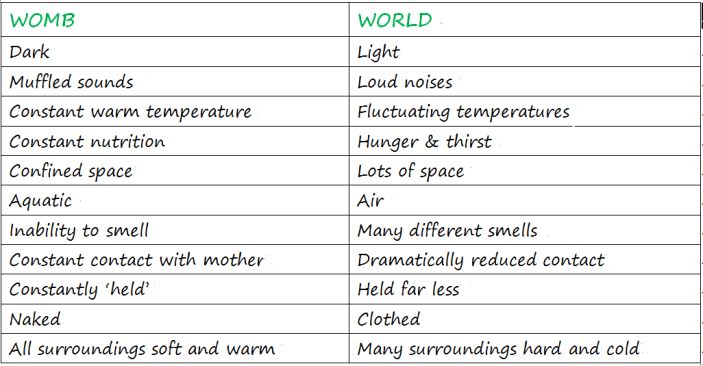
So lets quickly compare the two different ‘worlds’ your baby has lived in:

Image

Pretty different huh? On top of this the big thing to understand is that in utero the baby’s world was constant, each day was the same, the stimulation didn’t change, but now they are born each day is different – ever changing,  ever stimulating!

The concept of the fourth trimester helps us to understand the transition a newborn must make over their first few weeks earthside and once we understand we find so many ways we can help – but to me the most important facet of the fourth trimester is parental understanding and empathy, once that exists everything else will flow naturally.

Here are some common newborn calming techniques that tend to work quite well, but remember each and every baby is different, if you don’t already know, you will soon learn what your baby likes best and that’s what matters, that it is unique to *your* baby. Prescriptive ‘do this/don’t do this’ baby calming lists don’t help anybody – because they forget they are dealing with individuals – both parents and babies! Some things on this list will be inappropriate for you and your baby, some simply won’t work, some you won’t like – and that’s OK! because really it isn’t about these tips it’s about you and your baby getting to know each other!

Movement

The womb is a constantly moving space, Braxton Hicks would squeeze your baby at the end of pregnancy and each time you moves your baby was wobbled around inside. Imagine how walking upstairs feels for a baby in utero! Babies tend to love movement but so often we put them down somewhere completely still. You could try dancing, swaying from side to side, going for an exaggerated quick walk or bumpy car ride.

Skin to Skin Contact

Such a brilliant baby calmer! Being in contact with your warm, naturally (un)scented, skin is heaven for a baby, it helps to stabilise their body temperature, heart rate and stress hormones and stimulates the release of oxytocin – the love and bonding hormone – in you both. Topless cuddles, shared baths, baby massage and bedsharing are all great skin to skin experiences for your baby and you.

Bed-Sharing

Sharing a bed with your baby is an amazing way of getting more sleep for everyone, babies are generally much calmer and sleep more easily if they sleep with you in your bed, yet it is such a taboo topic and although 60% of parents will share a bed with their baby at some point it’s a subject that makes society very uncomfortable, but…it is an *amazing* baby calmer!  It’s really important that you think about how bedsharing will work and follow some important safety guidelines HERE.

For more on bedsharing and other ways to improve your newborn’s sleep, watch my free webinar here:

Swaddling

Imagine how snug your baby was at the very end of your pregnancy inside of you – now imagine how strange it must feel to them after they have been born and have so much space around them! The absolutely best thing you can do is to envelop your baby in your arms, but for times when you don’t want to or indeed can’t then swaddling is an option. Swaddling is becoming increasingly popular, however there are important safety guidelines to be followed if you choose to swaddle your baby, if you are breastfeeding please make sure feeding is established before swaddling and take care not to miss your baby’s hunger cues if you are feeding on demand:

  •  Never swaddle over your baby’s head or near his face
  • Never swaddle your baby if he is ill or has a fever
  • Make sure your baby does not overheat and only swaddle with a breathable/thin fabric
  • Only swaddle your baby until he can roll over**
  • Always place your baby to sleep on his back
  • Do not swaddle tightly across your baby’s chest
  • Do not swaddle tightly around your baby’s hips and legs, his legs should be free to “froggy up” into a typical newborn position.
  • Lastly start to swaddle as soon as possible, do not swaddle a 3 month old baby if he has not been swaddled before.

** The American Academy of Paediatrics recommends swaddling for babies 0-14wks.

Babywearing

Wearing your baby in a sling is one of the ultimate ways to keep them calm and happy. It increases the time a baby spends in a state of “quiet alertness” – a time of contentment when they learn the most. When a baby is in utero they spend 100% of their time in physical contact with us – yet the moment they are born this is estimated to drop to only 40%! Babywearing also means 2 free hands!

Choose your sling carefully. A good sling will be easy to use and will support both yours and your baby’s spine whilst not placing any pressure on your baby’s growing hips – newborns should always be carried facing inwards with a “frog leg” pose, not a crotch dangle pose so commonly used by commercial baby carriers. Also seek to carry in an ‘in arms’ position – i.e: how your baby would be held if you were holding them!

Babywearing is a great way for dads to bond with babies!

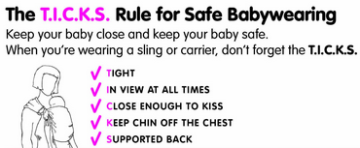
It is quite common for a baby to cry once placed in a sling, this does not mean that they hate the sling – it just means that you need to move, so get dancing! As with swaddling,babywearing is becoming increasingly popular, however there are important safety guidelines to be followed, the TICKS acronym below neatly sums them all up:

Image

Position

The “tiger in the tree” position below, taken from baby yoga, is often magical, stopping a crying baby in an instant!

Noise
Babies love sound, but for many not the sound you might think. For many babies a hoover is much more calming to a baby than a lullaby. A special white noise recording, such as THIS,  can be played on loop whilst your baby sleeps to help keep them calm.

Feed

If your baby is hungry nothing will calm him, so watch for his hunger cues. Feeding is always better if it is baby led, not led by a routine – whether you are breast or bottle feeding. Remember as well that your baby may not always be hungry for a full feed, they may want a quick drink, a quick snack or just some comfort sucking. Babies also find sucking the ultimate relaxation and comfort tool. Sucking helps a baby’s skull bones to return to their normal position after birth as well as providing them with comfort and security. If you are not breastfeeding you might find your baby will relax when given a dummy/pacifier.

Deep Bathing

The womb is a wet, warm place. The world as we know it is dry and cold! Sometimes a nice deep, warm bath can stop a baby’s tears in seconds – even better if mummy or daddy goes in the big bath with baby too as skin to skin contact is a wonderful baby calmer.

Outside

If all else fails many babies stop crying the minute they hit the open air – I’m not sure if this is because we are usually moving (e.g.: walking over cobbles with the buggy/ bouncing in a sling and the drone and movement of a car) or because of the change in air – but it works!

What have you found calms your newborn?

The NEWLY UPDATED Gentle Sleep Book – out now! If you would like to understand and learn how to improve your baby’s sleep WITHOUT cry-based conventional sleep training, this is the book for you!
sleepbook-1

Sarah

p.s: Come and chat with me on FacebookTwitter and Instagram 

Or watch my videos on YouTube

You can also sign up for my free parenting newsletter HERE.