I am often contacted by desperate parents in September or October who say “Help! My child has turned into a demon at home, but school say they are brilliant all day and behave really well, what have I done wrong?”.
The presumption here is that the parents must have done something wrong to cause the poor behaviour, because school aren’t having the same issue. In a sense they’re correct, the behaviour is because of something they’ve done, but not in the negative way they expect. This happens because parents have done everything right! When you make your child feel loved, safe, supported and respect with you, they feel comfortable enough to be their authentic selves with you, or in other words, they don’t have to pretend or ‘be good’ anymore. They have spent all day, at school, holding in frustration, fear, anxiety, anger and other uncomfortable emotions, because they know that it is “naughty” to let them out at school. When they get home to you however things are entirely different. There’s a massive release. Imagine your child at school and everything they have to deal with as being a bottle of fizzy drink. They have spent all day being shaken, building pressure, but have ‘been good’ and managed to keep their lid screwed on tightly. When they see you, the need to release is huge, pop, off comes the lid and the ensuing spray of all that has been bottled up inside. The technical term for this is restraint collapse, but I much prefer to think of that bottle finally releasing its pressure.
This is all a wonderful compliment of your parenting skills. If you hadn’t made your child feel secure enough to be authentic with you, when they were feeling happy and otherwise, then they would continue to bottle up the feelings and the release (and subsequent mess) would likely happen at school. Causing far more problems. Many children sadly get into the cycle of not being able to release to their parents, perhaps because their parents have raised them to not share how they feel with them through constant punishments and exclusions, or perhaps because the parents have been too busy, or absent, to listen. The result then is constant difficulty and poor behaviour at school, as they struggle to keep a lid on things and erratically explode, without the safe release of home.
What can you do about restraint collapse? Really, the best thing is to understand and accept it for what it is, a great testament to the hard work you have put into raising a child with good emotional intelligence and a strong bond with them. The effects wear off as children settle into school and things become easier for them, however you will see it time and again throughout the school years. When it happens again (after initially ceasing) you will know that they are struggling with something at school. Don’t take any explosions personally, they are definitely not acting this way because they hate you, it’s actually a bizarre way of them saying that they love you, lots. Instead, let your child know that it’s OK, you’re here for them and you’re big enough and mature enough to hold their difficult feelings as well as their happy ones.
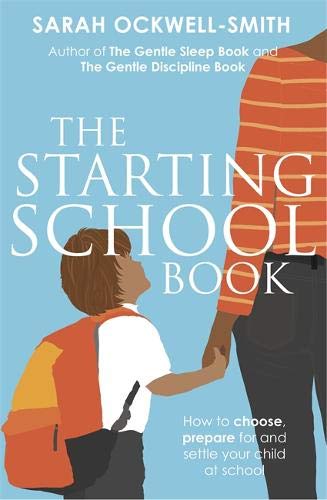
This is a small excerpt from my ‘The Starting School Book’ . You can order HERE in the UK and HERE in the rest of the world
Has your child started school? Or are they about to start? Read on for my top tips to help them settle:
Some children take the transition in their stride and settle in with very few bumps, others do better than you would ever have expected. Some children however really struggle with the transition. Anxiety, sadness, reluctance to leave you, angry behaviour and other other regressions are very common. More than many parents realise I think. These difficult reactions sometimes pass quickly, but often they can remain for several weeks and months after the initial start.
It is one of the most heart-breaking things in the world to watch your child struggling with their new place in the world. If you are certain that the school route is for you, here are ten tips that can help:
1. Allow Their Emotions Perhaps the most important thing you can do if your child is struggling is to allow them to feel what they are feeling. Don’t try to tell them to “stop crying”, say “you’re OK, you don’t need to be upset” or “you will be fine, don’t worry!”. These don’t help to reduce anxiety, but they do dismiss the child’s feelings, which can add to their upset. Instead say “you’re feeling really sad, would you like to talk about it?”, or “I can see you had a hard day at school, would you like a hug to help you to calm down?”. Allowing your child to express their emotions (which may also manifest as anger, whining and shouting, as well as sadness) is the healthiest response here. Make sure you don’t add to their feelings though. There is a difference between empathising and projecting your feelings onto the child!
2. Ease the Drop-Off School drop off can be incredibly stressful for new starters. The hustle and bustle, lots of bigger children, younger siblings and hundreds of parents can be overwhelming. Arranging with the school for your child to enter the classroom before the main rush begins, or arriving 10 minutes after everybody has left can make a huge difference. Similarly, sometimes drop-off is better if somebody else does it, allowing your child to say goodbye to you in the safety of home. They may be calmer when dropped off at school by a partner or friend.
3. Keep Your Own Anxieties in Check The time when your child starts school is a highly emotional stage for any parent. Try to not add to what your child is feeling by keeping your own nerves and sadness at bay. Anxiety is catching. If you’re really worried about your child, there is a high chance they will sense this and it will undermine their confidence. Try your hardest to stay calm and collected. Lots of deep breaths, positive affirmations and working through your own feelings, so that you can be a pillar of strength and confidence in your child.
4. Take off the Pressure at Home Now isn’t the time to push your child to tidy their room or their toys, or to pick up on every little misdemeanour. Cut them some slack. I’m not suggesting you become permissive, but relax your boundaries a little and let things slip for a couple of weeks while they settle in. Turn a blind eye to rudeness for a little while and allow home to be a place where your child is safe to relax. For the first couple of months after starting (or returning) to school, it’s common for behaviour at home to be tricky. This is your child’s way of discharging after a day of holding everything in at school. It’s a great compliment to your parenting skills! It means they feel totally safe to be authentic with you!
5. Be Their Champion Starting school can push many parents out of their comfort zones, because it often means you have to initiate conversations that you’d rather not have. This can be even harder for introverted parents. If your child is not being treated fairly, be that by staff or other children, they need you to stand up for them and be their champion. They need to know that you *always* have their back, however uncomfortable the conversation or meeting you may have to have is.
6. Give Them Practical Tools Separation can be really hard for some children. Giving them a tangible, physical, way to connect with you throughout the day can be really helpful. For instance, you could create matching friendship bracelets, or even just coloured wool/yarn tied simply. When you tie them on yourself and your child say “this bracelet connects us. Throughout the day when you are sad and miss me, you can touch it and know that a little piece of me is with you and I will do the same”. Another good idea is to create a little “magic spray” bottle. Using mini travel spray bottles filled with water, a drop or two of lavender and some edible glitter. Make up the bottle and tell your child that when they are feeling sad, or scared, they can spray a little bit of the liquid onto them and it will help them to calm down (obviously the teacher needs to be aware and may need to monitor usage!).
7. Watch Eating and Sleeping Starting school is a huge activity for little children. Making sure that they get enough sleep and enough food is so important. For some, this may mean that they need a little emergency nap when they get home from school (which may mean they need a slightly later bedtime to compensate), others may need their bedtime brought forward for a bit (which is a handy way to cope with the clock changes next month, when it ‘falls back’ to its regular time!). School also means the end to intuitive eating throughout the day, which many children struggle with. Snacks on the way home from school (not even waiting until you get home) can help, as can a snack after dinner, just as bedtime starts.
8. Meet With the School If things are still tricky after a few days, then ask to have a meeting with your child’s teacher. Explain what is happening and ask if they have any suggestions to help. Remember, teachers have dealt with this many times before and may have some ideas you haven’t thought of. They may also have a different view to you, for instance, some children are find once they are in the classroom, out of the sight of parents.
9. Consider Flexi Schooling Starting school full-time can be too much for some children, particularly those who are ‘summer-born’. Some schools will be happy to allow children to attend on a part-time basis for some time. My firstborn didn’t start full-time at school until the summer term. He went for mornings only until just before his fifth birthday, at my request.
10. Give it Time School starts can be tricky for several weeks. It’s a big transition for little people. Think back to when you started college, university or a new job. I doubt you felt totally calm, confident and settled for several weeks, if not months. The same is true for children starting school. It doesn’t mean that there is anything wrong if it takes 2, 3, 4, 5 or more weeks for your child to settle in. They all do things at different paces. In the interim, all of these points still apply. Usually it’s not until the October half-term that most children become more settled.
This is an extract from my ‘The Starting School Book’ – it’s for those starting to think about education choices for their children, applying for a place, and preparing children for starting school (and beyond). You can order a copy HERE in the UK and HERE for the rest of the world.
Many parents (particularly those who follow gentle parenting principles) struggle with the discipline policies at their child’s school, but what should you do if you find yourself in this position? The following is an excerpt from a section of my ‘The Starting School Book’ concerning this issue.
1. You have to come from a position of understanding the limitations faced by the school and the teachers. Remember to approach any discussions with them with the mutual respect, understanding, empathy, collaboration and open and honest communication we mentioned at the start of this chapter, however, keep your goals realistic. The school are not going to change their whole approach to discipline based on your discussion, but they may agree to look at one very small aspect of it. Here, pick your battles, go for the smallest section that bothers you the most, rather than trying to change the world.
2. Be your child’s advocate. Be prepared to stand up for your child and their rights, even when you feel uncomfortable doing do. Your child needs you to be their voice and in their corner. Always approach discussions with the school as a team with your child.
3. Your child’s class teacher should always be your first port of call. If you still have concerns after speaking with them the next step is to request a meeting with the deputy or head teacher. Of, if your concerns are about SEND (or potential ones), ask to meet with the schools SENCo. Make sure you write down your concerns before heading into the meeting and take notes while you are in there. You could also follow this meeting up with an email detailing the key points discussed, ask them to place a printout in your child’s file. Emails create paper trails that are much harder to ignore.
4. Consider joining your school’s board of governors. Sometimes it is easier to petition for change from the inside.
5. Consider how you can ameliorate any negative impact at home. Remember right at the start of this book, we discussed that you were and always will be, the most important influence on your child? Children are resilient and we can make them more so. If you focus on unconditional support at home and you act as your child’s sounding board and champion, then a few days on a sad cloud or red traffic light, and a handful of superficial certificates really will have a negligible effect. Discuss how a certificate made a child feel, ask if they felt proud and say “ah, we don’t need certificates to show that do we? It’s what we feel inside that matters the most and I’m *always* proud of you”. Teach them to feel pride in their efforts as well as their accomplishments and help them to realise that they are always safe to discharge their difficult emotions with you at home. You can also discuss why schools need to use behavioural control you don’t use at home, explaining to your child that because schools have so many children to care for they have to do things you don’t use or agree with at home.
Ultimately, you have very little control over how schools do things, but you have total control over how you do things at home and that is always far more important.
While I am happy to compromise on most school discipline, there are two forms that I cannot ever support. Attendance Awards and Clean Plate Certificates. Awarding children for having a high attendance at school (usually in the region of ninety-eight to one hundred percent) and thus punishing those children who do not have good attendance for whatever reason is a ludicrous and wicked scheme. Children have no control over whether they are sick, they have no control over whether their parents struggle for whatever reason to get them into school and they have no control over other issues that may prevent them attending. Effectively punishing a child who has a chronic health condition, requiring multiple medical appointments, one who has been unlucky enough to contract several infectious illnesses in a term, or one whose parents are separating, experiencing financial problems or health problems of there is mean and short-sighted. These schemes do far more harm than good and they should be stopped immediately. My firstborn has an autoimmune disorder meaning he regularly missed school for consultant appointments and because he was too sick to attend, thankfully these attendance schemes didn’t exist when he had just started school (though he was unfortunate enough to run into them as he progressed through school). If they had this would have been an issue that I would have raised immediately and taken as far as I needed to take it to be heard. It is discriminatory and highly damaging.
My other non-compromised form of school reward was stickers or certificates given for ‘eating well’ or clearing dinner plates. These awards encourage over-eating and non-mindful eating, which as children grow, can turn into severe eating disorders. My daughter once left school with an “I ate all my lunch up today” sticker and I immediately asked the school to never reward (or punish or chastise) her for her eating again. I don’t think they realised just how damaging one little sticker could be, because from that day onwards I didn’t see any other eating related stickers or certificates again.
My Starting School Book can be ordered HERE in the UK and HERE in the rest of the world.
I would say over 90% of the parenting dilemmas posed to me daily have one very simple answer; “you’re expecting too much of them”.
Our expectations of child behaviour are totally warped in society today. We just expect too much of kids (and no age or behaviour is immune). We expect them to sleep like adults. We expect them to control their impulses like adults, regulate their emotions like adults, manage their time like adults, observe social rules and niceties like adults and eat like adults (and as adults – our eating is totally screwed and unnatural, check out my ‘Gentle Eating Book’ for more). We expect them to consider the consequences of their actions like adults, communicate like adults and plan for the future like adults. If they can’t do these things we desperately try to ‘fix them’ and train and discipline them to do them (and frequently get frustrated when our efforts fail).
The thing is babies can’t do these things. Toddlers can’t do these things. School aged children can’t do these things. Teenagers can’t do these things – heck, even adults struggle to do these things a lot of the time! .
If you take just one piece of advice from me – please make it be to drop your expectations. Stop expecting mature adult behaviour from a child (and teens are still children!) who has a totally different brain structure to you. It’s a recipe for stress and disaster. You can’t teach a baby to drive a car. You wouldn’t even try……but that’s what happens when you try to teach or discipline children to do something that is beyond their development and age ability. Understanding and accepting normal, natural child development is the way forward. Reset those expectations and if you can, adapt life around them for a while. This is the key to calmer, happier family life.
Do you have a reluctant tooth-brusher? There are several reasons why young children don’t like having their teeth brushed, but the top three in my opinion are:
1. Because it makes them feel completely out of control (imagine how you would feel if somebody brushed your teeth for you?) 2. Because it disrupts what they would rather be doing/something that is way more fun 3. Because there is something about the sensation of it they dislike.
The answer then is to come up with a solution that mixes up all three. First reluctant children should always brush their own teeth, even if that only involves chewing on a toothbrush for a minute. The alternative here is to allow them to brush your teeth while you brush theirs. Taking turns to brush for 10 seconds or so.
Second don’t aim for a specific tooth brushing time and think outside of the bathroom. Tooth brushing while in the bath often works well, as does tooth brushing while watching a favourite video clip or reading a book. There are several great apps and youtube videos that encourage tooth brushing that work really well (I turn a blind-eye to the close the bed screen time this requires, it’s only for a couple of minutes and the positive for teeth outweigh the negative for melatonin inhibition). You can also turn it into a game and pretend you’re hunting for dinosaur bones or hidden treasure in their mouth.
Third investigate different types of toothbrushes, chewable rubber ones are often more successful, as are dental wipes. Some children are thrilled with an electric toothbrushtoo. Lastly swap out mint toothpaste for fruit ones, or other alternatives. As a grown adult I still HATE mint flavoured toothpaste with a passion, it’s a very strong flavour and knowing that young children have more sensitive taste buds than us, it makes sense to avoid anything very strong flavoured (Punch and Judy make a great strawberry flavoured toothpaste).
I’m often asked my opinion of talking to children about interactions with strangers and how I would best approach the topic. It may surprise you that I am really not a fan of the idea. Why?
* Most child abductions and abuse occur from somebody known to the child (family members, family friends or professionals known to the child). Warning children about ‘Stranger Danger’ somehow implies that they can implicitly trust all those close to them, when actually these people pose far more risk to the child.
* Strangers can play an important part in keeping a child safe. For instance, if they get lost in a shop, or run into trouble when they venture out alone for the first time.
* Following from the above point, those who children really need to trust to help them keep them safe are technically strangers – here, the most pertinent being Police Officers.
* Warning children of the danger of all strangers can cause unnecessary anxiety when children meet new adults.
Instead, I far prefer the terms “funny tummy people” or “tricky people”. Of these two terms “funny tummy people” is my favourite. While a young child could struggle to grasp the idea of a ‘tricky person’, most will understand the concept of something not feeling right and giving them a funny feeling in their tummy. Most importantly, these terms include ALL adults (and older children), not just strangers.
What should children know?:
* Who they can trust in an emergency (e.g: the emergency services, store security guards, a mother with young children etc..) * What to do if somebody makes them feel a funny tummy (how to say “stop!” and find and tell a trusted adult) * That they should never be made to have physical contact with somebody they don’t want – this also includes visits to Santa, never force a child to cuddle him for a photo opportunity if they are uncomfortable! (more HERE on respecting body autonomy in childhood) * The pants rule (click HERE) * When it is appropriate to speak with strangers (eg if they are in danger, or if you are with them) and when it is not. * How to call the emergency services * Teach them a password, in case you ever need somebody to collect them in an emergency. Make it short and easily memorable and tell them to never go with anybody (whoever they are, even if the child knows them well) unless they know the password. * That they can tell you ANYTHING that is worrying them, without fear of repercussion or ridicule (this is where Gentle Discipline is so important – if children are used to your support when they are experiencing tricky times, rather than being excluded from you as punishment – they may be more likely to confide in you).
I don’t think it’s ever too early to start these discussions with children. Particularly if you use age-appropriate props, such as cartoons and books to aid the discussions.
Are you just starting to think about choosing your child’s first school? Not sure what to look for, or what to ask when you visit? This article should help!
A lot of schools will run tours of the school by the oldest pupils. This can be off-putting to parents initially, who may prefer to be shown around by a staff member, however this is unique opportunity to find out about the school from some of the most important people the children themselves! Children tend to be brutally honest, whereas staff members will tend to be more diplomatic. Ask them questions and make full use of the opportunity! On your tour, ask to see lesser covered areas, such as the changing rooms or pupil toilets, the condition of these can give you a good indication of the school’s views. For instance, pupil toilets that are well kept (although they may be old) and brightly painted to appeal to children is usually the sign of a caring school.
A good open day will also allow you to speak with the headteacher and other teachers at the school, even better if you get to view a lesson in progress. Here, really observe how the teachers interact with the children and how the children respond. What they say and do to the children is of far more importance than what they say to you!
The following is a list of questions you may want to ask, both the teachers and children, at an open day:
*Do you enjoy working/going here? *What are you most proud of about your school? *What do you think the school could be better at? *Do you have any plans to improve certain things in the future? *What is the biggest challenge your school is facing at the moment? *How do you cope with difficult, or unwanted, behaviour from children? *What is your view on rewarding children for good behaviour, or for attendance? *What is your view on starting age for summer born children? *How do you help settle an anxious starter? *What do you do if a child is very upset at school? *How do you deal with friendship issues and bullying? *Do you have a peer mentor, or buddy scheme? (pairing older children with new starters) *What sport and physical activity do children do? *What are your school lunches like? Can I see a typical week’s menu? *How much time do children spend outside every day? How does this change as they get older? *How much time do children spend sitting still and learning? (e.g. at a table, or at a computer) *What is the school library like? *What does an average school day look like? *What opportunities are there for children who like art, music and drama? *What is your SEND and pastoral care provision like? *What do you offer for ‘gifted’ children, or high achievers? *What support do you provide for children who struggle academically? *What is your view on standard assessments? *What are the school values, or ethos? *What is the school’s opinion of homework? When does it get set, how much and what sort of thing? *What is your teacher retention rate like? How long have your current staff been here for? *Do you have an ‘open door policy’ if parents have any concerns? *Do you know how many siblings of current pupils will be applying this year? *How many children are in an average class? If this is a larger number, how do you make sure they each get the individual attention they need? *What clubs and extra-curricular activities do you run? *What do you think parents would say about the school? *What do you think pupils would say about the school? *Do you think your current official rating is a good reflection of the school? If not, why? *Does your school have an active PTA? *What opportunities do you have for parents to get involved with the school? *Do you offer school trips and visits? If so, can you let me know what they have been in the past?
Don’t feel embarrassed by asking too many questions, however if you are conscious of time, or of monopolising a tour, ask the headteacher if you can send them some questions to answer via email, or speak with them via the phone at a later date. Usually the response to this request is a pretty good indicator of the head’s attitude, however, do bear in mind that most are incredibly stretched and although they may want to spare you the time to answer all of your questions as thoroughly as possible, it may just not be possible.
Warning Signs to Spot on a School Visit School visits aren’t just about looking for the good points and asking the right questions, they also give an opportunity to raise alarm bells. There are certain things that you really don’t want to see, these include:
*Quiet classrooms – learning at infant and primary shouldn’t be quiet, that doesn’t mean it should be chaotic, but you should expect talking and laughter. If a classroom is quiet it may be an indication that the school are expecting too much compliance and age inappropriate behaviour from the children, it can also be a sign that they aren’t as engaged with their learning. *Few wall displays of children’s work – schools should be proud of the work of their pupils and want to display artwork and project work, even if it makes the walls look cluttered and non-colour-coordinated. Classrooms that lack in children’s work should raise alarm bells. *Unhappy children – this one goes without saying. Do the children look sad, or stressed? Or are they relaxed and smiling? *Stressed teachers – again, another obvious point. Do teachers generally look happy at work? Or do they appear very tense? Or shouty? *No mess – learning isn’t neat and tidy. A classroom where everything is put away and looks pristine raises suspicion. You don’t want utter devastation, but somewhere in Between shows a good balance *Lack of outdoor play spaces or equipment – outdoors is where children relax, what does the school offer them? *Children being disrespectful to each other – what is the general feel of the school? Are children polite to each other as well as teachers? Do they hold doors open for each other, or help when another drops something or falls over? A lack of compassion towards each other is often indicative of a lack of compassion and respect towards children.
If your child is starting school soon and you would like to learn how to choose the best school, how to prepare them (and you), or know how to settle your child into their school, then my new ‘The Starting School’ book will be perfect for you! You can learn more and order HERE in the UK or HERE in the rest of the world.
I’m often contacted by parents who are worried that their children (usually toddlers) wake seemingly inconsolable after sleep, usually naps. They describe children who won’t settle (even for their usual fail-safes), can’t be reasoned with and seem in great discomfort. This crying lasts anything from a couple of minutes, to ten or twenty minutes, or more.
This pattern is characteristic of a condition known as Confusional Arousal disorder. In adults, this parasomnia (a disorder that commonly affects falling asleep, waking up, or the period during sleep) usually manifests as slurred or slow speech, forgetfulness and generalised confusion (or what some may term as ‘sleep drunk’) and affects around 2.9% of people. In young children however the incidence is much higher at 17.3%, manifesting almost always as intense crying, although sometimes it can be continued subdued sobbing or whining. Confusional Arousal is more common if the individual is woken from sleep (ie parents wake the child from a nap), rather than the sleep cycle naturally concluding, however this is not always the case. The best way to view them is like an electrical blip in the brain, where the individual is jolted out of sleep too quickly and therefore becomes severely disorientated, with their body and mind taking a while to catch on to the fact they are now awake.
Although these episodes can be incredibly scary (and hard to handle as parents), the good news is they are not harmful to the child and are usually outgrown naturally by around the age of five years. As with other parasomnias (such as sleep walking or night terrors), there is often a genetic link and children who are affected will often have a parent who used to experience the same (or another parasomnia) as a child.
What can you do to help a child who suffers from Confusional Arousal? Ultimately this is a case of waiting for the child to outgrow the disorder (and keeping them as comfortable and safe as possible during an episode), until then, the following may be helpful:
Make sure the bedroom (or room they nap in) is not too hot, or too cold. In general the ideal temperature to keep a bedroom at night is around 16-18 centigrade.
Keep artificial light out of the bedroom at night (if you use a nightlight, make sure you only use one that utilises light on the red colour spectrum).
Try to avoid waking your child from naps if they suffer from Confusional Arousals.
Try to avoid your child becoming overtired.
Consider their intake of Omega 3 fatty acids (a limited amount of research has shown a link between deficiency and parasomnias in children).
Ultimately though, be ready to reassure them and offer as much physical contact as the child wants, to help them to calm down when they wake properly.
This is an extract from my NEWLY UPDATED Gentle Sleep Book – out now! If you would like to understand and learn how to improve your baby, toddler, or pre-schooler’s sleep WITHOUT cry-based conventional sleep training, this is the book for you!
I’m often contacted by people who, having read my Gentle Eating Book, ask me if I really set absolutely no limits on the junk food my children eat. I think they presume that they eat only sweets/candy and chocolate all day long and that my house is reminiscent of some sort of Willy Wonka’esque never ending sugar factory.
To answer this, I need to do a quick recap of the main ideas in my Gentle Eating Book. I’m not adding the research in here as 1. it’s all referenced in the book should you want to read it and 2. I’m writing this newsletter with zero time while our dinner cooks and don’t have time to dig them all out! Anyway – the main ideas behind so called ‘treat’ food are:
1. Labeling palatable food as ‘treats’, ‘sometimes foods’, ‘unhealthy’, or something similar can in itself make a child more likely to crave them as they get older. When we anthropomorphise something (ie give it a personality) it greatly impacts on how we interact with it. 2. Restricting palatable foods (by palatable I mean predominantly refined sugar) is shown consistently to be a large risk factor in the child being unable to self-regulate it later in life. ie: if sugary foods/junk foods are banned, or overly restricted, early in childhood, the child is more likely to struggle to regulate them as they grow and gain independence surrounding what they can eat and when. This dis-regulation often results in overeating and bingeing on the previously forbidden items in the teen and young adult years, which can and does impact on weight gain. 3. Children are able to self-regulate their food intake if adults don’t interfere with our learned beliefs and eating behaviours. Even refined sugar (and no – it’s not addictive! despite what you may read online, or in certain books, similarly it doesn’t make children hyperactive, or cause problems with sleep!). The key here is to look at what they eat in total over the course of a week, not analyse it hour by hour or day by day.
So – what does this look like in reality?
In our house, I order our groceries online and get a delivery that is to last us for between 7-10 days. I meal plan, so we have no wastage. What gets delivered I know will be gone by the time the next order arrives. Each week I order what many people would term ‘junk food’, or ‘treats’ (I just call them ‘food’): small chocolate bars, biscuits, crisps, fromage frais or chocolate desert pots and choc ices or ice pops usually. It usually works out so that there is enough for 1 chocolate bar, 1 packet of crisps and 1 desert option per day, per child. Plus a couple of biscuits per day, per child. These all go into our pantry or fridge/freezer and once they are delivered I have zero control over them. My control is what I buy and bring into the house. The children are allowed to self-regulate their eating of them. If they choose to eat loads the day the shopping arrives, then they have none for the next 7 days. If they eat them slowly they can have a feast the day before the new shopping arrives. If one child eats their own and their siblings’ food, well then they all have to figure it out themselves, because I don’t get involved in small sibling squabbles (I should add a caveat they are all tweens/teens, I would get involved if they were younger). Mostly, they take their allocation of food that doesn’t have to be refrigerated and keep it in their bedroom (personally, I hide my chocolate at the bottom of the vegetable drawer!). If they chose to eat chocolate for breakfast, then so be it (they invariably eat ‘proper’ breakfast 30 minutes later).
They are each free to spend their pocket money as they would like. If that’s all on sweets/candy, then so be it (it rarely is by the way, usually only when they have a sleepover or go into town with a friend and visit the sweet shop), because once I give that money to them I don’t believe I should have control of it (more HERE). If we’re out and about and they ask for a cake, or an ice cream, I will buy one if I have enough cash on me (they tend to only ask for sandwiches, sushi or cooked pasta pots though).
When it comes to Halloween, they do go trick or treating and come back with impressive hauls. I let them eat this haul with almost zero restrictions (when they were younger I used to take out the gluten containing items for my coeliac son and I won’t let them eat gumballs , bubble gum, or toxic waste type sweets – that’s a brand name by the way, google it – it’s disgusting!). If they want to eat all of it for dinner, then so be it. Usually I end up throwing away discarded sweets/candy a couple of weeks after Halloween when they’ve got bored of them, in fact it only takes a couple of days for the boredom to set in. I often find Christmas chocolate in the summer and uneaten Easter Eggs in the Autumn/Fall.
The only other way I get involved with their eating of ‘junk’, is by asking them to check in on their bodies if they’re hungry and want to eat. They tend to come home from school ravenous and want to eat immediately. My daughter in particular will grab the quickest thing, which is usually the biscuit tin. If I see her going for it I will ask “are you hungry? if you are, then some cereal or toast would probably fill you up more”. Sometimes she opts for cereal, other times she opts for the biscuits, but I make sure I have no further involvement in her choice, aside from getting her to think about why she is eating.
Is my approach perfect? Of course not, what is? Although, what I can see is that (so far) none of my children have the terrible relationship with ‘junk food’ that I had as a teen (and still do). My mother heavily restricted refined sugar when I was a child, junk food was a special treat only. I didn’t know any better until I got a little older and saw my friends had biscuits, cakes and soda streams in their homes. I would gorge on iced party rings and sweets at parties and when I went to secondary school I would often spend my dinner money solely on cake. I hope I’m raising my children to be different!
You can read more about the psychology of eating in childhood – and what the science says about raising children to have a healthy relationship with food in my Gentle Eating Book. available HERE in the UK and HERE in the rest of the world.
I came across this quote recently and it really spoke to me. Of course, this isn’t only true for women, but men too. I think it’s highly applicable to parenting.
Sometimes I think we’re our own worst enemies when it comes to parenting. Yes, it is wonderful when we set the bar high and aim to be the very best parent we can be, but it can also be incredibly damaging. I come across far too many parents who confess their guilt to me. They worry that they make too many mistakes, yell too much, don’t find joy in every moment, wish the days and nights away, regret having children, utilise screens too much, don’t play enough, didn’t breastfeed long enough, don’t feed their children totally wholesome food and so on….you name it, I’ve heard a related guilt confession. In fact I’ve never come across a group of people who are harder on themselves than those practising gentle parenting.
Yes, introspection and awareness of our flaws is a really important part of gentle parenting, but too many people let it get in the way, because they treat themselves so poorly. The irony that gentle parenting highlights children should be treated fairly, with empathy and respect is not lost on me when I think about how heavy some parents are on themselves.
I have made parenting choices that I am not proud of now and I would not make again if I knew then what I know now. I’ve also slipped up, many times, ‘in the moment’ and said and done things I regret. Everyone has, but I welcome my guilt for it teaches me to be a better parent. When we know better we do better. Life is about living in the now, parenting is about living in the now, not dwelling on what happened yesterday. If you don’t feel you have enough patience today, that’s OK, because tomorrow is a new day and everybody can change!
If you’re up for it, I’d like you to try something. For the next 7 days I’d like you to pay close attention to your thoughts. Every time you catch yourself feeling negative about your traits and parenting related qualities, I’d like you to stop and correct yourself. Remind yourself that you’re learning, you are doing your best and that you can – and will – be better with practice and a little self-directed empathy. Cut yourself a break, try to direct some of the nurturing you are constantly aiming at your children at yourself instead. If you’re an affirmations type of person, try repeating some of these to yourself when you feel most in need:
“I am still learning and I am doing the best I can”
“I am a great mum/dad”
“I can do this”
“Today is a new day, what happened yesterday is in the past, it’s time to move on”
“I am good enough as I am”
“Perfect doesn’t exist, real does”
“Today I will be kind to myself”
“It’s OK if I don’t know all the answers”
“We are learning together”
“All parents have bad days, some just hide them better than others”
“It’s OK to focus on my own emotional wellbeing”
You must be logged in to post a comment.