The Secret Way to Achieve a Calmer and Easier Toddler Bedtime

Are you struggling with getting your toddler or preschooler to bed? Bedtime resistance is common in the toddler and preschooler years and what was once an easy bedtime can often stretch out to hours. Similarly night waking may resurface (or not improve as expected). There are many reasons for disturbed bedtimes and waking (see HERE for more), however the bedtime routine and what happens immediately before it is key in my opinion.

Toddlerhood and the preschool years often mean that children are more likely to be separated from their parents in the daytime. Even if one or both parents stay home from work, children often attend nursery/kindergarten. Similarly, the arrival of a new sibling often means that older children don’t get to spend the 1-2-1 time with their parents that they need during the daytime. This separation, lack of 1-2-1 and need to reconnect in the evenings can – and often does – play havoc with bedtime. It’s not just bedtime that can be negatively affected though, night waking may increase (because the child needs the parent more in the night when they wake).

So, what can you do to help?

My answer is to schedule in re-connection playtime every evening, between dinner and bedtime. I know many working parents will read that sentence and say “but I don’t have time for that, it’s too late – and I need adult time!”. The thing is, if what you’re doing now isn’t working then you need to make a change. A delayed bedtime allows time for re-connection which means an easier, quicker bedtime and often less night-waking. A trade-off you may consider worth it. Ideally this re-connection time lasts for an hour and that hour is spent fully engaged playing with the child. For the first forty-five minutes of the re-connection time, make play as loud, crazy and busy as possible. Lots of running around, lots of rough-housing, lots of being really silly. In the summer, this is great spent outside, in the garden/yard or park. Think of it as having a puppy who needs to get their energy out ready to be crated for the night. A toddler and preschooler is no different, except that to them play spells connection too. The only proviso here is that the child needs to lead the play as much as possible and that screens don’t feature at all (so no TV, tablets or smart phones). After 45 minutes, slow the play down and come inside, into your main living area. Now it’s time for 15 minutes of quiet time. Reading books, drawing, puzzles and so on – once again, no screens. This is time that needs to ideally be spent sitting and as still as possible, because it’s preparing the child for bedtime. Once the final 15 minutes of calm play is up, it signals that bedtime is shortly about to begin. Just before bedtime begins though, I recommend a quick bedtime snack. My snack of choice is wholewheat (brown) toast with almond butter, or porridge/oatmeal with sliced bananas (these snacks contain good levels of tryptophan and magnesium, needed for sleep).

Once snack time is over, it’s time for bedtime to begin. Here, my only proviso is that once bedtime starts, you don’t go back to the main living area again, you only go to the bathroom and the room your child sleeps in. Nowhere else. This is a firm boundary (see HERE for setting and upholding boundaries in a gentle but effective way).

Let’s look at a quick run-down of what a typical evening might look like. I’ve based this on a bedtime (sleep onset) of 8:15pm, which research shows is a good physiological match for toddlers and preschoolers. Obviously timings won’t be as exact as they are here, and you may need to juggle times to work for you, especially if you work, so this is just a rough idea:

 
  • 5:30-6:00pm: Dinner/tea time
  • 6:00-6:45pm: Crazy and loud active play (no screens)
  • 6:45-7:00pm: Calmer, quiet play (no screens)
  • 7:00-7:25pm; Bedtime snack
  • 7:25pm: Prepare bedroom for sleep
  • 7:30-7:40pm: Bathtime
  • 7:40-7:50pm: Into PJs etc..
  • 7:50pm: Story, milk, cuddles
  • 8:00-8:15pm: Sleep onset
The combination of re-connection time, a physiologically appropriate bedtime, bedtime snack and consistent bedtime routine can really help sleep, not just in terms of taking the stress out of bedtime, but also in reducing night waking too.
 
The NEWLY UPDATED Gentle Sleep Book – out now! If you would like to understand and learn how to improve your toddler, or pre-schooler’s sleep WITHOUT cry-based conventional sleep training, this is the book for you!
sleepbook-1

Sarah

p.s: Come and chat with me on FacebookTwitter and Instagram 

Or watch my videos on YouTube

You can also sign up for my free parenting newsletter HERE.

How to Get a Baby to Take a Lovey or Comfort Object

Are you trying to get your baby to take to a comfort object?

For the first few years of life babies take comfort predominantly from one thing, or should I say one person – their mother. This isn’t a reflection of their love for their mother being greater than their father. Simply they have spent nine months growing inside her and in the case of breastfed babies, a significant period of time receiving nourishment from her post birth. To a baby their mum is their home. They know her inside and out. As they grow, their bonds with other family members will increase, but in the early days it is natural that they need to be close to their mother whenever they are scared, overwhelmed or overstimulated. Some people incorrectly say “the baby is using you as a dummy/pacifier”, or “they have developed a bad habit of always needing to be held or fed to sleep”. The reality is though, that dummies and pacifiers are a replacement for the real deal, not vice versa.

The best thing a mother can do is to allow her baby to snuggle and feed as often as they need. Often though this is not possible. Returning to work or even just needing a couple of hours ‘me time’ necessitate that babies sometimes need other things that comfort them too. When it comes to sleep, if the baby has an object which they strongly associate with their mother they may transition between sleep cycles independently, feeling as if they have a piece of their mum/mom with them.

Despite what many manufacturers claim, there are no magic toys or loveys. It is not the object itself that is important, but what you do with it. That said, my best tips for choosing a comfort object are to get something that is fairly flat (you’ll see why in a minute!) and made up of very soft fabric, preferably with a contrasting fabric from a sensory perspective. For older babies and toddlers I love a baby blanket made out of fur or ‘minky’ fabric and edged in thick satin ribbon (like THIS) and for younger babies something flattish in a very soft fabric with a few tags, or ears made from a different fabric (like THIS).

Condition the object as follows:

1. Every time you feed and cuddle the baby put the comfort object between you and them (now you’ll see why I recommend something fairly flat!).
2. Show the object lots of love yourself, comment on how soft it is, stroke it and say how calm it helps you to feel.
3. If your baby throws or pushes the object away simply calmly put it back (repeatedly).
4. At nap time and bedtime snuggle the comfort object next to the baby while they are going to sleep (for under 12 month olds remove when they are asleep).
5. For older babies and toddlers (over 12 months) make sure that they have free access to the object all night, for younger babies just while you are present to supervise.
6. For babies in daycare, make sure the comfort object is always with them as needed during the day.
7. Consider buying two – it’s not fun if you lose it!

Expect a period of around 4 to 6 weeks of doing this daily before your baby forms a connection with their comfort object. Remember, they aren’t magic. It takes time for them to associate them with you. Around two thirds of babies will eventually form a good bond with a comfort object, often for many years to come.

The NEWLY UPDATED Gentle Sleep Book – out now! If you would like to understand and learn how to improve your baby, toddler, or pre-schooler’s sleep WITHOUT cry-based conventional sleep training, this is the book for you!
sleepbook-1

Sarah

p.s: Come and chat with me on FacebookTwitter and Instagram 

Or watch my videos on YouTube

You can also sign up for my free parenting newsletter HERE.

What to Do When You Feel Like Sleep Training Your Baby

Feeling close to giving up & sleep training your baby?

The first thing I want to say is that at some moment ALL parents have, or will feel, how you do right now. I definitely have, more than once (in fact more than that!). There is absolutely nothing wrong in feeling that you “just can’t do this anymore”. There is nothing wrong in feeling resentment towards your partner, your friends whose babies ‘sleep through’ and even your baby. There is nothing wrong in having a good old moan about how exhausted you feel. Parenting is tough, really, really tough. Although each age brings its own challenges, the first two years are definitely the hardest on you physically. It’s ironic that the hardest physical work comes at a point when your body is still trying to recover from carrying and birthing your baby, the time when you need rest the most.

I know too well how tempting it is to follow the magic sleep plan your friend with the perfect sleeping baby has followed. I know what it feels like to second, third and fourth guess your choices. Your parenting style is meant to make your baby MORE confident, but she’s only becoming clingier. What did you do wrong to create such a needy and anxious little boy? The answer is – absolutely nothing. NOTHING you have done has created a ‘bad sleeper’. In fact I would wager that your baby actually isn’t ‘a bad sleeper’ even though it sure does feel like it. Hundreds of thousands of babies around the world have been trained to sleep abnormally, these are the unusual ones – not yours. One day your hard work will pay dividends, but frustratingly that day isn’t here yet.

So, what can you do when you feel at the end of your tether?

1. You MUST start here. You are exhausted. You MUST find some way to rest. Right now, if you are at rock bottom it is better for your baby to some time with somebody who cares for them (even though they may not settle well for them) while you recuperate, than to have a drained and barely functioning mother. Tanking up on a night’s sleep, or sleeping in the day while your partner/mum/sister/friend takes the baby (preferably out of ear shot so you don’t hear any crying) is so important. When you have had some sleep, even just for one night, everything will seem different.

2. You MUST start practising daily self care of some form. This looks different for everybody – it could be joining a singing group, a running group, a knitting group, a salsa class, a yoga class, a book club – something involving adults where you can be your pre-baby you. In addition take long baths or indulgent showers, eat well, meditate or try mindfulness, go to bed as early as possible. Get a massage, get a pedicure, get some reiki or reflexology – whatever floats your boat.

3. Make sure you are not adding to your exhaustion due to postnatal depletion. Many new mothers are lacking in Vitamin D, Zinc, Magnesium, Vitamin B12 and Iron. If you’re lacking in these you’re going to feel even more run down and even more tired. I’m firmly of the opinion that ALL new mothers should supplement B12, Magnesium and Vitamin D (for all I use sprays made by Better You). Tablets are really not well absorbed by the body and if you’re deficient a multi-vitamin will not be sufficient.

4. Check your own anxiety levels. Many (most?) new mothers have high levels of anxiety, especially first timers. Birth trauma, difficulty transitioning to motherhood – perhaps after an unplanned pregnancy, a long wait and fertility issues, giving up a job where you were in control, or relationship issues can all play havoc with our emotions. Research shows that maternal anxiety plays a big role in infant sleep and can make babies wake more. In addition anxiety can make you second guess your choices and decisions and make you feel less sure of them which can lead to a lack of continuity and consistency – something else that affects sleep. Speaking with your GP, a helpline, a counsellor or a local support group can really help.

5. Remind yourself why you are parenting in this way. What messages do you want to send your baby? What are your long term hopes? How would sleep training fit with this? How would you feel if you sleep trained tomorrow, but in 6 months time your baby was sleeping no differently than if you hadn’t sleep trained at all? One of the downsides of sleep training is that results are not long lasting. Even pro sleeping training research admits there are no permanent positive effects!

6. There are ways in which you can help your child to get more sleep gently. These mostly involve looking at their sleeping environment, their daytime routine, their bedtime routine, their diet and any potential physical issues. I run regular baby and todlder sleep (without tears!) webinars – details HERE. I also offer limited bespoke support via email for those who need a little more support. If you really MUST do something now, you don’t have to resort to CIO, controlled crying, pick up put down or gradual retreat!

The NEWLY UPDATED Gentle Sleep Book – out now! If you would like to understand and learn how to improve your baby, toddler, or pre-schooler’s sleep WITHOUT cry-based conventional sleep training, this is the book for you!
sleepbook-1

Sarah

p.s: Come and chat with me on FacebookTwitter and Instagram 

Or watch my videos on YouTube

You can also sign up for my free parenting newsletter HERE.

How to Stop Rocking Your Baby to Sleep

Do you want to stop rocking your baby to sleep?

Rocking is often a fail safe way to get babies off to sleep and certainly not something I would ever recommend avoiding. Many view rocking as a negative ‘sleep prop’ or an ‘unhealthy habit’, however I don’t agree. Babies need to feel safe and secure and they need our help to calm them to a level where it is easy to fall asleep. The close contact and movement of rocking meets all of these needs. In time all babies will grow out of the need for rocking, the question is whether they outgrow this need before they become too big and heavy for the parent to rock. If you can still rock your two year old to sleep there is absolutely nothing wrong with continuing to do so, it is very unlikely that it will affect their night time sleep negatively, despite what others may tell you. If you do want to reduce the rocking however read on for my three step plan:

1. Step number one is to introduce other calming methods alongside the rocking so that the baby associates them with rocking. Here I would suggest calm, rhythmical music, such as my Gentle Sleep Music, a calming scent in the room, such as lavender, and using a small very soft and sensory blanket to hold around or against the baby. I would also softly speak key words repeatedly while rocking (e.g “close your eyes little sleepyhead, it’s time for sleep and time for bed”) or you could read a short rhythmical storybook if you can read one handed. These should be used for a minimum of two weeks, whilst rocking as usual. Read THIS for more on crying.

2. Step number two is to keep a log of roughly how long you rock for over the two weeks when you are introducing new calming methods. Keep a log of how many minutes you rock for each night and calculate an average over the two weeks.

3. Step number two starts after two weeks. On the first night you should rock for two minutes less than the average you calculated in point two, this is repeated each night adding another two minutes. For instance if you calculated your average rocking time to be ten minutes you would rock for 8 minutes on the first night, 6 on the second, 4 on the third and so on. At the end of the rocking time if your baby is still awake then continue to hold them but don’t rock (or move in any other way). This applies whether you are sitting in a rocking/nursing chair or are standing and rocking in your arms. If your baby cries (which they probably will) continue to hold them and comfort them in any other way other than rocking (or moving in another way) once the rocking time is up.

After a week of point 3 (which is 3 weeks since you first started) you are aiming to reach a stage of just holding your baby to sleep with no movement. If you want to move on past this point and wean off of holding to sleep altogether I would recommend that you adopt a floor bed or co-sleeper set up where you can lay down and cuddle the baby to sleep and then move away when they are asleep.

The NEWLY UPDATED Gentle Sleep Book – out now! If you would like to understand and learn how to improve your baby, toddler, or pre-schooler’s sleep WITHOUT cry-based conventional sleep training, this is the book for you!
sleepbook-1

Sarah

p.s: Come and chat with me on FacebookTwitter and Instagram 

Or watch my videos on YouTube

You can also sign up for my free parenting newsletter HERE.

Why Your Child Needs Boundaries – and How to Set & Enforce Them


There is a pervasive myth that Gentle Parenting is permissive – because it allows children to “get away with anything”, doesn’t discipline, doesn’t have any rules, never says “no” and doesn’t uphold any boundaries. All of these beliefs are wrong (see more of them HERE). Boundaries play a crucial role in Gentle Parenting, in fact, so much so they really do form one of its cornerstones. I think the difficulty in understanding, comes from those who don’t really ‘get’ this style of parenting and also from those who practice it, but are a bit too scared to set and particularly enforce boundaries.

Why Are Boundaries Important?
Simply put, they help kids to feel safe and secure, by knowing – clearly – what is expected of them. As much as we may like to think we’re ‘rule-breakers’, it’s rare that people do well without any instruction at all. Boundaries are in essence the blueprint of behaviour for kids to follow – if they know what’s expected of them, it’s much easier for them to behave in ways that adults would prefer. To add to this, boundaries keep kids safe (our own children as well as other people’s children), it keeps the environment safe (by reducing breakages and damages) and it helps kids to grow up to be kind, respectful individuals who are capable of forging good relationships with others and functioning in the ‘adult world’.

What Boundaries Should You Have?
That’s entirely up to you. There will be some obvious basics that all families share – those that involve safety (“no running into the road”, “no going off with strangers”, “no playing with fire”, “no hitting/biting/kicking others” etc..). Then there will be others that are more unique to your own beliefs, albeit some may be commonly shared with other families (“no shoes inside”, “no jumping on the sofa/bed”, “no painting without covering the table/floor first” etc.). What you choose is entirely up to you. Some parents have no issue with jumping on beds or sofas, so that’s a boundary they wouldn’t need to set, for others it really matters – so they would set that boundary. That’s the beauty with boundaries – they really are flexible. You simply choose what’s *really* important to you. My only proviso is that non-safety related boundaries need to be really mindfully set (ask yourself WHY am I feeling the need to set this boundary?) and the number kept to a realistic minimum. A home with way too many boundaries (aka Authoritarian parenting) is in many ways worse than a home with barely any boundaries (aka Permissive parenting). Gentle parenting tries to strike a balance with boundaries – not too many, not too few. It also aims to keep them realistic based on the age of the children and their physical and psychological capabilities.

When Do You Discuss and Enforce Them?
Depending on the age of your children, once you have decided upon a boundary (and therefore set it), it’s a good idea to discuss the boundaries with them. Of course, if you have a baby or a toddler, this is a pretty pointless exercise, the chances are they won’t understand (although it gets you into a good habit of communicating with them, regardless of their understanding!), but if you have a 3, 4 or 5 year old (and definitely older) then discussing your boundaries when you set them is a great idea. Make this discussion appropriate to their age – for instance with a three year old, reading a story book about not hitting others is a great age appropriate way to help them to understand. If you have a seven year old, then sitting and discussing with them, watching some videos together – and even getting them involved in drawing a poster of ‘our family rules’ is probably the way to go.

When should you enforce them? Every time they are broken (or about to be broken). The thing with boundaries is that you must be consistent with them. if you’re inconsistent, it’s confusing for kids. They never know whether to test your boundary (ie break it) or not. All parents involved in the child’s care need to be on the same page too, inconsistency between adults, is just as confusing as one adult being consistent over time. If you find yourself being inconsistent with boundary enforcing, then it’s quite likely that you need to cut back on the number you have, and ask yourself that question again “why do I feel the need to set this boundary?”. Inconsistent enforcing is a huge cause of increasingly problematic behaviour.

How Do You Enforce Them?
This is the one where people get confused the most I find. Because a lot of people think it’s not gentle to make a child cry. That’s just not true. Most of the time it’s impossible to reinforce a boundary without making the child cry. Similarly, sometimes you’ve just got to say “NO!”. Saying “no” and making the child cry often go hand in hand with boundary enforcing. The gentle part comes in when you set the boundaries (mindful and considerate) and in what you do when you enforce them.

Here are two examples of boundary enforcing. In both cases the scenario – and the boundary broken – is the same. The child in your care has hit another child.

Scenario One
“(screaming) Stop it!! How DARE you hit another child, what have I told you?”, “Get over there now, stay there for five minutes and think about what you’ve done, you naughty little boy”…..(child eventually quietens)….”I’ve told you not to hit, why don’t you ever listen? Stop crying – what are you crying for? You were the one who hit, it was your fault! If I can’t trust you we won’t come to the park again”

Scenario Two
(loudly) “STOP! I won’t let you hit!” (moves in to physically move the child away as quickly as possible)….(after you have moved the child away) “Remember, we don’t hit – it hurts people!”….(child inevitably cries)…….(following cues from child – stay at the distance they prefer)…”let me know if you’d like me to help you calm down, I’m right here”…(when the child is calm/has stopped crying)..”do you remember when we read the book about not hitting? Why don’t we do it?”….”What could you have done instead of hitting if you were feeling angry?”

Hopefully you can tell the difference between the two. Scenario one is very authoritarian, yes, it upholds the boundary – but completely ignores the fact that children hit for a reason. The adult misses the cause of the behaviour and as a result, any resulting discipline is fairly ineffective. The child is left to deal with their upset alone and punished by being excluded from their carer – and then further punished by not being taken to the park again.

In scenario two – the boundary is enforced, but it’s done in a way that is considerate to the child, understands that there is always a reason behind ‘misbehaviour’, seeks to teach the child how to behave better and reconnects and supports the child while they cry.

In this scenario – ie your child hitting another, unless you distract from the hitting (before it happens) there is no way to enforce this boundary without making the child cry. Crying is not the problem – it’s what you do when the child cries that matters. The key is to stay calm, stay consistent, stay connected and once everyone is calm – and capable of listening – use the opportunity to communicate and reinforce not only why the boundary is important – but more appropriate ways to behave in the future – ie to allow learning and growth to happen – this is the true meaning of discipline! This is what makes reinforcing boundaries gentle, not the absence of crying.

For more on boundaries – including what to do when parents and carers clash on them, check out my Gentle Discipline book (in the UK/ROIUSACanada and Rest of the World).

Sarah

p.s: Come and chat with me on FacebookTwitter and Instagram 

Or watch my videos on YouTube

You can also sign up for my free parenting newsletter HERE.

When Good-Eater Babies Become Picky-Eater Toddlers.

Towards the end of babyhood, parents can often feel confident about their child’s eating. After any initial bumps in the weaning road, babies often take to eating solids with a gusto. It is common for parents to feel proud about their ‘good eater’, the babies with a good appetite who eat a large variety of food, but especially ones considered to be healthy.

By the time he had had his first birthday, my firstborn son was one of those ‘good eaters’. He would eat practically anything I put in front of him. I remember feeling particularly proud one evening when he ate a whole bowl of sardines, sweet potato and spinach for dinner. Cooking for him was a joy, I would spend hours steaming organic vegetables that we had delivered as part of a box scheme from a local farm, and he would reward me with gummy smiles of appreciation. I felt like a good mum. I felt like I had this eating thing sorted. I didn’t understand why so many parents complained about their child’s eating. In fact, I believed that they had brought the problems upon themselves, by not offering their child a good range of different tastes and textures and instead pandering to their children. Oh, how wrong I was.


Around two months after his first birthday, my ‘good eater’ son pretty much stopped eating. Foods he had previously wolfed down were left untouched, met with grimaces and tears. My easy baby with the good appetite was replaced with a tricky toddler who would only eat food if it was white, beige, yellow or brown, would only eat dry food (sauces were pushed away with disgust) and acted as if he was being poisoned if anything green went within an arm’s length of him. His appetite seemed to shrink in a reverse correlation with his growth. The bigger he got, the less he would eat. My baby with the hearty appetite and rolls of comforting fat was replaced by a skinny little boy with the appetite of a sparrow. I no longer felt like a good mum. In fact, I felt like a complete failure. Each day I felt as if I was failing my son, failing to keep him healthy, failing to provide him with the nutrients he needed to grow big and healthy.

Days out with friends, whose toddlers ate, became torture. Lunchtime would come and while their children ate whatever was put in front of them, my son would push a few raisins and a breadstick around his plate. The other mothers would try to placate me, “oh, I’m sure he’ll be fine, don’t worry”, but the more I tried not to worry, the more anxious and obsessed with his eating I became. I started to believe that he was doing it on purpose. I begged him to eat, I scolded him to eat, I bribed and rewarded him to eat, I spent hours trying to hide vegetables in food, I bought special cutlery with aeroplanes on and pretended to fly the spoon into his mouth, but nothing worked. He still didn’t eat.

I only wish I had known then what I know now. It would have saved me and perhaps more importantly, my son, months of anguish and stress. You see, my son was entirely normal. Now, he is a big burly teenager, scraping six foot tall. He eats like a horse, even green foods and foods with sauces! What did I do to produce this miraculous change in eating habits? How did I turn my non-eating toddler into a healthy teen with a voracious appetite? In truth, I didn’t do anything. In fact, it was when I stopped trying to change him that the change happened. I relaxed and accepted his eating. The most powerful thing I did was to educate myself about eating in early childhood. Once I understood his eating, or rather lack of it, I could relax, which was possibly the most powerful thing I did. I hope that, through this book, I can bring the same comfort and peace to you too………….
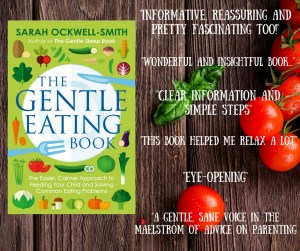
This GentleEating_CR_Draftis a small excerpt from my new Gentle Eating Book – out now! 

To order in the UK/ROI click HERE

To order in Australia and New Zealand click HERE

To order anywhere else in the world click HERE

Sarah

p.s: Come and chat with me on FacebookTwitter and Instagram 

Or watch my videos on YouTube

You can also sign up for my free parenting newsletter HERE.

Choosing Childcare: How to Choose a Setting In-Line With Your Parenting Beliefs

If you’re considering childcare options at the moment, it’s important to make sure that any potential providers are on the same wavelength as you. Ideally you will visit the setting at least twice before making your final choice. Seeing the provider ‘at work’ and observing how they interact with the children in their care is absolutely vital. In addition to this, a meeting arranged at a quiet time, perhaps after the children have gone home, will allow you time to talk and make sure that you get a chance to ask your questions without feeling rushed.

Preparing your list of questions in advance is vital. Write them down and take them with you to the meeting. If you run out of time to ask them all, ask the provider if you can send the rest over to them via email. Don’t feel embarrassed if your list is long, you are entrusting your most precious ‘possession’ in this person’s care!

The following questions are a good guide, decide which points matter to you and edit so that they fully cover your concerns.

Q: What are your beliefs surrounding ‘naughty behaviour’ in children?
Q: What would you do if my child hurt another child in your care?
Q: What would you do if another child in your care hurt my child?
Q: What would you do if my child didn’t listen to your request to do something?
Q: How would you help my child to feel happy and secure in your presence?
Q: What would you suggest is a good ‘settling in’ plan?
Q: What would you do if my child was still upset to leave me after this settling in work?
Q: My child is breastfed/cuddled/rocked (delete as appropriate) to sleep for naps. How will you settle   them?
Q: Do you have set nap times? Or are you happy to follow my child’s individual routine?
Q: Do you have set mealtimes? What if my child is hungry before the set eating times? What if my child is not hungry at a mealtime?
Q: What would you do if my child refused to eat the food that you offered to them?
Q: What are your views on screentime?
Q: What are your views on play? Do you have structured playtimes? Or will play be child directed (freeplay)?
Q: How much time do you spend outdoors? Can my child choose when to be indoors or outdoors?
Q: What would you do if my child was upset in your care?
Q: What would you do if my child was having a grumpy/uncooperative day?
Q: What are your views on praising children and rewarding them (with stickers etc.)?
Q: What are your views on potty training?

You can see some more points which parents agree are important to consider for daycare HERE.

Despite these questions, your instinct is undeniably the most important guide. How do you feel about the staff and their attitudes and approach? This is so much more important than the physical aspects of the setting – e.g: decor and provisions. Ask yourself “is my child going to feel nurtured here?”, “will my child’s time here be overwhelmingly positive?” and “do I have any niggles about this setting?”. These three questions are as important as any that you could ask a provider.

For more on selecting and using childcare, see my Gentle Parenting Book.

Sarah

p.s: Come and chat with me on FacebookTwitter and Instagram 

Or watch my videos on YouTube

You can also sign up for my free parenting newsletter HERE.

Whining Woes – Why Children Whine & How to Stop it.

Whining is an almost inevitable part of childhood. “ Mommeeeee, Daddeeeee . . .  pleeeeease . . .” or “But why? I don’t want to. I want you to do it” are almost guaranteed to be heard in your home at some  point—  more likely than not in a  high-  pitched, whiny voice that gets to you in the same way as nails being dragged on a chalkboard.

Why Do Children Whine?
Children whine for many different reasons; however, there are some that are fairly universal. Let’s take a look at some of the most common reasons for whining and how to reduce them, using a mindful and gentle approach to discipline.

Lack of Control 
Perhaps the top reason why a child whines is because they struggle for control over their daily lives and environments, and these are often expressions of their feelings of powerlessness. When children of any age feel powerless to control situations, whining is prevalent. They know that there is nothing they can do to control the situation, and so regular communication is pointless. Whining is almost an admission from the child that they have “lost,” even before negotiations begin, and are not happy with the outcome.

Lack of Communication Skills
For younger children, particularly toddlers and preschoolers, language acquisition is often not on a level with the emotions that they experience. If a child cannot vocalize how they are feeling, particularly if they are feeling bad, the chances are they will whine. Can you imagine how frustrating it must be to feel sad, angry, anxious, or tired and not be able to vocalize your needs to the people caring for you?

Lack of Emotion Regulation
The frontal cortex of the  brain—  responsible for helping children to form rational  conversations—  is not yet fully developed, which results in whining or dramatic displays of feelings, such as tantrums. The immature brain development also means that once they are behaving in this manner, they are almost incapable of stopping.

Feeling Overwhelmed
Children can feel overwhelmed for all sorts of reasons: at home they can feel overwhelmed by the requests you make of them; at school they can feel overwhelmed with the work they are expected to do and the organization required of them; in organized groups they can feel overwhelmed because of all the people around them; and in new environments they can feel overwhelmed by the sensory input. Feeling this way, particularly when they cannot control the situations they find themselves in, can leave children very prone to whining.

Being Overtired 
When a child of any age is  overtired—  whether from a lack of sleep the previous night because of focusing on exams, from running around a lot, or from spending full days at day  care—  behavior almost always regresses. When this happens they tend to resort to whining in particular. As adults, we struggle to control our emotions when we are exhausted, so it’s not surprising that the same is true of children.

Not Feeling Heard
As with most undesirable behavior, when a child feels a disconnect with their caregivers, whether they are parents, teachers, or day care workers, their behavior regresses. So if children don’t feel listened to, they can quickly resort to whining. Conventional wisdom says to ignore them and pay no attention to them when they whine. This is outdated advice, however, and is the worst thing you can do. Ignoring a child who is whining because they feel disconnected highlights the fact that you are not listening to them and increases their perceived lack of control over their life. Another common response to whining, namely, “I don’t understand what you’re saying, talk properly,” makes children feel chastised and that their feelings are being ignored. Once again, this only increases the problem and is likely to result in even more whining and sulking in the future.

How Do You Stop Whining?
Ultimately, time has the biggest impact. Whining tends to be outgrown as the child approaches adulthood, although I’m sure everyone knows an adult who still whines! In the meantime, there are several interventions that can ease the intensity and occurrences of whining  –  usually a combination is required.

Listen Intently
Connection almost always comes at the top of my list of recommendations for helping with undesirable behaviors. If your connection with your child is fractured for some reason, this should usually be your starting point. Take time to really listen to what your child is saying. Make eye contact when they speak, communicate with them at their level physically, and, whenever possible, make them the focus of your attention. When they speak to you, repeat back what they are saying: “OK, so you’re feeling really grumpy that we have to stay home and clean today, when you would like to go out.” Listening intently to what your child is saying or asking of you really helps to make them feel validated. Even if you cannot agree to their request, it can lessen the degree of whining hugely. Remember that even if what they are whining about may seem trivial to you, it is still really important in their world, so don’t be tempted to belittle their wishes or concerns. They may be whining about the colour of their cup, while you are worrying about paying the rent or the mortgage, but it matters to them just as much as your concerns matter to you. If your child has a habit of whining when they want your attention, but you are  busy—  especially when you are speaking to somebody in person or on the  telephone—  it is very important that you make them feel heard. Rather than ignoring them or saying, “Wait a minute, I’m busy,” excuse yourself from your conversation temporarily and say: “I hear you. You are getting bored waiting; I will do my best to finish up quickly.” You may have to repeat this a couple of times, but just showing that you understand that your child is bored can really help to give them a little more patience to wait.

Alternative Communication
For younger children who struggle with communicating their feelings verbally, using nonverbal methods can make a huge difference. For toddlers, learning some basic sign language can be a big breakthrough. Using emotion flashcards (laminated cards with pictures of different emotions and the words underneath) can prove insightful. The child can sort through the cards and show you how they are feeling, even when they are unable to communicate this to you verbally. Encouraging children to draw pictures of how they feel can be enlightening too. You can also make up a secret language between you, for your child to let you know when they are feeling overwhelmed. For instance, squeezing your hand could mean “I’m scared,” touching the top of your leg could mean “I’m bored,” and putting their head on your leg could mean “I’m sad.” These nonverbal forms of communication can be really helpful when you are out in public, especially if your child is expected to keep  quiet—  and the connection and security of being “heard” is well worth the trouble of establishing this special language.

More Autonomy
Helping children to feel that they have more power over their lives is one of the best ways to reduce whining and sulking. More autonomy doesn’t mean that you have to always let them do what they want—  far from it. You do, however, need to allow them to have as much control as possible, adapting as they grow older. When giving them more control, it is important to understand that it is not given through forced choices. Asking, “This or this?” does not give the child control.

More Downtime
When children are tired or overwhelmed, scheduling some downtime into their day can have a wonderful impact. Create a space in your house that can be used as a “ chill-  out area” (under the stairs works really well). Put a couple of bean bags there, some squishy cushions, some fairy lights, blankets, books, and a CD or MP3 player (relaxation or mindfulness CDs are very effective). When your child seems tired or overwhelmed, but not ready to sleep, suggest that they go to the  chill-out area, either with or without you (their choice). Scheduling in fifteen minutes every day for downtime can have a really positive effect on whining.

More Physical Connection
Touch is a great regulator for children. A hug can help at any age, even if your older child initially shrugs you off. Roughhousing, play fighting, and general “goofing around” can help to draw you closer, as can play. For younger children, getting down on the floor with them, building bricks or train tracks, playing with dolls or painting and drawing, are great ways to connect in proximity to each other. For older children, a shared game on a console, going out to see their favourite band in concert, or a trip to see the latest blockbuster movie with dinner beforehand can be a good icebreaker.

Encourage Emotion Release
Whining can often be caused by storing up emotions. Just like us adults, if children become too “full up” with uncomfortable feelings, they may explode or become grumpy, irritable, and whiny. If your child is particularly whiny and the previous tips don’t help, it’s likely that they need an emotional release. In this case “having a good cry” is very much applicable. Encouraging children to communicate their feelings and release them safely in your supportive company can be really cathartic for you both. Parents can unwittingly cause children to store up emotions. If your child does tend to retain difficult feelings, a quick analysis of your communication is probably in order. Instead of telling them, “Come on, don’t cry,” or, “Don’t be silly, stop crying,” or, “You’re a big boy/ girl now,” use phrases such as, “It’s OK, you can cry all you need,” “Sometimes it feels good to cry and let it all out,” or, “You’re never too old to  cry—  I’m here for you.”

For more on the causes of whining, and other common concerns– and how to gently change your child’s behaviour, whatever their age, check out my ‘Gentle Discipline ‘ book – out NOW in the UKUSACanadaAustraliaNew Zealand and Rest of the World.

Sarah

p.s: Come and chat with me on FacebookTwitter and Instagram 

Or watch my videos on YouTube

You can also sign up for my free parenting newsletter HERE.

Why Baby Schedules Suck – But Bedtime Routines Rule!

I receive lots of questions asking about putting babies on a schedule or routine. Namely whether they are a good idea and if so, when should you implement them?

To answer this, we need to differentiate between the idea of schedules (rigidly timed activities over the course of the day/night) and routines (repeating the same activities in the same order each day). While I am not at all a fan of schedules, routines on the other hand are something different. Let’s look at schedules – and why I think they’re so inappropriate for babies – first.

Babies are not robots. I know that is a ridiculous thing to say, but I sometimes wonder if we forget that they are tiny, thinking, feeling beings with needs. Think about the last 24hrs of your life. When did you decide to eat, drink, rest, play on social media, talk to your friend/partner/relative and go to sleep? Did you do all of these activities based on the clock? Or did you do them in response to physical and emotional internal drives? ie – did you eat because you were hungry, drink because you were thirsty and slept because you were tired? Or because the clock struck 12, or 10? Can you imagine how frustrating it would be to have somebody override all of these innate drives and tell you exactly when you could – or most importantly couldn’t – eat, drink, play, sleep and rest? Why do we impose this on babies? Why do we think we know their levels of hunger, thirst, tiredness and need for human interaction better than them?

I can't control when I'm hungry, or need a cuddle. Please don't try to put me on a schedule.

In writing my The Gentle Eating Book it became apparent to me that every piece of research I came across, supported the idea of responsive feeding in infancy. In short, this means that for the best outcomes (by that I mean weight gain, health, future eating habits, risk of obesity and so on) for babies, they need to be fed (and for babies eating and thirst may be different entirely – but both require milk) when THEY need to be fed. The healthiest thing a parent can do is watch for their cues and follow them. Enforcing a feeding/drinking routine on a baby is setting them up for a risk of eating problems for the rest of their life. When a baby is tiny (in the first few months of life), responsive feeding is even more important, especially if you’re breastfeeding. Setting the clock on breastfeeding is a surefire way to make it stop prematurely. Schedules and breastfeeding just don’t work, babies fail to thrive, milk supply dwindles (because babies are prohibited from the ‘comfort sucking’ and cluster feeding they need to establish supply) and inevitably the breastfeeding stops before mum and baby are ready to cease.

It’s not just eating that schedules impact negatively on. To set sleep to a strict schedule is naive. There are two drivers of sleep – circadian rhythm (the body’s response to light/dark and the hormonal reaction that follows) and a sleep deficit. The latter refers to the amount of time the body can go before it *needs* to sleep again. Sleep deficits differ for all individuals. Some babies can stay awake for 5 hrs before needing to sleep, others need to sleep after 1.5hrs. Importantly, sleep deficits can and do change on a daily basis – in response to activity, wellness, growth/development spurts and based on sleep in the previous 24hrs. Trying to enforce an artificial sleep schedule misses the individuality babies need. They don’t just need you to see them as an individual, they need you to see each day as individual. The most healthy response to sleep for a baby? It’s no different to the healthiest approach to feeding – responsive and mindful of the baby’s ever changing needs and cues.

DOES THIS MEAN NO ROUTINES ARE GOOD?

No, it doesn’t. Everything I have discussed so far relates to schedules – artificially imposing rigid timings. A routine can be – and is – different. We all incorporate routine into our lives, even if we don’t think we do. At night, I go to the bathroom, wash, brush my teeth, visit the toilet and then get a glass of water to take to bed. That’s a bedtime routine. It’s one I repeat wherever I am. The timings vary though – often by hours, because I go to sleep when I’m tired, not because of setting an arbitrary bedtime.

Babies and children thrive on routine. Doing the same things in the same order, in the same way help them to make sense of the world and feel safe by giving them a sense of predictability. Research agrees – the best way to encourage sleep, is to have a great bedtime routine. What the research doesn’t say though is that this routine must be kept to a strict schedule. Timing doesn’t matter, order and content does.

DO YOU NEVER SET A ROUTINE TO A TIME?

Sometimes. In the early days – no, never. Learning your baby’s cues and needs is vital. I wouldn’t dream of imposing any timings, no matter how loose, on a newborn under 12 weeks of age. Over 12 weeks, when you start to see some patterns, it’s a great idea to note some rough timings and aim for a window either side of them. For instance if your baby always seems sleep around 10am, that would be a good time to try for a nap. I always say “aim for an hour’s window”. Half an hour either side. So, if their pattern is tiredness around 10am, aim to start trying for that nap (maybe by offering a feed, popping them in the sling, rocking and singing a song etc) around 9:30am to 10:30am. The same is true of bedtimes. Keep a loose window. That window does tend to get narrower as children grow into toddlers and preschoolers, but even then – there will be days when they’re just not tired (or hungry, if we’re talking dinner) at the regular time – that’s OK!

WHEN SHOULD YOU START A ROUTINE?

In a sense, you start routines from birth, you just don’t know it. Singing a certain song, using wipes, then cream, then putting on a new nappy – this is a routine! As is bath, moisturise, cuddles, feed and sleep. These routines tend to appear entirely naturally. From 12 weeks onwards, I advocate starting to introduce a little more structure, ie devising a specific bedtime routine (remember we’re talking doing the same things in the same order, not clock-watching!). Pre that, really – just try to enjoy the unpredictable beautiful chaos of the newborn period and resist any urges to try to control anything! In terms of timings, aim for that hour window, but don’t expect much regularity until 4 or 5 months onwards – and even then, flexibility is still key. Some babies will naturally settle into their own patterns and be very predictable from a very young age, some will take longer, but trying to find your own groove – together, is so much better than any prescribed schedule you may come across!

The NEWLY UPDATED Gentle Sleep Book – out now! If you would like to understand and learn how to improve your baby, toddler, or pre-schooler’s sleep WITHOUT cry-based conventional sleep training, this is the book for you!
sleepbook-1

Sarah

p.s: Come and chat with me on FacebookTwitter and Instagram 

Or watch my videos on YouTube

You can also sign up for my free parenting newsletter HERE.

Picky or Fussy Eater? Parents it’s NOT Your Fault!

The following article is a small extract from my ‘Gentle Eating Book’ 

The most powerful thing I learned about childhood eating as a parent, was that picky eating is normal. By normal, I mean there are genuine physiological reasons why it exists and these reasons are often important in keeping the child safe. The relief I felt when I understood that the very behaviour I thought was hurting my son was actually keeping him safe was immense. I hope I can share some of that relief with you in this section as we discuss some of the top causes of picky eating.

Neophobia
Neophobia is used to describe an irrational fear or dislike of anything unfamiliar or new. In the case of eating, it is used to describe the instant dislike children, particularly toddlers and pre-schoolers, take to any new foods, even without tasting them. Neophobia is the norm, rather than the exception to the rule, in young children. While it may be incredibly frustrating to parents, especially after they have lovingly prepared a new meal to introduce their child to a new taste and ingredient, it is actually important to the child’s survival as it helps to keep them safe. Think back to a time before food regulation, sanitised food shopping and ingredients labels. A time when we would have lived ‘in the wild’, when  we would have hunted or gathered our food ourselves. Hungry children would have foraged for food and eaten what they found. From an evolutionary perspective, neophobia would have kept young children safe. By avoiding foods that they had not previously eaten, children would avoid any potential toxins found in the new foods. When young children stick to eating only what they know, they demonstrate an important evolutionary throwback. Although the new foods offered by parents today may be completely safe, the child’s instinctive drive to refuse them is unchanged from the same one that protected children hundreds, if not thousands, of years ago.
Research has shown that most children develop a degree of food neophobia when they turn two years old. Predominantly this means that the toddler will stop accepting new foods that are offered to them, however many also begin to refuse foods that they previously ate.  Children are significantly more unlikely to eat foods at two years of age that they previously ate as babies. This refusal of previously eaten foods may be because the child doesn’t remember eating the food before, or it may be that they associate the food with a negative experience. Sometimes there is no obvious reason for the refusal, however parents can take heart from the fact that this pattern is very common and very normal and usually entirely temporary. Albeit not as temporary as parents would like.

Genetics
Another way that nature protects young children from being accidentally poisoned is to make toxic foods unpalatable. From birth, we favour sweet and savoury tastes and tend to dislike sour and bitter flavours. This is no surprise when you realise that most poisonous substances have a bitter taste. Our innate taste preferences help to keep us safe and prevent us from accidentally ingesting foods that could endanger our lives, in a similar way to food neophobia. The only slight flaw in nature’s plan is that there is a class of compounds contained in certain foods, known as glucosinolates, which are bitter tasting and can sometimes be toxic, but not always. Safe glucosinolates naturally occur in certain fruits and vegetables, such as broccoli, cabbage, kale and Brussels Sprouts and many other green vegetables. The very same vegetables that most toddlers and pre-schoolers dislike so much. Quite simply, there is a very real physiological reason why children don’t ‘eat their greens’, they are genetically pre-programmed not to, in order to stay alive!
All children have a natural aversion to bitter tastes, but some find them much harder to tolerate than others. In fact, some adults still struggle significantly with bitter tasting food. Perhaps you do? Or perhaps you know an adult who does? Again, the reason is genetic and entirely normal.
The bitter compound phenylthiocarbamide (or PTC for short) is detected by a specific taste receptor governed by the TAS2R28 gene. PTC sensitivity is variable, depending on the specific gene encoding the individual has, meaning that ability to detect PTC, or bitterness, is different for everyone. Some people will be sensitive to very small amounts of PTC and have a low tolerance level for bitter tastes as a result, while others will have very low sensitivity and can tolerate very high levels of bitterness, others however will not be able to detect PTC at all. While PTC is not naturally occurring, the ability to taste it is closely linked to the ability to detect other bitter substances found in nature, such as glucosinolates. Those who are ‘strong tasters’, or more commonly dubbed ‘super tasters’ by the media are far more sensitive to bitter tastes than others. Strong tasters make up around a quarter of the population, both adult and child. Research has also found that children with high PTC sensitivity are significantly more sensitive to bitter tastes than adults with high PTC sensitivity. Or, in other words, children experience stronger tastes, particularly bitter ones, more than adults, because our sense of taste fades with age. There is a genuine, physiological reason why young children don’t like green vegetables. There is also hope that they will venture into consuming green foods as they grow older and their sensitivity to bitterness fades.
There are likely other genetic factors governing food fussiness too, not just related to bitterness perception. Research looking at the eating habits of three-year-old twins has shown a significant genetic impact on food fussiness and eating behaviours. Similarly, Children who are picky eaters tend to have parents who are picky eaters, especially when considering vegetable intakeWhile there is clearly a psychological effect when it comes to the impact of modelling and learned behaviour, there is also undoubtedly an underlying genetic influence too. Too often we expect our children to eat foods that we don’t like very much ourselves, perhaps we may be better considering whether they have inherited the same trait responsible for our own dis-likings, rather than trying to raise children to be better than ourselves.

Autonomy Struggles
There are only three aspects of their lives that toddlers and pre-schooler can control. Sleeping, toileting and eating. Parents may control everything in a child’s life, but they cannot make a child sleep, go to the toilet or chew and swallow food. These things are solely the domain of the child. Why does this matter? Because if a child is struggling with autonomy over their own life then eating is one of the areas that can become problematic. If a child feels suffocated by their schedule, too many boundaries, too little opportunity for free and independent play and too little opportunity for child-led activities, then they often seek to gain the control that they seek via their eating. Picky eating may sometimes have its roots in a totally different aspect of the child’s life, although there is often a lack of autonomy felt around actual eating. A good example here is to think about what you ate yesterday. Think about each of the items that you ate, who chose them? Who chose how you ate them? When you ate them? What temperature they were served at? What about where you ate them and the portion size that you ate? Who decided when you had had enough? Or if you had more? The chances are that your answer to all of these questions was “me”. Now think about the same question, but this time substitute yourself for your child. Were your answers any different? We may think that we are giving children control over their eating, but we aren’t, not much anyway. Parents often say to me “but I always give my child a choice – I ask if they want pasta or fish, a cheese or a ham sandwich, cornflakes or porridge”. In response, I always ask the parents to imagine themselves in a restaurant, they are given a menu to choose from, they open the menu expecting to see perhaps ten different options for each course, maybe more. Upon opening the menu however, they find only two choices. Chicken done one way and a vegetarian lasagne. Now ask yourself, if you were in that restaurant, what would you think to their menu? Would you consider it a good menu? Or would you exclaim “wow, what a poor choice, only two different options? This is a ridiculous menu!”. Now ask yourself again, if you are really giving your child a good choice when you let them choose between two different options to eat?
We don’t just take away control over what a child eats though, we also keep control of how they eat it (fingers or cutlery – but only with specific foods, sometimes fingers are OK, sometimes they’re not), where they eat it (at the table), what time they eat it (lunchtime is at twelve o’clock, dinner is at five o’clock), what foods they eat at specific times (cereal for breakfast, sandwiches for lunch – never the other way round), the order they eat the food in (desert always comes after dinner, not before), the temperature it’s served at (“eat your food quickly, before it gets cold”) and what constitutes an acceptable blend of foods (“no, you can’t have fish fingers with custard, don’t be silly”). We also tend to override our children’s hunger and satiety (“don’t be silly, of course you can’t be hungry, you only just ate dinner” and “you can’t be full up, you’ve barely eaten anything all day”) as well as not truly respecting their taste preferences (“oh, it’s lovely, how can you say you don’t like it? Just eat a bit more!”). Research has shown that the more controlling a parent is about their child’s eating, the fussier the child will become. Even those who feel they are giving their child as much control as possible over their eating, most likely aren’t. Giving more control back to the child is an important consideration when trying to improve picky eating.

For more on the causes of picky eating – and how to gently change your child’s eating habits, whatever their age, check out ‘The Gentle Eating Book’ – Available now in the UK/ROIAustralia, and Rest of the World.

Sarah

p.s: Come and chat with me on FacebookTwitter and Instagram 

Or watch my videos on YouTube

You can also sign up for my free parenting newsletter HERE.