Our society is in the throes of an ever increasing and worrying epidemic, that of infant sleep training. For six thousand years humans have parented in a manner similar to that of other mammals who nurture their young. Babies would be held both day and night, they would be placed at the breast whenever they needed and as a result, although new parents were undoubtedly tired, there was no need for experts or products to solve baby sleep problems. Quite simply baby sleep problems didn’t exist. Adults understood normal baby sleep and they understood what babies needed to sleep in a more restful way. They also understood that disrupted sleep was temporary and adjusted their lives accordingly.
The dawn of industrialisation two hundred years ago changed everything. The pursuit of wealth and material belongings relegated parenting to a second class occupation. A new role appeared, that of the male parenting expert, such as Truby King and John Watson. Parents were advised to put their babies on strict feeding and sleeping schedules and love was seen as a weakness. Children were not to be ‘mollycoddled’ or shown excessive affection. Parenting styles come in and out of vogue with regularity. Interestingly they always seem to reflect the state and views of society at the time. In the case of the industrialised society these views were predominantly misogynistic and focussed on increasing wealth and productivity. You could argue that this is the prevalent view still today.
In a society focussed on creating money and workers, love and emotion gets in the way. Mothers today are encouraged back into the workforce prematurely, at least when compared to the needs of their babies. More mothers in work however means a better economy and more money for the country. Is it any wonder that governments have no interest in supporting mothers to stay at home for the first three years of their child’s life? Our country’s economy benefits from baby sleep training in many way. Less tired mothers (and fathers) make better workers. Sleep consultancies create jobs and taxes, as do manufacturers of products intended to be used as mother substitutes to try to pacify babies who really need to be ‘in arms’. The same is true of the formula industry. More products mean more profit and more money for the governmental coffers. Why would they ever want to adopt a more nurturing and natural view on childcare?
….and then there are the parents. Split in two and not winning at anything. Struggling with their jobs and so little sleep, struggling to pay the bills and worrying about taking care of their homes and relatives. On the other hand there are instincts. The instinct to protect this delicate newly created life. The pull on the heart when the baby cries, the feel of the baby relaxing when they are held close. The feeling that the advice given by a health professional is somehow wrong, but questioning what a naive first time parent knows compared to years of experience and medical degrees. Over the last two hundred years we have gained so much, electricity, fast transportation, instant communication and a longer life expectancy. What we have lost is far, far more though. We are starting to lose our humanity in the quest for ‘more’. Industry and jobs have forced families apart. Families who throughout history have helped to share the burden of new parenthood. Motherhood is increasingly undervalued. How many stay at home mothers do you know who introduce themselves as “just a mother”? Some people argue that gentle or attachment parenting, which frowns on conventional sleep training, is anti-feminist. I would argue completely the opposite, the sleep training epidemic and misogynistic industrial society of today is the true enemy of feminism.
The biggest losers of all though are the babies. The sweet innocent babies who have not changed since the babies of six thousand years ago. Their needs are unchanged and simple. They need love, nurturance and the constant reassurance of parental presence through day and night while their brains develop enough to allow them to become truly independent. They need food when they are hungry. Now though they are treated as problematic. The same sleep patterns that have been handled without trouble or ‘expert advice’ for thousands of years have now become a source of big business. It is in the benefit of industry for babies to be seen as having sleep problems. It creates money and it also stops parents asking what in the heck we have done that we now consider normal human biology problematic and to instead accept, without thought, the brainwashing that we *need* to constantly work to earn money to buy more stuff.
Babies don’t have sleep problems. Babies have never slept through the night and they never will, at most the modern day sleep training epidemic will cause them to lay awake alone at night and not signal their distress to their caregivers. The problem has nothing to do with the way babies sleep. The problem belongs to us, as adults. The problem belongs to industrialisation and the questionable ethics of those who live off of the exhaustion and anxiety it has created. Those who make millions supposedly trying to fix the problem that the very same industry today has created. Many parents will say “but I HAD to sleep train my baby, I just couldn’t function. I have a job to do and a house to keep”. The truth is though that nobody ever needs to sleep train their baby, at least not in a manner that makes the baby suffer for being a baby. The real problem is that we are now so accustomed to our industrialised lives that we are unwilling to make the sacrifices that parents have made for their babies for thousands of year. There is always something that can be done that doesn’t mean enforcing unnatural sleeping patterns on our babies (see HERE for more). The question is, are we unselfish and un-blinkered enough to break free of the modern sleep training epidemic?
The NEWLY UPDATED Gentle Sleep Book – out now! If you would like to understand and learn how to improve your baby, toddler, or pre-schooler’s sleep WITHOUT cry-based conventional sleep training, this is the book for you!
November and December herald a rising trend in the arsenal of parenting weapons. As Christmas looms parents increasingly seek to control the behaviour of their children through the threat of Santa and his Elves and manufacturers and marketeers increasingly profit from their desperation. Elf on the Shelf, personalised letters and videos telling children they will only get presents if they “are good”, telephone calls, videos and phone apps threaten to report children to Father Christmas if they have been naughty and tell them they must do better if they wish to receive presents. The magic of Christmas is increasingly overshadowed by the constant undercurrent of behaviour surveillance and threats of a present free Christmas if children don’t behave.
Many parents buy into this. Only today I heard a mother telling her daughter “Santa won’t bring you any presents if you don’t stop tantruming”. Words uttered frequently at this time of year.
I say, enough. Enough with the threats, the surveillance and the bribes. Not only are they highly ineffective parenting methods, but we run the very real risk of scaring our children with these mythological ‘all seeing’ creatures. Where is the magic in that?
All children are ‘good’. What most believe to be ‘bad behaviour’ is not indicative of a naughty child. Behaviour that we do not like as adults does not indicate that the child is not motivated to do better. On the contrary it indicates that the child is usually behaving in the only manner in which they are capable of according to their level of emotional and intellectual development. Most children would rather they didn’t misbehave too. They don’t need any motivation to not misbehave, whether that comes in the bribe of “I’ll buy you XYZ for Christmas if you behave”, or in the threat of punishment of “Santa won’t bring you any presents if you don’t stop it”. Simply, misbehaving and all the uncomfortable, uncontrollable and messy emotions and feelings that accompany it usually makes children feel just as crappy as their parents, if not more so. They are already motivated to behave, they intrinsically want to ‘be good’.
Offering bribes of more Christmas presents won’t make a child’s drive to behave any stronger. Similarly threats of less, or no, presents won’t motivate them any more. If they are misbehaving, the issue is either that they cannot behave better, either because of their age, their level of brain development or their capabilities of regulating their emotions and drives or that they are in an environment that is triggering the negative behaviour.
The key to changing ‘misbehaviour’ is to reset expectations, help to develop regulation and social skills and keep them away from places and people who trigger the unwanted behaviour. Imagine how upsetting it must be for a child who already wants to be good, but is incapable of being so, to be threatened with losing Christmas presents? The motivation is already there, but without the skills necessary to ‘do better’ they are totally and utterly helpless. Losing presents is therefore inevitable. How is this meant to help? In most cases it will actually make the behaviour worse as the child gives up, knowing they can’t do better. Their self esteem (which is usually pretty low already) plummets and their behaviour often regresses even more.
Imagine how it feels to be young and threatened by an ‘ever watching’ array of mythical beings. Is it any wonder children cry when sat on Santa’s knee? The judgemental old man who despatches elves around the world to spy on children to see if they are worthy of having his gifts bestowed on them. Those elves who “see everything” and are “always watching”. That’s pretty scary already without adding a demonic looking shelf sitting elf into the mixture.
On the subject of said elf, what about the example he himself sets? He is allowed to get up to all sorts of mischief and mayhem, most of which would get a child swiftly added to Santa’s ‘naughty list’. How confusing must it be for children to watch the elf doing all sorts of things they are never allowed to do knowing if they set one foot wrong that he will go scurrying back to Santa to tell on them. Hypocritical much? Many parents think this is “just a bit of harmless fun” and it might be, if it didn’t send a very strong and a distinctly un-fun message to children.
Of course, come January the threat of Santa lessens dramatically. One would hope the Christmas bribery would end there, however I have heard of plenty of parents who threaten to call Santa to get him to take their presents back. If that fails there is always the Easter Bunny or the ever present Tooth Fairy. Both of whom are certainly used to their fair share of supernatural bribery.
The answer to ‘behavioural problems’ is to step outside of the commercial festive frenzy and ditch the hypocritical spying elf. Write to Santa if you want your child to believe, but thank him for seeing the good in all children. Ask your child to write a list of what they are proud of this year about themselves and leave the words ‘good’ and ‘naughty’ out of it completely. If you are visiting a Father Christmas, quickly have a word with one of his helpers before you visit and ask him or her to have a quick word with Santa to let him know that you don’t want him to ask your child if they have been good this year. If you want to play with an Elf, first check that the idea of a creature coming to life in the house every night is not one that will scare your child (how can we tell them monsters aren’t real while at the same time pretending a naughty elf is?) and then make sure that they do not do anything that your child is not allowed to do. Skip any accompanying books, cards or stickers and just enjoy the festive fun.
Merry Christmas!
Sarah
Note: I have used the terms Santa and Father Christmas interchangeably. In the UK we call Santa Father Christmas!
p.s: Did you like this post? Want to read more similar content and receive weekly top tips, reader Q&As, hear my take on current parenting research and enter the odd competition? Then why not sign up to my new FREE WEEKLY NEWSLETTER and get the latest in gentle parenting delivered straight to your inbox. I promise I will never share your email with anybody else and if you don’t like what I send you can unsubcribe straight away!
Adults, children and babies all wake many times each night. ‘Sleeping through the night’ is a misnomer, it indicates something that is not biologically possible. We all sleep in cycles moving through light and deep sleep. At the end of each cycle a new cycle may immediately begin (giving the impression that the individual is ‘sleeping through’), or the individual may wake.
Babies move through many more sleep cycles than adults, in part because they sleep for longer at night and also because their sleep cycles are significantly shorter. While adults will experience around 5-6 sleep cycles per night, babies experience anything between 12 to 16 (depending on age and total length of sleep).
When it comes to transitioning between sleep cycles adults only have to link cycles five or six times. Babies however have to transition anything up to three times as many cycles. Each end and start of a sleep cycle is an opportunity for them to wake if something in their body or their environment is not right.
Conventional ‘sleep experts’ focus heavily on teaching babies to ‘self soothe’ or ‘self settle’. They believe that teaching this skill will help the baby to transition between cycles without parental input. This they believe is the key to getting babies to ‘sleep through the night’. This is often taught by a degree of parental abandonment where the child is left to ‘figure things out’ alone (which supposedly teache them to self soothe). Techniques vary from ‘Cry it Out’ (where the child is left to cry until they eventually fall asleep) to ‘controlled crying’ (a version of the above where the parent checks the child every few minutes and then leaves the room to allow the baby to cry more), to ‘disappearing chair’ or ‘gradual withdrawal’ (where the parent moves further and further away from the child and responds initially with sshing and patting the baby’s tummy or bottom, to ultimately only ssshing or talking to the child from the other side of the room or even outside of the door). The presumption with these techniques is always the same, to teach ‘Self soothing’ or ‘self settling’.
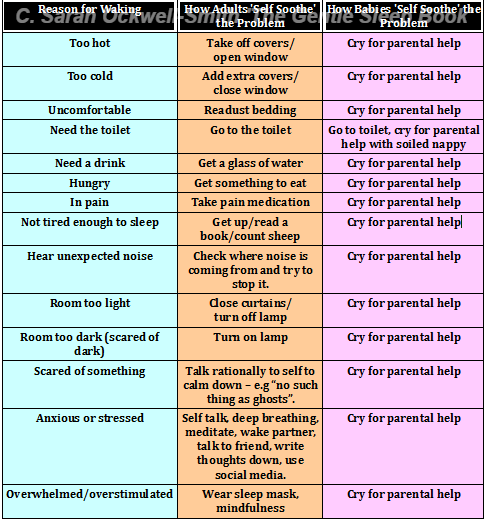
I feel it is vital however that parents understand exactly what the baby is capable of doing, from a brain and physical development point of view. When an adult ‘self soothes’ it looks very different to an infant ‘self soothing’. Some examples are shown in the table below.
The ability to ‘self soothe’ requires both sophisticated brain development and physical skills such as getting out of bed alone, walking and manipulating the environment. If the infant therefore ceases crying, does it mean that they are soothed? Or does it mean that they have been trained not to cry because they quickly learn that the parent does not meet their needs, ergo, there is no point in crying? The answer is blatantly obvious to me, is it to you?
The NEWLY UPDATED Gentle Sleep Book – out now! If you would like to understand and learn how to improve your baby, toddler, or pre-schooler’s sleep WITHOUT cry-based conventional sleep training, this is the book for you!
One of the most popular blog posts I’ve ever written is all about the 4-5 month sleep regression. I need to make a confession, I lied a little bit in it.
I gave the impression that things get a lot better after six months. And they do. Often though the improvement is only temporary and things can often get a lot, lot worse towards the end of the first year. Once again it is transient, things will get better. I apologise for withholding this information from my earlier blog post. I did it deliberately for a good reason.
When parents are deep in the depths of the 4-5month sleep regression the very last thing they want to hear is that things will get better, but only for a couple of months when they get much worse. The feelings of utter despair this may cause may make parents turn to conventional (not gentle) sleep training, to get over the 4-5 month regression and to try to stop the 8-10 month one from happening. I really would hate to be responsible for that decision, so I lied. I’m sorry, but I did it with your, and your child’s, wellbeing in mind.
So what the heck happens to sleep between eight and ten months of age? One thing is for sure and that’s the fact that it’s a very common age for lots of night waking and difficulty settling babies to sleep initially.
Research has shown us that at nine months of age, getting on for two thirds of babies are waking regularly at night, that’s almost twenty percent more than those who wake regularly at six months. In fact sleep at this stage is actually worse (in terms of night waking) than it is at three months! It is second only to newborn sleep in terms of sheer number of night wakings needing your help.
The problem with this is that this is unexpected. Many parents expect infant sleep to get continuously better as the baby ages. This assumption is one supported by most sleep experts, mainstream media and health professionals, with many expecting babies to be ‘sleeping through’ after six months. Society really does lose all tolerance of baby sleep (or lack of) after six months. Newborns wake lots, that’s to be expected, but once they are nearing their first birthday most feel they should be ‘sleeping through the night’.
If we presented these expectations in graphical form they would look something like this:
In reality however it looks more like this:
Sleep in infants is not a constant, it doesn’t continue to get better, it’s messy. It improves, it regresses, it stays the same. Life happens; teething, illness, holidays, returns to work, moving bedrooms, developmental leaps and many more can and do have a great impact on baby sleep. Normal baby sleeping patterns don’t just stick to an upward trajectory.
What happens in the life of an eight to ten month old?
Teething
Eating more solids (new experiences and risks of allergies/intolerances)
Learning to pull up, cruise and crawl
Increasing communication skills
Separation anxiety
Moving to their own bedroom
Mother returning to work
Attending more baby classes and groups (which may overstimulate)
and more…..each of these can have a dramatic impact on sleep.
There is no doubt however that separation anxiety is a key player when it comes to babies waking at night and needing parental reassurance to get back to sleep. While this age is commonly one that many parents resort to sleep training it is the very age that is most important to NOT resort to sleep training. Separation anxiety is a normal developmental stage, it’s an indication of parenting done well and although it may not feel like it, it’s a great indication that – in time – the baby will be confident and independent. This is the stage where babies need to know that parents are always there for them, that they can trust us to always come back. Once this trust is built that’s when the path to independence (and what many term ‘self settling’ or ‘self soothing’) really starts to develop.
For a quick video discussing this developmental stage (and the impact on sleep) in more depth – see my clip below:
My biggest tip for this age range when it comes to sleep is to understand why it happens and if at all possible engage in some mega ‘self care’ to allow you to make it through the tough couple of months, ultimately this will make your life easier in the long run, although in the short term I can appreciate it feels anything but. Other elements to consider:
Is there something wrong in the baby’s sleeping environment? (temperature, lighting, bedding)
Is your baby going to bed at the correct time for their biological needs?
Do they need to drop a daytime nap?
Are you using a dummy/pacifier? (post six months I strongly believe they negatively impact sleep).
Do they have any allergies or intolerances to the new food in their diet?
Do they have any nutritional deficiencies?
Are they being overstimulated in the daytime?
Are you taking a good couple of hours to reconnect after returning from work?
Are you trying to night wean prematurely?
Following the above point many babies this age are genuinely hungry at night. Their busy daytimes often lead to a dramatically lowered intake of milk (whether less breastfeeds or less bottle feeds), the quiet nights are often used to consume what they didn’t during the day.
Do they have other items that provide them comfort and remind them of you? (taking on board all senses).
Are they getting enough daylight exposure?
If they are in daycare, is the setting right for them?
Is your bedtime routine sleep friendly? and long enough?
Do they have any other sleep cues aside from you?
Are their needs for attachment being met sufficiently in the daytime?
Are you reading their tiredness cues correctly?
What I can promise you is that it will get better (and just for full disclosure I should add “until 18 months”, but that’s another blog post!).
The NEWLY UPDATED Gentle Sleep Book – out now! If you would like to understand and learn how to improve your baby, toddler, or pre-schooler’s sleep WITHOUT cry-based conventional sleep training, this is the book for you!
How Do You Stop Early Morning Waking? This is probably one of the top three questions I get asked by parents. Unfortunately it’s not one I have a positive answer to, but don’t let that put you off reading the rest of this post!
You see early morning waking is the human biological norm. We are meant to wake with the rising of the sun, just as we are meant to go to sleep shortly after it sets. The problem is that we, as adults, just don’t do that any more. Our sleep is abnormal. Our circadian rhythms bear little resemblance to what is truly biologically normal for our species. Modern day inventions have allowed us to create artificially light evenings and artificially dark mornings. We stay up far later than our predecessors who relied solely on moon, star and fire light to brighten their nights. Modern electric lighting, with its blue tinged wavelength, tricks our bodies into believing it is still daylight long after the sun has set. Our bodies secrete cortisol in an effort to stay awake and alert. When we do finally retire to bed we cover windows with blackout blinds and thick lined curtains, keeping the early morning sunlight at bay for as long as possible and so too allowing melatonin secretion to continue so that we can repeatedly hit the snooze button on our alarms. Pre-children, non work days commonly start at nine, ten or even eleven am. This modern-day adult sleep pattern is abnormal.
Babies and toddlers bedtimes are far more in sync with sunset and so too their wakings are far more linked to sunrise. Mornings commonly start at some point between five and six am. This is normal. This is how we, as adults, should sleep and have done for many hundreds of years. The problem most adults have is that their child’s normal sleeping habits are at odds with their abnormal ones. The most simplest answer to the question “how do you stop early morning waking” is simply “when your child learns and adopts your abnormal sleep patterns”. Commonly that takes until they are around four years old.
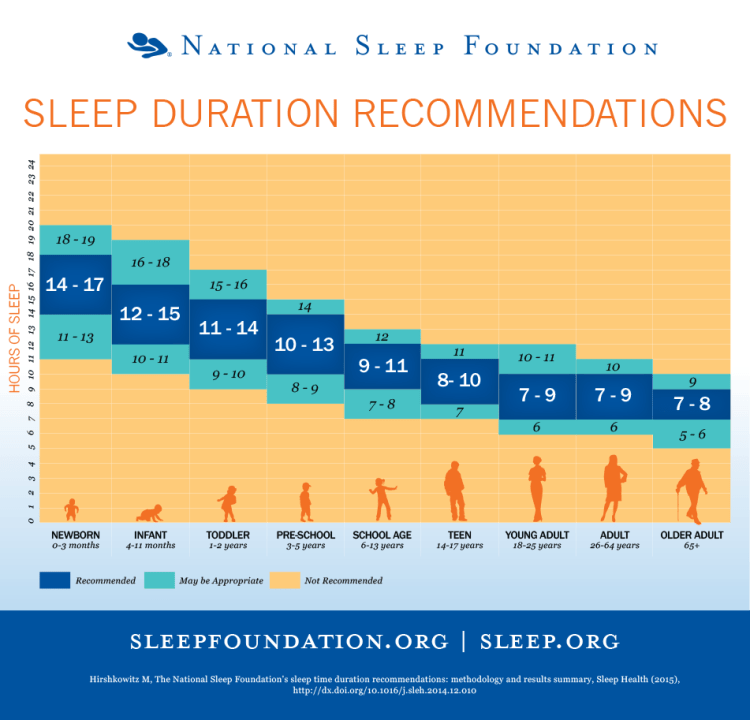
There is another point to consider here that rests once again on adult expectations. Many expect (hope?) that their children will go to bed at seven pm and wake at seven am. For many however twelve hours sleep per night is just too much sleep. An individual baby or a toddler has a fairly unique set sleep requirement per twenty-four hours. Some may need only eleven hours, others may need eighteen. Both of these are within the realms of normality. A twelve month old baby, who has a two hour long nap in the day and who only needs eleven hours sleep in a twenty-four hour period, will only need nine hours sleep per night. If said baby goes to sleep at seven pm, it is fair to expect that they will be ready to start the day at four am. They simply won’t go back to sleep because they are not tired. They have fulfilled their sleep need. A twelve month old baby (with similar nap timings) who needs fourteen hours sleep in a twenty-four hour period will wake at seven am. All babies are different. Charts and tables provide only educated estimates, if your child naturally needs less sleep per day then you have two options: continue to put them to bed at seven pm and accept the early morning waking. or adjust their bedtime to a more natural sleep time of around eight thirty pm in the hopes of the waking reaching nearer to six am. As a general rule, it is fairly unrealistic to expect a baby or toddler to sleep much past six am whatever time they go to bed.
Image courtesy of The National Sleep Foundation
Other Tips That May Help Early Morning Waking:
Expose your child to as much daylight as possible during the day, keeping naps in natural light (no blinds closed or sleep shades on prams or car seats for daytime naps). Conversely keep nights as dark as possible. Be aware of the lighting used at night – see THIS post for more.
Use blackout blinds in the bedroom overnight in an attempt to keep the early mornings as dark as possible. Cover any nooks and crannies with stick on fabric or film.
Try to slowly and gently move your child’s naps later in the day if they are prone to nap early in the morning, with the earliest nap (if they have more than one) not being earlier than ten am. This can help shift the circadian rhythm a little towards a later bedtime and later wake time.
Encourage your child to come into bed with you early in the morning (following safe sleeping guidelines) for sleepy snuggles and feeds which may encourage them go back to sleep again or allow you to drift in and out of sleep for an extra half an hour.
Aim for a bedtime of not earlier than eight pm, in the hopes that your child’s sleep needs will be fulfilled at a later time in the morning.
Consider dropping a nap during the day, or at least don’t encourage them to go back to sleep after the end of a sleep cycle (40-60 minutes depending on age).
Keep the early morning interactions quiet, calm and as boring as possible. For toddlers try telling them “it’s still time to sleep now” and encourage them to lay down and snuggle a comforter or toy and listen to a relaxation CD.
Make a visual cue for older toddlers and preschoolers. Get a cheap plastic ‘school’ clock (the type you find in offices or schools, something like THIS) dismantle and colour in sections to represent night and day. For instance one half of the clock yellow with a big smiley sun and the other half blue with a smiling moon. Explain to your child why we sleep at night and that when the clock is still in the moon section it is still night-time. Make it clear that they can come to you/you will come to them whenever they need you. The clock is to *only* be used as a visual guide to show them night and day, at no point should they be made to stay in bed if the clock isn’t in the ‘day’ section. Not only is this significantly cheaper than the myriad of ‘sleep training’ clocks on the market importantly it also avoids the coloured lights these devices all have which unfortunately almost always focus on colours that are known to inhibit sleep (such as blue), making their use counter-productive.
Embrace the early mornings. This is hard to do (I have been there four times!) but ultimately I think it’s the most successful way to handle early mornings. Go to bed early yourself and get up with your child. Appreciate how beautiful the sunrise is and the quietness (or bird song) of the very early mornings. This is a wonderful time to get things done too, especially if there are two parents at home, the extra pair of hands may mean that you may have some free time to prepare dinner for that evening (slow cookers are great!), do any jobs that need doing or get some exercise in (such as an early morning run).
Remember ‘This too will pass’. Because it will………Each day may feel like an eternity, but in the grand scheme of your life, two or three years of crazy early mornings really is only a very short percentage. All too soon your child will inherit your abnormal sleep patterns and the tables will soon turn in the teenage years when you are unable to get them out of bed until midday.
The NEWLY UPDATED Gentle Sleep Book – out now! If you would like to understand and learn how to improve your baby, toddler, or pre-schooler’s sleep WITHOUT cry-based conventional sleep training, this is the book for you!
Some babies love car journeys. The car was like a magic switch for my first-born. If I was struggling to get him to sleep or to soothe his tears two minutes out in the car would see him sleeping soundly for a good hour, sometimes two. In fact when he was a colicky newborn my husband could often be seen driving around our village in his pyjamas at 2 AM with my son in the car. He would return with a peacefully snoozing baby in the car seat every single time.
The car had less magical properties for babies two and three, it wasn’t the instant light switch it was with number one, but after ten or fifteen minutes of driving we could still pretty much guarantee they would fall asleep. For a couple of years we enjoyed long car journeys as a family of five, three little boys snoozing quietly in the back behind us. If anybody asked me for my top ‘baby calming’ tips “going for a drive” would undoubtedly be in the top three.
Then my daughter was born. She HATED the car. She would scream, loudly, within minutes of being in it and invariably the screaming would continue for almost all of the journey. It was rare that she ever fell asleep in the car, even if she was exhausted. I have spent many, many hours sitting in the back seat next to an unhappy baby stroking, singing and trying everything to comfort her. I avoided all but really non-essential car journeys that required me to drive so that I could sit next to her and at least have physical contact. We walked a lot that year!
Interestingly at age eight my daughter has horrific travel sickness. Her brothers don’t suffer at all. If we are in the car for longer than fifteen minutes she needs medication to quell the nausea otherwise she vomits in spectacular style. I wonder now if this was the cause of her upset as a baby?
I’m often asked “so, you don’t recommend controlled crying or ‘cry it out’, but what about when I’m driving and I absolutely cannot stop and my baby is screaming?”. I can totally relate, I’ve been there. All I can say is that I feel it is very different deliberately causing a baby to become distressed and ignoring their cries and responding to the baby verbally and physically as much as possible. We very quickly learned that if a journey wasn’t essential it wasn’t made (in a car anyway). I drove very little during the week when my husband was at work, if I did then my daughter was in the front seat next to me with the airbag turned off. This isn’t something I’d recommend for safety reasons, however I felt we were at less risk of a crash if my full attention was on the road, rather than a screaming baby. At the weekend I would always sit in the back next to my daughter holding her hand, talking to her and stroking her head. We would stop often, by often I mean every twenty to thirty minutes, and avoided motorways to make this more possible. Our journeys would take much longer and we planned around this. Again if the journey wasn’t essential it wasn’t made. At all points though we were as responsive as possible.
The following are tips that either helped us and/or have helped parents I have worked with when car travelling was a must:
Take your baby to see a cranial osteopath or chiropractor. Sometimes effects from the birth (particularly if it was via C-Section, forceps or ventouse or the labour was very long) can cause discomfort to the baby which can be heightened by being in a car seat. Releasing this tension can make them happier travellers.
Try different car seats, sometimes the dimensions and angles of different seats can make a really big difference. We had two car seats (one for my car and one for my husband’s) and my daughter was much happier in ‘my’ car seat.
Try to time the journey around nap times, getting the baby to sleep and then transferring to the car seat after five or ten minutes, so that much of the journey occurs when they are asleep if possible. Don’t travel if they are awake but tired or due a nap, this can make the crying and distress much worse when overtiredness is added to the mix.
Play white noise or alpha music in the car stereo. Play this on repeat throughout the journey to help to soothe your baby (if the recording makes you feel sleepy wear ear plugs or listen to your own music through headphones).
Try scenting the car with a baby friendly anti-nausea aromatherapy oil, such as mandarin. If possible use a portable battery operated aromatherapy diffuser, if not pop a couple of drops on a muslin and drape over the back of seat near to your baby (making sure it can’t fall on the baby though!).
If your baby has a comfort object (generally for sleep time) make sure they have it with them. This may sound obvious, but it’s surprising how many people don’t try this.
For older children, consider some natural travel sickness remedies, such as Ginger.
Consider using a tablet/smart phone holder fixed to the seat in front of the baby. Ordinarily this is something I would never recommend. I am really not a fan of any screen time for babies (or even toddlers), but sometimes this really is the only thing that makes a real difference. Don’t necessarily select children’s programmes though, sometimes videos of animals or fish swimming in the sea can be much more successful!
Sadly none of these tips are magic. Ultimately what seems to help the most is time. Babies may not necessarily grow out of their hatred of car transport, but as they get older they can at least understand more and can also occupy themselves a little more with toys too. Infuriatingly, as with much of parenting, sometimes the most universal solution is to ‘wait it out’. In the meantime however you can rest easy in the knowledge that meeting your baby’s needs as much as possible is not at all comparable to ignoring them akin to behavioural, cry based, sleep training.
There are two events each year that cause many parents stress and upset when it comes to child sleep – clock changes! I’m not going to de-rail this blog with my thoughts on this archaic practice (I’ve detailed them at some length in The Gentle Sleep Book). I will however focus on ways that you can best help your children, and you, cope with the change.
Here’s my four step guide to dealing with clock changes:
Start Preparing 6 Weeks in Advance.
By the far the easiest way, and indeed the gentlest way, to cope with clock changes is to gradually inch bedtime forward or back (depending on which way the change is happening) a little at a time.
Starting 6 weeks before hand change bedtime to either 10 minutes earlier (for spring) or 10 minutes later (for autumn) each week. I recommend breaking this down further if possible to a couple of minutes per day.
Here’s a worked example:
If your child’s bedtime (time they go to sleep) is 8pm and you are preparing for the autumn change, you would do the following:
Week 1: by the end of this week you have moved bedtime to 8:10pm
Week 2: by the end of this week you have moved bedtime to 8:20pm
Week 3: by the end of this week you have moved bedtime to 8:30pm
Week 4: by the end of this week you have moved bedtime to 8:40pm
Week 5: by the end of this week you have moved bedtime to 8:50pm
Week 6: by the end of this week you have moved bedtime to 9pm
The clock will then ‘fall back’ and the new bedtime becomes 8pm again.
For spring changes obviously bedtime will be gradually moving earlier, not back.
You may think “well why does this matter?”, or “if they go to sleep an hour earlier that means I’ll get more time in the evening, it can only be a good thing!”. The downside tends to come the other end of the night in the autumn though. If the child is going to bed at what will now be 7pm they are more likely to either wake in the night or wake earlier the following morning if they have fulfilled their sleep need. You cannot make them take an extra hour’s sleep if they don’t need it. It may therefore be “hello better evenings”, but that is often accompanied with “hello horribly early mornings” (or earlier than the normal early!).
In Spring the change may be good from a morning perspective, but if you don’t change sleep times you will have to be up with your child for an extra hour in the evening. So it’s win/lose either way!
2. Be really careful about light
In the autumn we’re lucky, the change means that the evenings are darker and thus more melatonin conducive, that’s a good thing for sleep. The mornings however are lighter, that’s not such a good thing. Blackout blinds therefore are a sterling investment for autumn and winter mornings when you’d like a little more sleep (though not always a guarantee sadly – early morning waking post coming soon!).
It’s also really important to think carefully about the use of artificial lighting, since it is likely to be dark at bedtime and you’re likely to need some light to do the bedtime routine. Read this post for more details on why light matters and how to prevent it from inhibiting your child’s sleep.
In the spring and summer things are trickier. You need to make the evenings darker than they perhaps naturally are, seeing as most tiredness depends upon the effects of light exposure on the eyes and brain. Here it’s all about closing curtains and blinds in the evening, a good hour or so before you want your child to sleep. Yes, it’s depressing losing the beautiful light spring and summer evenings, but it might help.
3. Daylight exposure.
Daylight exposure is really important for resetting circadian rhythms (aka ‘body clocks’). Our bodies know when to be tired and when to be alert based upon the amount of exposure to sunlight we receive. This daylight exposure tells the brain whether it is time to release the hormone of sleep or the hormone of alertness. The quickest and best way to reset a circadian rhythm that is a bit wonky is exposure to direct daylight as early as possible in the daytime. This means bundling your child and yourself up in warm clothes and getting outside straight after breakfast. Taking a walk, playing in the garden, going to the park are all great. If possible you will get outside for a minimum of thirty minutes every morning.
4. Be Sensitive and Patient.
Your child didn’t ask for the clock changes to happen, just like you. As infuriating as the sleepless evenings or tiring early mornings may be to you, being made to change developed, normal sleeping patterns because of an obscure quirk of modern-day society is just as hard for your child.
Try to stay on the same team. Clock changes are really hard for parents, just as you have got over one another one happens, but they’re really hard for children too. Understanding this will make them a lot easier on the whole family
The NEWLY UPDATED Gentle Sleep Book – out now! If you would like to understand and learn how to improve your baby, toddler, or pre-schooler’s sleep WITHOUT cry-based conventional sleep training, this is the book for you!
I am strongly against piercing the ears of a baby or toddler. Although relatively minor, ear-piercing is still mutilating the body in some way. Making holes in any part of a child’s body without their consent is wrong in my opinion. No matter that the holes may close up and they can take the earrings out when they are older if they choose to. I believe it is morally wrong to alter any part of a child’s body when they are too young to understand the implications or give informed consent unless there are serious medical reasons to do so.
At what age are children old enough to understand and give informed consent though? This is something I have really struggled with. My daughter has been asking to have her ears pierced with regularity since the start of this year. Personally I would prefer her to wait until she turns eleven and starts secondary/high school and explained this to her, many times. Yet she still kept asking. I explained that the piercing would hurt. My daughter is a dancer and a gymnast and I explained that having pierced ears could lead to an accident, where even small studs may get caught during her routines. I explained that because the piercing made holes in her ears that if she changed her mind and took the earrings out that her ears may be permanently scarred. I explained that piercing carries a risk of infection and that she would have to keep her ears scrupulously clean for many weeks. She said she understood and still wanted it done. Many times.
This weekend I was putting in a new pair of earrings that I had just bought and she asked, again. I started to say “darling, we’ve spoken about this…..” and then second guessed myself. Why was I really saying “no” again? What was really stopping me from allowing her? Was it my personal preferences about children and pierced ears? Or was it because I felt she wasn’t old enough to make an informed choice?
This brought me to the realisation that actually this had now become much more about me than her. She did understand fully and she still wanted it done. Her ears are her ears, not mine. I felt that I had taken on a caretaker role of protecting her body, until she could protect it herself, but is now the right time to start handing over some of that role to her? By preventing her from piercing her ears I was no longer protecting her body autonomy, I was preventing it. This had now become about me and not about her.
I asked her if she was sure and explained all of the risks again, she understood and still wanted to go ahead. Sitting in the piercer’s chair and watching my child have her ears pierced was right up there in one of the most horrible moments of my life. My daughter didn’t even flinch though and has been taking great care of her newly pierced ears. I have no doubt she will continue to do so. I feel I’ve learned something quite big this weekend, she may be ‘my little girl’, but she is her own person too and now it’s time for me to hand over some of the caretaking to her, little by little.
When do you think is the right age to ‘allow’ a child to have their ears pierced?
2023 UPDATE: I wrote this post in 2015. My daughter is now 16 and still loves her ear piercings (in fact she has recently added 3 more each side and a naval piercing!). Retrospectively would I change anything about my decision? I possibly would have given the go ahead a little earlier. I wanted to make sure she could give informed consent before she had it done and in doing so I think I delayed a bit longer than was necessary.
I’ve recently written a book about childism (the discrimination of children in society) which covers the issues of body autonomy and consent (and other unconscious discrimination children face on a daily basis) in much more detail. The book is called ‘Because I Said So!’ and you can order a copyHERE.
Bad habits. Rocking to sleep, feeding to sleep, cuddling to sleep, bedsharing…there are so many potholes and pitfalls to be avoided as a new parent. If you commit any of these heinous sins you are sure to end up with a child who is unable to sleep alone and you’ll still be rocking or breastfeeding a teenager. These bad habits must be broken, ASAP, if you ever want your child to sleep through the night or go to sleep independently. They must learn to self soothe and you must teach them how to sleep without you.
Have you ever heard such a load of twaddle? Widespread twaddle though. Have you ever been advised to “break the bad habits” with your baby or toddler? The fear of God put into your if you dare to ignore the advice. It’s your duty as a parent to teach your child to sleep, it’s not a natural skill for them and if you continue to mollycoddle them you’ll disadvantage them for life.
Honestly, I do wonder where this eye rollingly awful advice originates. What research is there to back it up? Where are the studies of teenagers still breastfeeding to sleep or needing to be bounced, rocked or walked in college? Where is the evidence of the dire consequences of these bad habits? There is none? That’ll be because they are not bad habits then! That’ll be because those fear mongering, do-gooder baby trainers are just repeating the same old myths to try to scare parents into sleep training. I say ignore them. I say there are no ‘bad habits’. I say rock or feed your baby to sleep all you want!
When is Something a ‘Bad Habit’?
In my opinion a ‘bad habit’ is something that causes (or may cause) potential harm to somebody. Something that may be detrimental in some way in the long-term. If all parties involved in ‘the habit’ are happy and content and there is no negative consequence then what is so bad about it? In this instance surely it’s a ‘good habit’?
Is it Really a Habit at All?
The definition of a habit is: “an acquired behavior pattern regularly followed until it has become almost involuntary:”
There is an important point here, the word “acquired”. This presumes that the habit previously didn’t exist. It’s something new. To my knowledge babies have always: 1. fallen asleep while feeding or sucking, 2. fallen asleep while being rocked and 3. fallen asleep in physical contact with their mother. Surely from birth these are all normal and beneficial behaviours. It goes beyond that though, these three things all happen in utero. While in the womb babies ALL fall asleep while sucking (or receiving nutrients via the umbilical cord), while being rocked (think about the movement they experience while the mother walks, climbs up stairs, dances or runs) and while in constant physical contact with the mother. Indeed there is no point during pregnancy that they have ever fallen asleep alone. The assertion by many that “they need to learn to fall asleep” is ridiculous, they have been falling asleep for months before they were born without the need for sleep training.
If none of these behaviours are new, or acquired, technically they do not meet the definition of being ‘a habit’.
When Supposed ‘Bad Habits’ are Actually Beneficial
When babies suckle and nurse a chain of positive events happens:
the sucking action helps their cranial bones to re-align and reduce cranial pressure and tension that may remain from the birth
the sucking action helps to relieve discomfort and pressure around the jaw from teething
baby and mother secrete oxytocin, the bonding and calming hormone
baby and mother secrete endorphins, the pain relieving and feel good hormone
if the baby is breastfed at night they will receive melatonin, the sleep hormone, via the mother’s milk
The result is a calm, relaxed and soothed baby who drifts of to sleep more easily. Win, win for both mother and baby I’d say, wouldn’t you? The extra special bonus here is that these effects don’t ever wear off, they remain for as long as the baby feeds or suckles to sleep, whatever age.
The same is true of cuddling and rocking. The movement and physical contact with the parent acts to help the baby feel calm, safe and relaxed – sleep comes more easily. Another win. win.
But You’ll Have to Rock/Feed/Cuddle to Sleep Forever
Not forever. Maybe a year, maybe two, maybe three. Or maybe a month, or three, or six. At some point, two important things will happen naturally.
When these development stages occur the need for external soothing measures will naturally pass. Just as all babies will eventually grow out of needing nappies, prams/strollers/buggies or slings and carriers. They will become developmentally redundant.
Won’t They Never Sleep Through the Night Unless You Stop Doing X/Y/Z Though?
Babies don’t sleep through the night because they are babies, not because they are fed or rocked to sleep. If you remove the feeding and the rocking you cannot change the fact that your little bundle just does not sleep like and adult and won’t do for several more months or years.
That said, when they and you are ready to move on it is possible to slowly introduce other calming measures that will allow you a little more freedom and perhaps a little more unbroken sleep. I have worked with hundreds, if not thousands of parents who still happily rock or feed their children to sleep at night and yet still have several hours, or perhaps even a whole night, of unbroken sleep.
The takeaway message? Next time somebody tells you that you are “creating bad habits” understand that what they’re saying tells you much more about them than you. They are telling you that they don’t truly understand baby sleep. They are telling you that they perhaps missed out on the wonder of snuggling a sleeping baby in their arms. Don’t allow their loss to cause you and your child to lose out too.
The NEWLY UPDATED Gentle Sleep Book – out now! If you would like to understand and learn how to improve your baby, toddler, or pre-schooler’s sleep WITHOUT cry-based conventional sleep training, this is the book for you!
Gentle Parenting is a scientific, evidence based, approach to raising confident and happy children. It is a parenting ethos characterised by the following four tenets:
Empathy
Gentle Parents are ‘mind minded’, that is they raise their children in a manner that they are aware and considerate of the child’s feelings. Too many parenting styles consider only the parent’s feelings when resolving problems, yet research shows us that the best way to raise an empathic child (or what many would call “a kind child”) is to be empathic towards them.
Most difficult parenting situations arise because the child’s needs are misunderstood, this is largely because most popular parenting methods consider young children “manipulative” or “naughty”. If the parent takes time to consider the child’s feelings and the root cause of their misbehaviour, in most cases it becomes obvious that the child’s behaviour is a sign of distress, unease, anxiety or fear. Once the true feeling and cause behind a behaviour has been identified it can be dealt with and ultimately the reasoning behind the ‘bad behaviour’ is extinguished, leaving the unwanted behaviour extinct. If parents only respond to the superficial behaviour without empathy the root cause is never dealt with and the behaviour will either continue or will manifest in another undesirable behaviour at a later date.
2. Respect
Most parents demand respect from their children, yet few truly respect their children in turn. This is a two-way equation. If parents respect their children and most importantly their child’s unique feelings and personality, then the child in turn is more likely to respect the parent. It is impossible to command true respect from somebody via fear or a mis-balance of power. Think of the people you most respect in your life, how did they gain your respect? Did they demand it, or did they earn it? Did they respect you? Do famous dictators really command respect? Or do people follow them out of fear?
Once a child respects you they become intrinsically drawn to want to help you and to keep you happy. Just as you desire to help and make happy those you respect and like.
3. Understanding
Babies are not mini adults, toddlers are not mini adults, pre-schoolers are not mini adults, tweens are not mini adults and teens are not mini adults. The human brain is not fully developed until the child enters their third decade of life. It is not until sometime after their twentieth birthday that we can expect a child to think and feel like an adult. Their brains are different. Their neurological functioning means that they do not see the world in the same way as us, they do not have the same control over their behaviour, the same ‘self soothing’ skills, the same empathy skills, or the same abstract thinking skills as adults. This means that our expectations of what is normal and what is problematic behaviour needs to change.
Expectations such as when children should share, when children should sit still and quietly, when children should cease tantruming and when children should sleep through the night change when parents understand some simple brain biology. With these new expectations and understanding it becomes far easier to parent our children.
Gentle Parenting also requires parents to understand how their own behaviour impacts on their children. If parents act violently, through smacking, spanking, yelling, biting back or so on then they are providing a role model behaviour for their children to mimic. Violent (whether physical or verbal) parents raise violent children. Modifying our own behaviour and communication is therefore vital. So to is communicating in a way that is positive and child centric, mindful of neurological immaturity. For instance telling a toddler “be a good boy” is not just meaningless (what does “being good” mean? Even an adult struggles with that concept, but to a toddler not capable of abstract through it is impossible), it can also be incredibly confusing (it doesn’t tell the child what they should or shouldn’t do) and also damaging too (labelling children as “naughty” can cause immense damage to their confidence and future motivation).
4. Boundaries
Gentle parenting is not permissive. It is not ‘lazy parenting’. These are two common insults that those who are ignorant as to the ethos’ real meaning often use. Gentle Parenting embraces discipline as a vital part of parenting. The simple difference is that gentle discipline is age appropriate, positive, respectful, empathic and intelligent.
The word ‘discipline’ actually means “to teach”. Think of the stories of Jesus and his disciples (disciples being ‘those being taught’, stemming from the same root word as “discipline”). Would Jesus have been considered such a great teacher if he taught his disciples by yelling at them, sending them to another room, smacking them, ignoring them, shaming them, taking away their beloved items or making them sit on a prescribed spot or step?
Great teachers teach out of respect, passion and understanding. To discipline a child means to teach them the qualities you most want them to have in life. If you want a child to be a free-thinker, should you really discipline them for questioning an instruction you give? Positive discipline fosters the traits you would like your child to develop as they grow while helping them to understand how to display them in an appropriate and socially acceptable way in the interim.
Many conventional parents over discipline, saying “no” becomes reflexive, the big stuff gets muddled up with the small stuff, which is confusing to a child. Gentle Parents take time to set limits and boundaries for those things that really matter to them (things like “not hurting others”, or “not throwing objects indoors”) and importantly they always enforce them. Having less, but constantly enforced, boundaries is very important. It allows the child to feel safe to explore the world having clear areas that they know are ‘off limits’. A world without boundaries is a confusing place, we all need them.
The manner of discipline is different too in gentle parenting. The discipline used is done with the aim of teaching the child and also with their level of brain development in mind. What does a two-year old learn when they bite another child and are forced to sit on the naughty step for two minutes? Their brains are not developed enough for empathy or analytical thought so they cannot consider how the other child feels, or that what they did was ‘wrong’. Instead they sit on the step quietly for two minutes, because like a dog in an obedience class, they learn that if they sit still and quietly they will eventually be allowed off of the step. No change has happened in their motivation. They will still bite again. In this popular parenting example the parent has failed to understand two important things 1. the motivation and feelings behind the behaviour and 2. the neurological limitations of the toddler brain.
In the same situation gentle parents would work on helping the child to express their ‘big feelings’ that motivated the behaviour (perhaps fear, anxiety or anger) and would teach them more appropriate ways to demonstrate them that don’t involve hurting others. This would be done as a team effort, there is no ‘winner’ or ‘loser’ in Gentle Parenting. No parent triumphing over their naughty child. Just families working together. Punishment should not play a part here, for it does not teach the child what they should do instead or how to help them to release their big feelings in a more socially acceptable way, it just makes them sit with these uncomfortable big feelings for longer.
What It Isn’t
Gentle Parenting is not permissive parenting. Gentle parents can often be more ‘strict’ than more mainstream parents. They just choose their boundaries wisely with the neurological capabilities of their child in mind.
There are three main types of parenting style that can classify all others:
Authoritarian
This is ‘old school’ parenting. It expects a lot from the child, in fact too much – authoritarian parents expect their children to behave in ways an adult would and are blind to the difference in brain development. In most cases there is a lack of emotional connection between the parent and child (in turn this lack of connection can often spur the child to misbehave). Punishment plays a big role here and the power is all given to the adult. Authoritarian parenting techniques include smacking/spanking, sending to their room, time out, naughty step, controlled crying and ‘cry it out’ sleep training. Research has shown that this style of parenting can damage the child’s confidence, happiness, intelligence and can often lead to more problematic behaviour as the child ages.
Authoritative
Authoritative parenting expects a lot from the child, however the expectations are age appropriate. Authoritative parents don’t expect children to be ‘mini adults’, they understand that their brains work differently and expectations are adjusted accordingly. There is a strong level of emotional connection and a large amount of mutual respect. Authoritative parents respect their children and their children respect them. Discipline plays a big role, though it is true and positive discipline with the aim of learning and growth and not punishment. The parents will guide their children to more appropriate behaviour and will also help them to control and regulate their behaviour until the child develops their own emotional regulation skills. Authoritative parenting has been shown time and again to be the most effective parenting style for raising confident, happy, intelligent and independent children.
Permissive
Permissive parenting is classified by low expectations of the child. They may not necessarily be age appropriate and permissive parents may be heard saying “oh he’s only a child” to excuse behaviour that is truly inappropriate for a certain aged child. Permissively parented children “get away with stuff” that they really shouldn’t do. Permissive parents commonly have a good attachment with their child and a strong emotional connection. This style of parenting however can prove damaging. It is often classified by a lack of discipline and guidance, which can lead to children growing to be insecure, anxious and out of control.
Gentle Parenting is Authoritative Parenting! The style of parenting science has proven time and again to be the healthiest way to raise a confident, happy, independent, intelligent kind child.
Gentle parents come from all walks of life. They are not uninformed (far from it – they can usually quote the latest scientific research on all aspects of parenting), they are not lazy (gentle parenting is often far more taxing for the parents than authoritarian or permissive), they are not ‘hippies’ (there are no rules to say parents should make any lifestyle choice – they can and do eat meat, wear clothing from the high street, use a buggy or stroller, use disposable nappies, use formula milk, birth in hospital and like music in the current charts. Some are vegan, some wear tie die, some babywear, some use cloth nappies, some breastfeed, some homebirth and some like to listen to whale music but that’s far more about their own personality, not the style of parenting they choose).
Why Should You Do It
Gentle Parenting comes with numerous benefits, for the parent and child – unlike most mainstream parenting methodologies where the benefits are almost always to the benefit of the parent to the detriment of the child.
Plus it’s a lot more enjoyable, being friends with your child and teaching them is much better than being their enemy and punishing them. Gentle Parenting creates a parent-child bond for life and a strong relationship over the years to come. Who wouldn’t want to be the type of parent that their children would always turn to in the future, however old they are?
What’s Wrong With ‘Normal’ Parenting?
Most mainstream parenting practices are outdated and/or not supported by current scientific evidence. There is a lot wrong with parenting today. A lot of the most popular parenting methods today are remnants of our own parenting, our parents parenting and our grandparents parenting. In the days before large-scale psychological research. In the days when, simply put, we didn’t know better.
Some research is filtering through into everyday parenting practice, for instance most (though sadly not all) people now believe that it’s wrong to hit a child to discipline them, other practices though are muddier. Most parents don’t know the risks of sleep training, of overly praising or rewarding a child, or of punishing them through isolating methods such as time out or the naughty step. This is sadly not surprising given the outdated and un-evidence based views presented in most popular parenting television programmes, books and magazines. What many don’t understand however is that the information presented by the mainstream media today usually comes from childless journalists and ‘experts’ who at most have had a few years nanny training. The *real* experts, the doctors, the professors and the researchers, usually present a very different picture.
How You Do It
As a starting point consider the four elements of empathy, respect, understanding and boundaries. Make sure that you understand normal child development and how the brain develops at each stage. It is especially important to have realistic expectations of babies and toddlers as these tend to be the most misunderstood years.
Consider your child’s feelings as well as your own and try to understand the big feelings that are causing them to act in the way that they do.
Ditch the naughty step, time out, superficial praise and rewards, controlled crying and other traditional styles of sleep training.
Once this is in place it’s time to move on to choosing, setting and enforcing boundaries and knowing what to do ‘in the moment‘. For a much more in-depth answer the upcoming ‘Gentle Parenting Book‘ covers ‘how to’ at all ages from birth to eight years of age.
Gentle Parenting at Night
Parenting is a 24/7 job. As much as most parents would like, their role doesn’t end at 7 or 8pm everyday when the children are in bed. Gentle Parents understand the importance of night-time parenting and why what you do at night matters just as much as you do during the daytime.
Children do not stop having needs, emotional or physical, just because the sun sets. Traditional sleep training is ignorant to these needs and poses many risks to the child’s developing mind and body. Many sleep ‘experts’ try to scare parents by telling them that “you must teach your child the important life skill of being able to put themselves to sleep”, or they will say “unless you teach your child to self soothe, they will not got enough sleep and this will be harmful to them”. They are wrong.
You cannot teach a child to self soothe, you cannot teach a child to effectively parent themselves at night, they still need you to do that, just as they do during the day. Responding to a child at night with empathy, understanding, respect and boundaries is just as important as it is during daylight hours.
What If It Doesn’t Work
Gentle Parenting sounds great, but what if you’ve tried it for a week, a month, a year or more and your child still doesn’t 1. sleep through the night, 2. stop having tantrums, 3. stop biting/hitting/screaming/whining? Does it mean the method has failed? Or does it mean you have failed to apply it? The answer is ‘neither’.
Parenting is a long-term business. No matter how many ‘experts’ may tell you that they can fix problems in one, two or three days, they can’t. What they can do is superficially – and temporarily – mask a deeper underlying problem, but there is categorically no way they can resolve it in such a short space of time. Why? Well inherently part of the ‘problem’ *is* childhood itself and all of the underdeveloped emotional control and understanding it brings. You simply can’t fix a child whose only problem is “being a child”.
Gentle parenting understands this. It understands the limitations of a child’s brain and it understands the longitudinal aspect of molding and shaping a growing individual. Gentle parents understand that all of the effort that they put in today may not truly bloom and blossom for another ten or twenty years. Gentle parenting isn’t about making an easy life for yourself today, it’s about investing in the future. It is parenting without selfishness. Gently parented children still cry, tantrum, hit and bite, because they are children. One day however they have a much better chance of being the type of person we all would hope to raise.
Being Gentle On Yourself
Whoever said gentle parenting was ‘accidental’ or ‘lazy’ clearly has never tried it. It’s hard, really hard. Parents have a tendency to put themselves last in the ‘needs equation’, but this is a mistake. An emotionally wrung out and stressed parent will be a parent prone to snap and yell. A parent who takes care of their own physical and emotional needs is one who is far more likely to be patient, calm and kind. Gentle parents need to be the latter, which means taking care of themselves and their own needs is just as important as taking care of their child’s.
Gentle parents still make mistakes, just like their children, they are learning too. The key here is to learn from the experience, forgive yourself, apologise to your child if necessary, take time for ‘self nurturance’ and vow to do better tomorrow. No parent will ever fully meet all of their child’s needs. Gently parented children still cry and sometimes that’s OK. Gentle parents cry too, often in front of their children, and that’s just fine too. In fact it’s a great way to teach children about emotions and why it’s good to release them.
For more on what gentle parenting is – and isn’t! – see my quick video explainer:






 Sarah Ockwell-Smith
You must be logged in to post a comment.