Getting to ‘Goodnight’ and Go

One of the top issues I am asked to help with from parents of toddlers and preschoolers is “how do I get them to go to sleep independently?”.

The goal is to tuck the child in, read them a story, give them a goodnight kiss and leave the bedroom shortly after, with the child still awake. Watch any film, soap or drama on TV and any bedtime will look exactly like this. The child sweetly replies with their “goodnight”, yawns, turns their head over on the pillow, eyes close and not a peep is heard from them until the next morning.

This goal is sadly unrealistic, for almost any age. Even as adults we struggle to fall asleep in such a peaceful and easy way. In fact, just over fifty percent of us struggle to do the very thing we aim for our children to do. In terms of when children may be happy with an independent bedtime, I usually suggest somewhere between four and seven years of age. Of course there will always be a baby who puts themselves to sleep from the off and twelve year olds who still need to be cuddled to sleep each night though.

The starting point for achieving “goodnight and go” however should always be in assessing your expectations and whether they are age appropriate. Once you are sure that what you’re hoping for is realistic, then your next step is to look at things that may be inhibiting your goal from being achieved. Let’s look at these in turn:

Sleep Onset Inhibitors

  1. Wrong Bedtime

Choosing the correct bedtime is crucial when working towards independence. Too early and the child will resist sleep (as would you if you weren’t tired and somebody was trying to make you sleep!) as their bodies are not chemically ready. Too late and the child becomes overstimulated, their bodies fill with cortisol as an emergency measure to keep them awake, and they find it hard to switch off.

Letting your child pick their own bedtime can be a recipe for disaster, this article explains why I would always recommend against it.

For the age range in question the bedtime should ideally be around 8-8:30pm, this is not the time that your routine starts, but the point where you are tucking them up in bed.

2. Poor Bedtime Routine

If your bedtime routine for your child is lax you may well suffer when it comes to sleep onset. Simply you can either spend the time running a great bedtime routine, or you can spend the time trying to get your child to sleep in bed. Either way it’s time you have to spend.

The bedtime routine should begin around an hour before you hope for your child to be asleep. This time is all about winding down, setting cues and preparing for sleep. It is so important to keep play out of the bedtime routine, no running around chasing, no playing with toys. These give the wrong message.

See more on bedtime routines in my video here:

3. Screen Time

This is one of the top causes of adult sleep onset insomnia and plays a large negative role in issues with children too. Your child needs at least an hour, preferably two, clear of screens before bedtime. No bedtime shows on TV, no watching videos on a tablet and no apps on a phone for toothbrushing or sleeptime either.

4. Lighting

Lighting at bedtime can cause problems for two reasons. First it can inhibit the onset of sleep and second, if a child is scared of the dark, a lack of it can also inhibit the onset of sleep. I would always recommend the use of a nightlight, but only a red one, for more on lighting see this article.

5. Lack of Reconnection Time

This is such an important point and one that is missed by so many. Children need to reconnect with their parents, particularly the mother, and if this need isn’t fulfilled they will try to postpone bedtime as much as possible to reconnect. The most common problem here is if the mother works outside of the home, but also siblings can impact too.

The best way to reconnect is in advance of bedtime. Ideally spend an hour focussed on the child, reading and playing with them before the bedtime routine starts. e.g if the routine for bedtime starts at 7:30, then spend 6:30-7:30 playing together.

Once again this is time you’re going to have to spend anyway, either reconnecting or dealing with your child’s resistance to go to sleep!

6. Lack of Boundaries

Boundaries are really important at bedtime. Once your child is in their bedroom there is no more playing, no more running, no more toys and no more stories once you have finished reading their bedtime story. There is no more food, no more drink, or any other excuse your child may have. This may sound harsh, but actually setting boundaries here and consistently reinforcing them is not only kind to you, but kind to your child too. They know what to expect and you are helping them to get the sleep that they need. It’s OK to say “no, it’s time to sleep now”, it’s OK for them to cry and it’s OK for you to comfort them when they cry. What isn’t OK is shouting at them, getting angry or leaving them alone with their tears. Bedtime boundaries are usually tough going when you first enforce them, you can expect a good two weeks of returning to bed, taking toys away and more. On the first few nights of using them bedtime may take two, or even three hours. Expect this, it is normal and it will pass.

Three Steps to Independent Sleep Onset

Only once you have removed the bedtime inhibitors can you move on to creating an independent bedtime. Here there are three steps to achieve this. Let’s look at them in turn.

  1.  A Bedtime Friend to Care For

Have you ever noticed that if you’re scared of something but caring for another that your fear lessens? This is the case with me and flying. I am a horrible flyer, I hate it and am terrified every time I fly. The only thing that calms my nerves is taking care of my children. The more scared they are, the calmer they get as I focus on them. In calming them I also calm myself in such a way that I could never do to myself alone.

Using this transference really helps children at bedtime. Take them on a special shopping trip to buy a ‘bedtime buddy’, allow them free choice and if possible go to a Build A Bear or similar. This is because they can have more input in making the bear and also because you can kiss the ‘wishing heart’ that is inserted and tell your child “I’ve put some of my love in the heart so that it will always be with you when you have the bear”. Encourage your child to name the bear.

When you return home, tell your child “Bob might be a bit scared and a bit lonely tonight, because all his friends and family are in the shop still. Do you think you could look after him?” then say “If he wakes and he’s scared or lonely, can you give him a big squeeze and tell him that it’s OK to go back to sleep?”. Remind your child of this again as you tuck them into bed with the bear. The hope is that they will comfort the bear if they themselves are feeling anxious or lonely.

2. Pop In and Pop Out

One of the keys to surviving separation anxiety, for both parents and children, is to separate in small, well timed doses. Using this  concept at bedtime can be really helpful. Once your child is tucked up in bed and their bedtime routine is complete say “Oh, I need to go to the toilet, I’ll be back in a minute”. Leave their room and stay out for as long as they don’t cry or call for you. If they cry or call for you go straight back to their room and say “it’s OK I’m here, don’t worry, I’m always here if you need me”. Once they are calm say “oh no, I didn’t turn off the tap, back in a minute” and repeat.

Initially your ‘pop outs’ may only be a minute or two long. Your aim initially is not for the child to go to sleep while you are out of the room, but just to be comfortable in your absence. Ultimately they may fall asleep while you are out, but don’t expect that to happen for at least the first few weeks.

3. Guided Relaxation

My ultimate tip for encouraging independent sleep is to use guided relaxation recordings. These work to take the child’s mind off of ‘going to sleep’, help them to relax and feel calm in your absence ultimately.

When choosing a recording, you want to aim for one that isn’t exhilarating in anyway (no flying, or chasing things) and ideally one that teaches them new coping strategies for sleep, so that the effect builds the more times that they listen to the recording. My own ‘Gentle Sleep Relaxation for Children’ is exactly this. Calm spoken word over alpha music (music that is written to help relax the brain). You can find it on iTunes, Amazon.com and Amazon.co.uk as a download in almost all countries and also on Spotify.

cd

Start the recording once you have tucked your child in and said your goodnights and for the first week or so lay with them until they are asleep, then you can try to leave just before you put the recording on, or part way into it.

Hopefully with all of these tips, combined with age appropriate expectations, you can look forward to kissing your children goodnight and leaving them to drift off to sleep independently, but most importantly happily, for many years to come.

Good luck!

The NEWLY UPDATED Gentle Sleep Book – out now! If you would like to understand and learn how to improve your baby, toddler, or pre-schooler’s sleep WITHOUT cry-based conventional sleep training, this is the book for you!
sleepbook-1

Sarah

p.s: Come and chat with me on FacebookTwitter and Instagram 

Or watch my videos on YouTube

You can also sign up for my free parenting newsletter HERE.

The Manipulation Myth

“If you always pick him up when he cries he’ll soon have you wrapped around his little finger”.

“You have to ignore, or punish her tantrums, otherwise she’ll learn to control you and think she can get anything she wants if she behaves like it in future”.

Much of today’s parenting advice focusses on the idea that children, right from birth, manipulate their parents. The advice encourages parents to keep control and never allow their children to ‘get their own way’. It is a combative approach which not only believes children to effectively be the enemy, but also ones capable of scheming and plotting from the day they are born. The manipulation paranoia stems from an age of parenting with the belief that the power of any situation should always be with the adult and that children should respect their elders, but do not deserve the same back.

The dictionary definition of manipulate is as follows:

“control or influence (a person or situation) cleverly or unscrupulously.”

The idea of children manipulating their parents via their behaviour, be that crying at night, or tantruming during the day, implies that not only are the children capable of such schemes, but that they also possess a degree of machiavellianism. In reality neither is true.

In order to manipulate their parents, babies, toddlers and even older children need the following skills:

  • Hypothetical Thinking
  • Critical and Rational Thinking
  • Empathy
  • Impulse Control

These cognitive skills lie in the domain of the prefrontal cortex. This area of the brain is one that is responsible for high functioning abilities. This area of the brain is what differentiates us from our mammalian cousins. This area of the brain is the very last to develop. Scientists believe that the final development of the prefrontal cortex does not occur until the child enters their twenties, or even until twenty five years of age.

Knowing this, it becomes blatantly clear that babies and toddlers are incapable of the complex thought processes that are necessary for manipulating the behaviour of others. In a sense those scared of creating demanding, manipulative little monsters are giving far more credit to young children than they deserve.

There is no possibility that a baby, laying alone in his cot at night, chooses to cry because he decides that he would rather be in the arms of his parent, even though he is perfectly fine where he is. This plotting and scheming would require the baby to plan and think through several responses that the parent may have. It requires him to indeed control his own behaviour too. For this all too happen we would be witnessing the birth of some sort of superhuman genius baby. Rather what is happening is the baby is crying because he cannot control his dominant response to fear and isolation, which is to cry. He cannot think hypothetically or critically. He cannot understand that he is in no danger despite the ‘fight or flight’ response occurring in his body. He cries because the primitive abilities of his brain allow him to do nothing else.

Similarly there is no possibility that a toddler, full of overwhelming emotions: sadness, anger, grief and fear, has chosen to tantrum on the floor of a supermarket because she wishes to embarrass her parent into buying her a chocolate bar. This manipulation would require far more sophisticated brain development than she has. All she knows at this present time is that her little body is full of adrenaline and she is scared, sad, mad and out of control. Can you imagine how scary it must be to lose control of yourself? And then to be ignored or punished by your parent? Why would she possibly choose to do that? Her brain is far too underdeveloped to plot and plan what outcomes her actions may have, even if she could do this the ‘fight or flight’ response her body is experiencing prohibits her from thinking so clearly. She tantrums because she is incapable of controlling her emotions, nothing else.

Believing that babies and young children can and do manipulate us predisposes to parent as two teams. Us against them. It predisposes us to punish and ignore, rather than connect and understand. Ironically this ‘us and them’ attitude and ignorance of a child’s true needs is far more likely to create a manipulative child in the future. If we raise our children to know that their needs will be met, they will have no need to manipulate us in the future. If a baby cries, they need to be picked up, if a toddler tantrums they need us to calm them. The only thing we create when we respond is trust, and trust and manipulation are two very different things.

For more on why babies and toddlers don’t manipulate at night and how to respond see my Gentle Sleep Book.

Fore more on why toddlers and young children don’t manipulate in the day and how to response see my Gentle Parenting Book.

Sarah

p.s: Come and chat with me on Facebook, Twitter and Instagram You can also sign up for my free weekly parenting newsletter HERE.


The Cry it Out Debate – Is it Safe, or Not?

It seems like every month new research is published trying to prove, or disprove, the safety of cry based infant sleep training. Each one contradicts the previous one and each one proclaims to give THE answer. I’ve fallen out of love with infant sleep research that tries to prove harm, or not, of different methods of sleep training and I now take them all with a pinch of salt. I don’t believe that there will ever be an unflawed study that will ever be able to prove the harm or safety of infant sleep training. Infant behaviour, especially sleep, is not an easily quantifiable issue, it is murky grey. There is no black and white ‘right’ answer and I truly believe that there never will be.

Here’s why I have lost faith in sleep training research:

Lack of Replicability

One study alone means very little. The results may be isolated. There is a reason why conflicting research is constantly published. Until research shows me the same results time and time again, by different researchers, I will treat it cautiously.

Sample Size

Understandably sleep research focussing on interviews, actigraphy and biomedical markers such as cortisol is going to be expensive and time consuming. Most studies therefore focus on a very small number of infants. This makes the findings less reliable.

Confirmation Bias

Scientists in this field of work tend to enter into research with a set idea of what they believe is right or wrong, often based on their own personal experiences of parenting. Unsurprisingly they tend to ‘prove’ what they believe. If they believe cry based sleep training is wrong, they tend to produce results that support their ideals, if they believe it is the right thing to do, they tend to produce results that support this too. Despite controlling for this as much as possible it undoubtedly plays a large role.

Lack of Surity of Action

Unless a scientists monitors each parent and child all night they don’t really know what they are measuring. Parents may have been given instructions to carry out a certain method of sleep training, but unless they are watched constantly the scientists have no idea of what they really did (this was a major flaw of research conducted in 2012 trying to prove sleep trainings safety). This lack of truly understanding what the parents did is only compounded by the fact that subjects tend to tell researchers what they think they want to hear.

The Ability to Quantify Infant Sleep

Infant sleep is ever changing. Month by month it does not look the same. Sleep changes by age, by location, with physical and psychological developments, with parents going back to work, with the introduction of solids, or with parental stress levels. We do not know what works at any particular time and in consideration of all variable. Just like adults, babies will have good days and bad, tricky sleep and easy sleep. Most sleep research is just a snapshot into their lives. What works and is safe, or unsafe today may not apply tomorrow.

The Inability to Prove Long Term Harm or Safety

Research into infant sleep concentrates on the very short term. Does it cause harm instantly or in a year or two down the line? What about ten, fifteen, twenty years down the line? No longitudinal research exists here. Who knows what will happen to the babies trained with cry based sleep training when they are adults. What effect will their upbringing have upon their relationships and indeed their own parenting. We just don’t know and until we do, we cannot say whether something is harmful or safe.

What we also do not know is the long term neurological effects of sleep training. What effects, if any, does it have on brain architecture? Measured long term. This of course will never happen. Large scale, long term MRIs are prohibitively expensive and time consuming. This is what is needed however to prove, or disprove, harm.

Parental Self Reporting

Most sleep research relies on parents to report their opinions of their child’s emotional state. At best the Ainsworth strange situation may be applied, but in most cases attachment and ill effects are assessed by asking the parents “do you think it negatively affected your child?”. Remembering the tendency for subjects to reply affirming the researcher, it is unlikely that any parent who knowingly agreed to put their child into the experiment would admit concerns. We must also take account of cognitive dissonance, would the parents even admit any potential harm to themselves?

The Inability to Prove Long Term Efficacy

Just as none of the research can prove long term safety, they also cannot confirm long term efficacy. As mentioned previously, infant sleep is not linear, it regresses as often as it improves. The effects of any intervention need to be monitored within a few days, a few weeks, a few months and a few years. Otherwise we have no idea whether any positive effect will continue and indeed whether it will produce negative sleep effects in the months and years to come after any initial improvement.

Quantifying Attachment and Emotional Stability

These are two concepts that are almost impossible to prove in infancy beyond educated guesses based on old techniques of measurement. Attachment, just like infant sleep, is almost impossible to quantify. Even if it was, what about the future effects and the development of independence and confidence years later? We have no idea of the effects of these.

The Reliability of Salivary Cortisol

Isn’t it ironic that in some cases the reliability of salivary cortisol is called into question (I’m talking the Middlemiss 2012 research), yet when it is used to support sleep training and supposed lack of problems it is freely accepted as ‘proof’ that it is safe and effective. Double standards anyone?

For those wondering, the reliability of it has been called into question many times, therefore one must ask if any research using it as their only quantitative evidence is reliable.

Researching the Wrong Goal

We must ask why research focusses on getting babies to ‘sleep through the night’. All scientists must know that this does not happen, in infancy or adulthood. We all sleep in cycles and we all rouse, or come close to it, many times. What they are really measuring is how long infants do not signal to their parents that they are awake. If they don’t signal we have absolutely no way of knowing whether this is because they are calm and able to easily transition to sleep or not, or if they do not cry out because they do not expect a response. Should the real goal not be to consider ways to help parents and babies to feel more rested and happier? Focussing on reducing postnatal depression and anxiety and researching the appropriate amount of sleep acceptable on an individual basis to consider emotional and physical health in infant and child? Why does all of the research fixate on the outdated authoritarian notion of ‘sleeping through’?

A poor understanding of the reason for the effect

We will never know why sleep training encourages babies to be quiet at night. We have no way of knowing whether it solves ‘sleep problems’, or whether it encourages a lack of trust and signalling in babies. Only the babies know this.

Contradiction With Other Research

We know that frequent night waking is protective for infants when it comes to SIDS and breastfeeding at night, particularly with bedsharing, can prolong the breastfeeding relationship, which is best for babies and mothers (from a biological point of view). Research that seeks to promote sleep training professes to show no harm, yet they forget the harm caused by prematurely ceasing breastfeeding and making infants sleep in an unnaturally deep state.

Confusion for Parents

The constant changing of opinions and ‘evidence’ of sleep training is confusing for parents. In fact they would be better with no research at all. Those who cry based sleep train because current research says it is safe will question their choice and feel guilt when the next study ‘proves’ it to be dangerous. Those who don’t sleep train will now be questioning their choices, particularly if they are in an vulnerable exhausted state. This research serves only to induce guilt,  confusion, stress and worry in parents, despite the researchers’ best intentions.

Gross assumptions by the researchers

Taking all of these issues into account, we must question the sweeping statements made by the researchers, keen to spread their message and indeed their method far and wide. Very often however their research is inadequate to support the claims they make. Indeed speaking about research that supposedly proves that cry based sleep training is ‘safe’ researcher Michael Gradisar says “It looks like you’ve got two effective treatments that don’t necessarily lead to negative outcomes,” however he just cannot say this based on the limited research and understanding that he has from it.

So what do we know about the effect and efficacy of cry based sleep training based on current scientific evidence? The answer is ‘not a lot’. As yet we do not have any research that is reliable, replicable and indeed longitudinal. From either camp. At this present moment in time we are left in the position of just not knowing the long term effects and our understanding of the short term is shaky too. This is why I am cynical about infant sleep research and why I believe we will be in this same position for the next fifty years or more.

Until such time I prefer to look at the issues from a moral perspective. Just because we can, doesn’t mean we should. Should we sleep train babies, when they are sleeping normally (like babies) to better fit into our world?  Should we endure the stress of hearing our babies cry and not responding? Should we listen to the (often poor) advice from health professionals to sleep train?

What of our ancestors, other cultures and other mammals. Why do they not struggle with sleep the way we do? Sleep training is an incredibly modern concept by historical standards, why did it not exist more than two hundred years ago?

Until such time when definitive proof exists of no long term harm and long term benefits, we must question why we are being urged to do it, especially when it is at odds with our parenting instincts.

The NEWLY UPDATED Gentle Sleep Book – out now! If you would like to understand and learn how to improve your baby, toddler, or pre-schooler’s sleep WITHOUT cry-based conventional sleep training, this is the book for you!
sleepbook-1

Sarah

p.s: Come and chat with me on FacebookTwitter and Instagram 

Or watch my videos on YouTube

You can also sign up for my free parenting newsletter HERE.

When is it Best to NOT be Child Led Regarding Sleep?

Many will know me as an author who advocated being as child led as possible as much as possible, particularly when it comes to sleep. I expect therefore that this post will surprise quite a few.

I strongly believe that you shouldn’t let your child pick their own bedtime.

I’m all for being as baby led as possible in the first few months, however in older babies, toddlers and preschoolers I firmly believe that in most cases, a totally child led bedtime is a mistake. I help many parents who allow their child to go to bed when they ask or indicate, often at differing times everyday, who struggle with their sleep. Out of the suggestions I give them, setting a bedtime tops the list.

So, why shouldn’t children pick their own bedtimes?

Imagine this scenario:

You are a toddler. You’ve had a great day with one parent and an enjoyable evening with both after the other comes home from work. The evening is still young and full of excitement. Games to play, songs to sing, cuddles to have, books to read and perhaps television to watch. Now, knowing that the area of your brain responsible for impulse control and self regulation is very underdeveloped (and remains that way even through the teenage years), what do you think you might do? Listen to your body’s tiredness cues, or fight through them to enjoy a fun, or hug, filled evening with your parents?

You may think, “well they will fall asleep when they’re really tired, even if they stay up a bit”. The problem with this presumption however, is that it rarely happens. Biologically speaking the child’s body does everything to prevent it. When they become overtired their body compensates by secreting cortisol to keep them awake (duracell bunny ‘second wind’ anyone?). Cortisol inhibits melatonin. Melatonin is the hormone of sleep. Do you see a problem? Our overtired little people are wired even though they are grossly overtired.

The next problem is that child led bedtimes can vary quite a lot and it may or may not be possible to do a consistent bedtime routine, the very thing that is proven to have a significant effect on sleep (see my video below for more on bedtime routines).

So, child led could result in an appropriate bedtime, but more likely it will result in gross overtiredness and an inconsistent bedtime routine – both of which spell problematic sleep.

For this reason, I commonly advise parents to adopt an age appropriate bedtime (around 8pm), preceded by a good wind-down routine and a bedtime routine for at least an hour prior to sleep. The bedtime can be a little flexible, but unless it is impossible because you’re not at home, or your child is ill I recommend sticking to 30 minutes either side of the bedtime, earlier or later, and no more, right the way through childhood (even the teenage years – though obviously the bedtime gets later as the child gets older!).

The NEWLY UPDATED Gentle Sleep Book – out now! If you would like to understand and learn how to improve your baby, toddler, or pre-schooler’s sleep WITHOUT cry-based conventional sleep training, this is the book for you!
sleepbook-1

Sarah

p.s: Come and chat with me on FacebookTwitter and Instagram 

Or watch my videos on YouTube

You can also sign up for my free parenting newsletter HERE.

What Time Should Your Child Go to Bed?

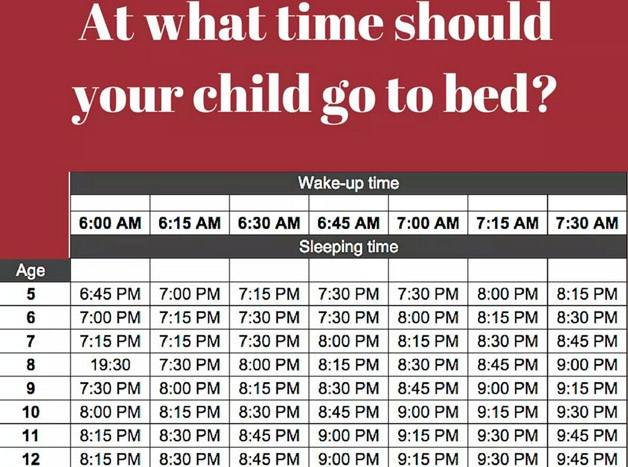
The chart below is going viral on social media. I am perplexed about why, since it is completely incorrect.

chart

I have no idea what research this guidance is based upon, however I expect the answer is ‘none’. There are several problems with this chart, which I will detail below:

Sleep Needs Are Individual

Each and every person in the world, young or old, has a UNIQUE sleep need. We are not all the same and we do not need the same things, sleep included. As individuals our sleep needs change daily, based upon what is happening in our lives. If we are ill we need more sleep, if all is well we can get away with less. Similarly we do not wake at the same time everyday. This chart ignores night waking, which differs hugely each day for every child (just because they no longer cry for you it doesn’t mean they don’t wake). This chart allows for no individuality.

Sleep Needs by Age Vary Greatly

This chart presumes that all children of the same age need the same amount of sleep, they don’t. At each and every age the amount of sleep an individual needs in a 24hr period sits within a wide range of normality. For the age of five for instance a child may need anywhere between eight and fourteen hours sleep in a 24hr period. The chart above believes that they ALL need eleven hours and fifteen minutes. Such a random figure that is not evidence based! Some five year olds will need nine hours, some will need twelve, either is fine!

This chart below, from the National Sleep Foundation gives a much more realistic view:

sleepneeds
Image courtesy of The National Sleep Foundation

Early Bedtimes Go Against Science

Falling asleep relies on the body’s secretion of the hormone melatonin. Melatonin is released when the brain senses changes in light levels, ie. when it gets dark at night.  Research has shown that putting children to bed too early will make bedtime much harder and will also cause them to wake more at night. In this research it was found that melatonin secretion started at around 7:40pm, far earlier than many of the bedtimes our viral chart recommends. Simply, if the body is not chemically ready for sleep, it doesn’t matter what time you put your child to bed, they won’t sleep!

The Tween and Teen Brain is Programmed for a Late Bedtime

As children enter puberty their body clock goes through a strange temporal shift. Biologically they need a much later bedtime. They become natural night owls. As a result they also need a later morning wake time, which causes a problem with the early start at schools. Not only does this chart overestimate the amount of sleep a near adolescent needs, the bedtime is not in line with their circadian phase. Research shows that mean bedtime at this age is 10:30pm, a whole hour later than our viral chart recommends.

Early Morning Waking is Normal

This chart gives us the subconscious impression that early morning waking is abnormal. The reverse is actually true. Early morning waking is the human norm. If we did not override our innate sleep needs and confuse our circadian rhythms with artificially light evenings (with electric lighting) and artificially dark mornings (with curtains) we would all wake at dawn, as a response to rising light levels. At the moment sunrise occurs at around 6am, although as we move into summer months this will get earlier. Our viral charts seems to punish children with pure and normal circadian rhythms.

Information Like This Unnecessarily Increases Parental Anxiety

If our viral chart contained evidence based information, and most importantly a range of timings at each age, we may consider it useful. The sad fact however is it does neither of these. It dictates a specific bedtime, with no normal range and no evidence to back it up. The authoritarian nature of information like this serves to scare and guilt, far more than it does to help. Yes, it may have been shared hundreds of thousands of times, serving to boost the social media reach and website clicks of the creator, however it has also served to undermine the parental instincts of its readers. How many parents are now worrying that their child doesn’t get enough sleep because of this chart? How does this help those parents? It doesn’t. If a child is happy, healthy and coping well during the day then they are getting enough sleep, no matter where they fall on this poorly executed chart. If they are not, this chart offers nothing by way of help or advice.

The NEWLY UPDATED Gentle Sleep Book – out now! If you would like to understand and learn how to improve your baby, toddler, or pre-schooler’s sleep WITHOUT cry-based conventional sleep training, this is the book for you!
sleepbook-1

Sarah

p.s: Come and chat with me on FacebookTwitter and Instagram 

Or watch my videos on YouTube

You can also sign up for my free parenting newsletter HERE.

Gentle Parenting and Me – By Sarah Storey

Welcome to the first of my special guest interviews on why gentle parenting matters to parents around the world. For this special first interview I chat with multi gold winning Paralympian Dame Sarah Storey about breastfeeding, bedsharing, tackling tantrums and postnatal bodies.

storey
Photo Credit: BBC.co.uk
Did you have an idea of how you wanted to parent before Louisa was born?
“I didn’t really know what to expect, I just wanted to make sure we raised a happy, healthy child. I read BabyCalm when I was about 7 months pregnant and everything in the book really resonated with me. It was as if the book was putting my thoughts into words and explaining things for me that I had previously liked but didn’t know why. I had watched shows like Super Nanny and seen the concept of the naughty step and how to deal with tantrums, but I never liked the idea of everything being a battle and hoped our house would be a calmer and more gentle environment.”
************************************************************
What made you want to take a gentle approach to both day and night parenting?
“I didn’t see night and day as being different, I didn’t want to create conditions for my attention. I always knew there would be night wakings and that was perfectly fine with me. I also never worried about the idea that life was going to change, the idea that we couldn’t have evenings to ourselves, or be on our own has never been a consideration, we wanted a family so that we could be with our little one all the time.”
************************************************************
How do you work gentle parenting in with your training and competitions?
“For training, Barney and I share the child care and I train while he looks after Louisa, and we also have a huge amount of help and support from my parents who live round the corner. When it comes to training abroad or competition we have to be really organised and plan to be sure that everything gets done from a training perspective and still be in an environment that functions for us as a family. Athlete mothers are still quite rare in British Sport and with a gentle or attachment
parenting style, there is less understanding of why this is important for mother and child. Many sports require huge chunks of time away from home but this obviously doesn’t fit well until a child is emotionally ready. Of course some children will cope early for various reasons but others won’t, and for Louisa and I and our natural term breastfeeding journey we are not yet ready for overnight separation. I don’t mind at all though, I love having her with me and when we are away with our road racing team [my husband and I run this and jointly manage everythinh] we have loads of
positive comments about how great it is to have Louisa around and what a positive impact she has on what can be a stressful competition environment.”
************************************************************
Have you noticed any changes in your body, when it comes to your fitness, since having Louisa?
“My fitness is better now than it was pre-pregnancy and I definitely benefitted from the strength that is reported from being pregnant and the physiological changes that take place. A temporarily increased blood volume and higher haemoglobin were two of the natural benefits that came with having a baby and I am now physically stronger and have more stamina. These aren’t given benefits for everyone though and I think I was lucky to have such a healthy pregnancy from start to finish. Immediately post birth I had to be careful not to rush back too fast so that my stomach muscles could knit back together and weight gradually reduce. I gained 4 stone whilst pregnant so there was a lot of work to do and I didn’t want to suddenly lose weight in case it affected my milk supply. I had a DEXA scan around 9 months after and my body fat was reduced to 22%, but 2 years further on and it’s back to 17%. It was really amazing to see my body change and change back!”
************************************************************
How have your fellow sportsmen and women reacted to the way you parent?
“I don’t know if they react to the way Barney and I parent or more likely to the way Louisa is. She is a popular visitor to my friends on the National Team and knows all of the riders on our road racing team very well. I guess it’s our parenting style and our lifestyle that has afforded her the amazing experiences she has absorbed and I think most people can see how beneficial it has been for us as a whole family.”
************************************************************
Would you say it is hard to take a more gentle approach to parenting in your field of  work?
“I think it is hard to have a gentle approach to parenting in most fields of work. Many people are trying to rush through life and get everything done and this can have an effect on the patience you have as a parent. For me it has been a brilliant way for life to be put in to perspective and whilst I used to do a lot of things such as blogging or writing race reports or just watching TV for no reason, I now have more direction and deliberately put Louisa ahead of everything else. When I am asked to do something my thought process used to be; “will it work for training?” Now that thought process is; “will it work for Louisa, can I still do my training?” With such a supportive family and lots of hands to help, we have been able to combine my training and competitions, but I guess that’s down to organisation and planning ahead.
I like to think a gentler approach to parenting has ensured we all benefit from taking time over things and seeing the world through the eyes of a Toddler is very, very refreshing and great fun.
One of the benefits of parenting in a flexible work environment that allows Louisa to be with us, is that she sees first-hand the work ethic and discipline of what we do. We are also able to explain the boundaries of behaviour with real life examples and by leading by example. 
It is obviously impossible to create routine as we don’t stay in one place for long. Our approach for this has been to create the cuddles and physical contact as the constant and so naps have always been taken whilst being cuddled and we co-sleep so that Louisa has the same sleeping  arrangements wherever we are in the world. This approach means she is really flexible and relaxed about travel, time zone changes and staying in different hotels every few days.”
************************************************************
How does your husband, Barney, feel about the way Louisa is parented?
“It’s very much a team effort. We both feel very strongly that Louisa is the most important thing and work hard to make sure we get everything done around her needs. Working as a team must make any style of parenting easier, but for us it has been of benefit to us all and I love the relationship Barney and Louisa share as they have so much time together.”
************************************************************
What would you say your three biggest goals are when it comes to raising your  daughter?
“We want her to be happy, confident and caring.”
************************************************************
How do you look after your own needs and ensure you don’t ‘burn out’?
“I go out on my bike! Also I get forced to sit down when naps happen and at bedtime. I find that because Louisa is included in our life and is good company, we can hang out and chill out together too. Co-sleeping means she lies in every morning too, so we don’t get up too early which is a bonus!”
************************************************************
What would be your best tip for any new parents reading this?
“Be as child led as possible, remember no child is deliberately naughty and always talk to them in a way you hope they will talk back to you, because they are good mimics!”
storey1
Photo Credit: SkySports.com
Sarah Storey is Great Britain’s most decorated female Paralympian in history having won 11 Gold, 8 Silver and 3 Bronze medals across an impressive 6 Paralympic Games. There is also no doubt she is one of the most versatile athlete’s in the World having won World and Paralympic Gold medals for her country across two sports [swimming and cycling] and across 12 very different events [6 in the pool and 6 on a bike]. In an international career that has spanned more than 20 years, Sarah Storey [nee Bailey] has a unique and inspiring story, not least because she has also won some of her gold as an able-bodied athlete. In June 2013 Sarah and her husband Barney (also a gold winning Paralympic Cyclist) welcomed baby Louisa to their family.

The Real Reasons Why You Cannot Teach Babies to Self Soothe to Sleep

The mainstay of almost all baby sleep training is the idea of teaching ‘self soothing’ or ‘self settling’. This approach believes that if babies are put down ‘drowsy but awake’ and parents do not rush in to feed or rock when they wake, that the baby will learn to settle back to sleep without parental input.

Once a baby can self settle, parents are to believe that the baby will ‘sleep through the night’. What they are actually implying, since no baby ever sleeps through the night due to extremely short sleep cycles, is that every time the baby wakes in the night (around 10 to 15 times, depending on age) they will be able to start a new sleep cycle alone.

This sounds like a sensible idea. If only it were true.

Babies are incapable of self soothing or self settling in the true sense. Sure, they can suck their thumb, stroke a lovey or take comfort from a dummy/pacifier. This is their limit though. It’s like ‘self soothing lite’. This ‘self soothing lite’ requires the baby to be in a position where everything is fine. If there are no problems, this ‘self soothing lite’ may work. If there are problems, it just doesn’t.

As an adult, why did you wake last night? Aside from your baby waking you!

  • Perhaps a different, unexpected noise woke you
  • Perhaps your partner was snoring
  • Perhaps you needed to go to the toilet
  • Perhaps you woke with a dry throat and needed a drink
  • Perhaps you woke cold
  • Perhaps you woke hot
  • Perhaps it was too light
  • Perhaps it was too dark and you could see shadows that scared you
  • Perhaps you woke because of a nightmare
  • Perhaps you struggled to get back to sleep because of anxiety
  • Perhaps you struggled to get back to sleep for no known reason
  • Perhaps you were uncomfortable
  • Perhaps you were lonely, missing your partner
  • Perhaps you woke because you were in pain
  • Perhaps you woke because you felt sick…………………..

The list is endless and unique.

Why do babies wake? I suspect the list looks pretty similar to that above. With the important addition of ‘hunger’.

So, as an adult, how could you fix the problems that caused you to wake?

  • You could investigate and stop the noise
  • You could go to the toilet and return back to bed ‘clean’
  • You could go to the kitchen and make yourself a drink
  • You could add blankets or a thicker duvet or add clothing
  • You could swap the duvet for a sheet or change clothing for something cooler
  • You could open or close the window or fiddle with the air con or heating
  • You could turn a lamp on or off
  • You could breathe deeply and remind yourself “it’s only a dream”
  • You could call a friend, check Facebook, write a diary or practice relaxation/meditation
  • You could give up on sleep and get up for an hour or two
  • You could call your partner, or ask them to come up to bed with you
  • You could take a painkiller tablet or medication

Now, how many of these can babies do? The answer is “none”. What do babies do? They cry. They cry for us, as adults, to help them. Because they cannot “self soothe” and do any of these things. Sure they can suck their thumb or stroke a lovey, but how many of the above will this help?

Babies are incapable of true ‘self soothing’. They cannot fix problems alone. They need our help.

Now, throw in some sleep training that includes getting them to fall asleep drowsy but awake. How do you think that helps them to resolve the problems above? If they can’t resolve the problems but the sleep training makes them quiet what is really happening? If they lay alone in their crib, not crying, but still experiencing a problem that they are incapable of fixing are they really calm, contented, happy and “a good sleeper”? Or perhaps have they learned that if they cry you do not come to fix their problem(s), so they may as well not bother? Is this perhaps what really happens when we mistakenly believe we can teach them to “self settle” and “self soothe”?

The NEWLY UPDATED Gentle Sleep Book – out now! If you would like to understand and learn how to improve your baby, toddler, or pre-schooler’s sleep WITHOUT cry-based conventional sleep training, this is the book for you!
sleepbook-1

Sarah

p.s: Come and chat with me on FacebookTwitter and Instagram 

Or watch my videos on YouTube

You can also sign up for my free parenting newsletter HERE.
How to Stop Cosleeping and Bedsharing….

Before I start this blog I want to point out the difference between bedsharing and cosleeping:

Bedsharing = Sharing a bed with your child

Cosleeping = Sharing a room (but not necessarily bed) with your child.

This article is actually about moving on from bedsharing, but for SEO purposes I’ve included cosleeping in the title as many still refer to bedsharing as cosleeping.

So, for one reason or another you are thinking about moving on from bedsharing. One of the questions I’m most commonly asked is “when do children grow out of the need to sleep with somebody?”, or in other words – when do children naturally outgrow bedsharing? They all do of course, I have never heard of a teenager who still sleeps in the same bed as their parents. The answer however is commonly one that is not very popular. Most children will naturally want to stop bedsharing at some point between three and seven years of age.

My own daughter stopped bedsharing, entirely of her own accord, when she was four. You can read our story HERE

I can understand why some people may not to wait that long though, but if you are not totally child led is there a way to stop bedsharing that is gentle? I think there is and this is how I would do it.

1. Night wean first.

If you are still feeding your child at night (particularly if you breastfeed) I would not consider stopping bedsharing until they are night weaned. if you do you are likely to experience lots of disturbance at night and your child has two big things to handle at once, which I don’t believe is fair. I also believe it is gentler to night wean while your child still has the close proximity of you for reassurance. For my nightweaning advice see HERE.

2. Introduce other comfort cues.

Your child will need things in his or her own room to help them to feel secure in your absence. Think about conditioning a certain smell, a certain light, a certain blanket, a certain story book, certain music (for my suggestions see HERE) for AT LEAST six weeks while you are still bedsharing. The aim here is that these all make the child feel secure and remind them of you, even when you’re not there.

3. Get the child used to their own room

You can do this point at the same time as number two. You should set your child’s bedroom up at least two months before you plan to stop bedsharing. Ideally they will have a big say in the decor. You should play in their bedroom with them as much as possible every single day, ideally for at least half an hour. They need to view their bedroom as a really happy and positive place to be.

4. Ditch the idea of a cot or crib

In my experience babies and toddler who have previously bedshared will very rarely ever be happy to sleep in a cot or a crib. I would go so far as to say most babies dislike cots and cribs, but those who have bedshared seem to have a special hatred of them. Save your time and your energy and don’t try to get them to sleep in one. Instead my top tip is to go straight for a floor bed. A floor bed is simply a mattress on the floor. You could use the one from your cot or crib, or you could use a single bed mattress. I would suggest you don’t go bigger than a single mattress however as the extra space can be a little overwhelming for babies and make them feel less ‘cosy’ and secure. You may want to use something underneath the mattress for air flow, such as a trundle bed base or bed slats (you can buy these easily online, they are often called ‘replacement bed slats’ and tend to come held together by two lines of thick tape). Of course you need to make sure the bedroom is as ‘child friendly’ as possible and posing no threats to safety (secure furniture and blind cords etc..and for under 12 months stick with sleeping bags, not duvets). The beauty of a floor bed is it allows you to still cuddle the child to sleep and then gently roll away, without trying to put them down (which invariably wakes them). Here are some floor bed examples (photos courtesy of Kirstie Lucas, Amy Jones, Lucy and Lee):

5. Room in.

This builds on point four. For the first two weeks of your child being in their own bedroom you should ‘room in’ with them, that means sleeping with them in their bed for the whole night for a fortnight (if they are on a cot or crib mattress you may want to use a bed roll or air mattress next to them). After two weeks, when your child is now used to sleeping in their own room you can slowly roll away from them once they are asleep. If they wake in the night then you simply lay alongside them and cuddle them until they are asleep again.

The whole process from decision to (hopefully) sleeping alone in their own room, after you have night weaned takes around two months. It’s not quick, however it works and most importantly it doesn’t distress your child (or you!).

One last little point to consider, think about the timing. Don’t be tempted to move your child because you’re going back to work, the extra closeness to you at night will most likely help them with the transition of missing you during the day. Similarly don’t move them during a period of separation anxiety, you’re likely to make it worse. As a general rule avoid 8 to 15 months for this reason. Don’t move them either just before, or just after a new baby arrives. You don’t want them to feel that they have been moved out to make space for their new sibling. Becoming a new big brother or sister is hard enough as it is. If you want to move your child to make space for a new baby don’t do it either side of a new baby being due/arriving. Lastly, there will always be times when your child needs to be close to you again, particularly when they are ill or in pain. Don’t be scared to let them back into your bed again temporarily when it happens.

The NEWLY UPDATED Gentle Sleep Book – out now! If you would like to understand and learn how to improve your baby, toddler, or pre-schooler’s sleep WITHOUT cry-based conventional sleep training, this is the book for you!
sleepbook-1

Sarah

p.s: Come and chat with me on FacebookTwitter and Instagram 

Or watch my videos on YouTube

You can also sign up for my free parenting newsletter HERE.

Aiming for 70/30: When ‘Good Enough Parenting’ is Enough

There are two prevalent myths surrounding gentle parenting:

1. Gentle parenting is permissive parenting. It’s all about letting children get their own way because you’re too scared to upset them by disciplining them.

2. Gentle parenting is akin to martyrdom. It’s about always doing what’s best for your child, at whatever cost to yourself.

Neither of these are correct. They are not at all what gentle parenting is about.

Those parents who understand gentle parenting will know that in truth it is all about balance. Balancing the needs of parent(s) and child. Discipline plays a vital role (as I’ve discussed in more detail here and here and here) and so does self care. In fact, mistakes are essential for effective parenting, they provide an opportunity to learn not only for the parent, but the child too.

There are no ‘gentle parenting rules’ to break, no tests to fail. Gentle parenting is about one thing: respect. Respect for your child and respect for yourself. Respecting our children means following their cues. While many gentle parents choose to ‘wear’ their babies or share a bed with their children, these are merely personal choices in response to their cues of the children. If a child prefers to be ‘out of arms’ a respectful parent will follow these cues and give them their space. This is the very beauty of gentle parenting – there are no rules! Respect for our children is important, but not at the expense of respect for ourselves. If we do not respect ourselves what sort of a role model are we for our children?

Here’s the thing. All parents make mistakes, all parents have days that they are not proud of. All parents make sacrifices and compromises. No parent is perfect. It is these mistakes that are the most important in terms of our growth as parents. Each time we don’t quite do our best we can learn and we can teach our children how to handle disappointment, failure and making mistakes. We can teach them grace, honesty and humility.

When I give Gentle Parenting talks I always speak about the 70/30 rule. Be the best parent you can be seventy percent of the time and don’t worry too much about the other thirty percent. I like to think of this as a daily quota that resets at midnight each night. If I can get through an average day feeling good about my parenting about seventy percent of the time, then it’s OK to have thirty percent I’m not proud of or didn’t do quite as I wanted.

When I speak to parents I’m often asked questions like “well don’t you ever reward/bribe your own children?”, in honesty, yes I do. Sometimes. Take for example when I’m doing a radio interview to several million people and I’m expected to be ‘a parenting expert’. I have four children, very close in age, who I don’t trust to a. not yell, b. not try to kill each other or c. not decide to loudly sing Taylor Swift/rap the Fresh Prince of Bel Air/impersonate Sponge Bob/have a farting competition right at the exact point I am speaking to half of the nation about how to parent. You can imagine that any of these happening live on air would not be good for my professional reputation. So what do I do? Yes I talk with them, tell them how important it is etc…but also I know that they are only 8, 11, 12 and 13 and that they have poor impulse control. I know in all likelihood that the lure of a, b or c above will be stronger than the urge to not embarrass mummy in front of the nation. So I bribe them – more screen time, chocolate, buying films on Sky, whatever it takes to not undo everything I’ve just said on the radio. But (and it’s a big but). I try to restrict this to only thirty percent of my parenting.

Now, I’m not shy about admitting my shortcomings. In my BabyCalm book I talk about hiding my own postnatal depression, in ToddlerCalm I talk about my massive mummy meltdown and in The Gentle Parenting Book I talk about my propensity to yell (a lot). I am not perfect. In part I do what I do because I’ve been where you are and made as many mistakes as you have but want you to know you can still make it through the other side with your goals to parent gently intact. I actually inherently distrust parenting experts who come across as always being perfect. I always wonder if they are trying to hide something, or perhaps they are genuinely that perfect. Either way I don’t find it inspiring, or real.

The thing is parenting is hard work. Really bloody hard work. Harder than anything else I’ve ever done. As the children get older it doesn’t get easier, it just gets different. We have to try to balance this with work, adult relationships and keeping a roof over our heads and food on the table. It is just not possible to be everything. A much more realistic goal to aim for is that of Winnicott’s ‘Good Enough Mother’. In my book seventy percent is more than ‘good enough’. I don’t mean that you have a pass to be and do whatever you want thirty percent of the time. The key with gentle parenting is to always at least TRY to be mindful and respectful. There are times though that while you may know the ‘right’ thing to do, for various reasons it just isn’t possible or just doesn’t work quick enough. In those times I truly believe that “do your best, whatever your best is” is just fine. Just so long as it’s thirty percent of the time or less and just so long as you forgive yourself when it happens and move on rather than throwing in the towel and thinking “ah well, I screwed up, I might as well give up this gentle parenting lark.” Your best is good enough. Those times when you got it ‘right’. The times where you counted to ten and responded with compassion and understanding. Those times when you connected when you least felt like it. These are the times that matter. They are not eroded by the times you don’t get it right. They always exist. Keep them in the majority, that’s good enough. Good enough to raise the type of individual you hope to raise. One who tries their best, but understands and accepts the times, and themselves, when they cannot.

The ‘thirty percent times’ can often be more valuable than the ‘seventy percent times’ too. These are the times that are eye opening. They show us what we need to work on within ourselves. They show us our trigger points. They show us how to cope with our anger. They show us areas we need to concentrate more on with our children. They show us how to turn a ‘bad’ situation into something positive when we use it as a learning experience for our children and apologise to them. Above all else though they show us where and when we are lacking self care. If your thirty percent starts to creep up it is a sure fire sign that you need support and breathing space. Sometimes it means you need physical space. Sometimes you need physical help or to take more care of your body. Sometimes you need somebody to talk to and sometimes you need to simply forgive yourself. Whatever your need it takes priority. Nobody can nurture anybody or anything else effectively if they need to nurture themselves. This is why so much of my Gentle Parenting Book is dedicated to self care and forgiveness. If these don’t exist you can never parent in the way you hope to.

So, start tomorrow. Keep a tally of your percentages in your mind. The chances are on most of the days your ratios will look something like 90/10, but some days there will be 50/50 days, some days there will even be the odd 40/60. On these days, rather than attacking your own self worth and esteem see them as a sign that you need a break. Celebrate the 70, 80 and 90 days. Let them build your confidence and belief in yourself. You are good enough.

Sarah

p.s: Come and chat with me on Facebook, Twitter and Instagram You can also sign up for my free weekly parenting newsletter HERE.

Why we Need to be More Tolerant of Toddler Tantrums

Think back to a time your toddler (or, then toddler) had an epic tantrum. How did you feel?

  • Embarrassed
  • Distressed
  • Angry
  • Anxious
  • Helpless
  • Sad
  • Stressed
  • Out of control

Now imagine how your toddler felt at the time……………the chances are the list is pretty similar to yours. That’s because toddlers don’t tantrum on purpose, they simply can’t help it. Just as you are desperate to stop the tantrum they are probably eager for a sense of equilibrium too.

So why do toddlers tantrum so much? Quite simply because their brains are incredibly immature. On top of an immature brain they also live in a confusing world and most importantly a world that they have no control of. Imagine how it must feel to have no idea what you’re doing today, no idea where you’re going, when you will get to eat or drink and when you’ll be coming home. Imagine being two foot tall and being towered over by hundreds of pairs of legs. Imagine the lighting and noises of a shopping centre viewed from that height and how stressful that may be, especially when you have no idea where you are or when you’re going home. Imagine being paraded past rows upon rows of objects that you covet – designer handbags, diamond jewellery, sports cars – and not even being allowed to touch their beautiful glory, let alone take one home. Life for a toddler is full of forbidden fruit, day after day. Life for a toddler is full of sensory overload and life for a toddler is full of a complete lack of autonomy.

Now imagine all of that happening in your life, but not having the brain development to put the brakes on and control your responses. The parts of the brain responsible for impulse control, social regulation, emotion regulation and analytical and hypothetical thought (the bit that allows you to think “what would happen if I did that?”) are just not developed in toddlers. Imagine how it feels to be overwhelmed, out of control and surrounded by forbidden fruit when you simply cannot control your response. Now, to make it even worse once a toddler starts to tantrum those huge overwhelming feelings consume them to a point that they simply cannot calm themselves down, they don’t have the same emotion regulation skills as you do. When a toddler is mid tantrum they need us to help them to calm down. There is a certain irony here that the point when we really do not like being around them is the point they need us to be with them the most.

A good analogy for a toddler tantrum is a pot full of water on a stove. The gas is on full and the water soon begins to boil. The gas continues on full and soon the water is boiling over, spilling down the sides of the pot. It will continue in this manner until the pot boils dry and it’s source of water exhausted. That’s a toddler tantrum. Left to their own devices, perhaps in ‘time out’ or on a ‘naughty step’ that pot is just going to continue to boil over until the source is exhausted – or until the toddler exhausts themselves so much that they are ’empty’. Some may think time out and naughty steps, or any other ‘discipline’ method where the tantrum is ignored (under the false belief that this will stop it happening again) is effective. How can the toddler learn anything (which is the true goal of discipline) if they are left to ‘boil dry’?

So, if conventional behavioural control methods don’t work, what do you do? Here we go back to the pot analogy. Your ‘baby pot’ is boiling over with the gas on full. Here you step in and 1. turn the gas down, 2. put a lid on the pot and 3. mop up the spilled water. You first help to keep the toddler safe and attempt to diffuse the situation, you allow them their emotions, but you help them to express them in a more positive and calm way and you ‘mop up’ their pain and sorrow, perhaps with a big hug or some gentle words. I’ve written more HERE on how to cope with tantrums ‘in the moment’. In psychological terms this is a concept known as containment. You as the adult contain your toddlers big emotions, because their container is not big enough to do so without overflowing. Of course this is only possible if your container is not too full. Worries and stress about money, family situations or work, lack of support or not making time for ‘self care’ can all leave parents too full up to act as an overflow container for their toddlers. The answer here is to ‘offload’ some of your own ‘stuff’ – perhaps through a good chat with like-minded friends, yoga, mindfulness, exercise, a long indulgent bath or a hobby.

Does this approach mean that you are being permissive and letting your toddler “get away with anything”? Far from it. This approach doesn’t mean that you have to ‘give in’ to the toddler over whatever caused the initial tantrum. It just means that you support them through their big feelings that result. I’ve written more HERE on how to cope in the moment without being permissive and HERE about why gentle parenting isn’t permissive.

As adults we should expect toddlers to tantrum. Responding to them respectfully and supportively doesn’t mean that they will stop. As I said right at the beginning tantrums and toddlerhood are inseparable. What stops the tantrums ultimately? Brain development. When the child is old enough to control their impulses and emotions. Interestingly research has shown that the best way to grow the parts of the brain responsible for emotional regulation is via maternal nurturance. Science agrees with the idea of supporting, rather than punishing, todlders when they tantrum.

Ultimately what has to change though is society’s expectations and views of toddlers. Toddlerhood is viewed so negatively with phrases such as “the terrible twos” and “the threenage years”. Most people still view toddlers as ‘naughty’ when they tantrum and have no clue that they cannot help it due to their immature brains. In some cultures they understand this more and are more supportive of children. Western culture is incredibly childist and intolerant though. As illustrated by the recent story of a mother being asked to leave a large department store because her toddler was having a tantrum. This needs to change. All parents should be made aware of basic neuroscience in antenetal or postnatal classes and at the very least all health professionals who come into contact with young families should have a good knowledge of brain development and age appropriate behavioural expectations. Sadly, we’re not there yet……..

Sarah

p.s: if this post has piqued your interest in ‘gentle’ parenting, check out my new book for more on child brain development, behaviour and how to cope with it in a calmer, more mindful way.

gpad